

Emerald Pages
◆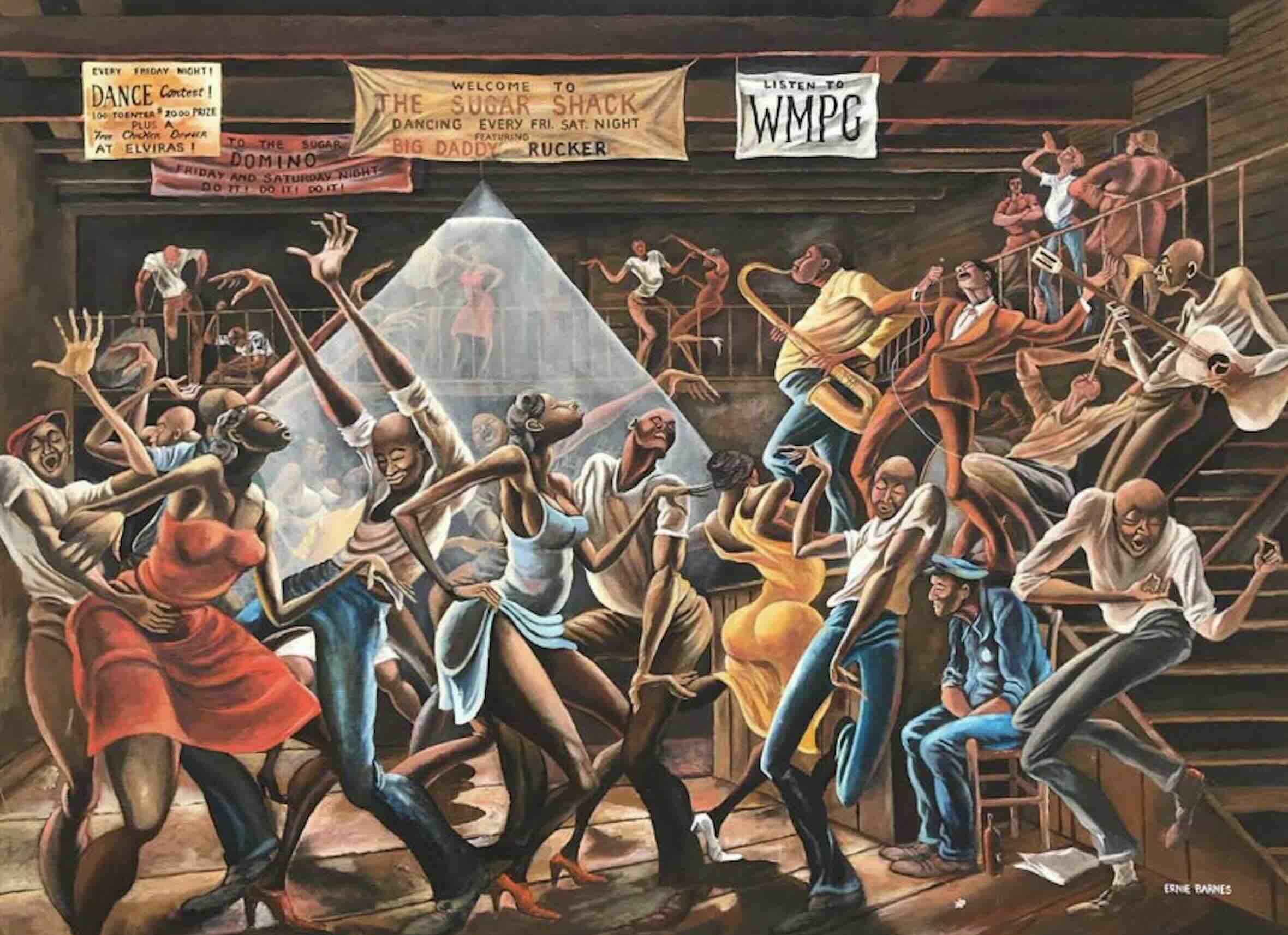
Photo: Sugar Shack | Ernie Barnes
There is a profound declaration that echoes through the lived experiences and cultural expressions of Black people globally: given the choice, despite every hardship, every injustice, and every attempt to devalue our existence, we would choose to be Black in every lifetime. This is not a statement of defiance born from struggle, but a deep, resonant truth anchored in an undeniable reality. It is the powerful conclusion of a people who, when judging our identity, look not at the cruelty of the systems that have tried to break us, but at the brilliance, resilience, and sheer beauty of our own spirit.
To understand this unshakeable choice, one must first dismantle the manufactured lie that Blackness is somehow inferior. The narrative of inferiority was a deliberate construct designed to justify systems of chattel slavery, colonialism, and segregation. But this lie, woven deeply into laws and institutions, has always been at war with a far more powerful truth. This truth is grounded in science, history, and culture, and it fundamentally reframes the value of our identity.
The Scientific Foundation: The Origin Point
The choice to honor our Blackness begins with an irrefutable scientific fact: every single human being on Earth traces their genetic lineage directly back to an African origin. In evolutionary biology, this is the "Recent African Origin" model, supported by a massive body of genetic evidence. Through the study of mitochondrial DNA (mtDNA), which is passed down exclusively from mother to child, scientists discovered that all living humans share a single common maternal ancestor.
Dubbed "Mitochondrial Eve," this woman lived in Africa approximately 150,000 to 200,000 years ago. She was part of the early population of Homo sapiens, and her unbroken female lineage is the root of our entire species. The fossil record, archaeological discoveries, and modern DNA sequencing overwhelmingly show that anatomically modern humans evolved in Africa. This places the African continent, and Black women, at the literal origin point of the human family tree. For centuries, anti-Black racism attempted to paint us as separate or "lesser" than the rest of humanity. This scientific truth reframes the narrative, positioning our ancestry not at the margins of history, but as its very center. It is a profound honor to belong to the source of all human life.
The Moral Compass of History
Beyond science, the historical record solidifies this intrinsic value. When examining the course of American history, Black people have consistently served as the moral conscience of the nation. Our fight for freedom was never a selfish pursuit; it was a fight to expand the promise of democracy for all.
Landmark victories like the Civil Rights Act of 1964, the Voting Rights Act of 1965, and the Immigration Act of 1965 were sparked by our freedom struggle. These legislative milestones did not just protect Black people; they systematically opened doors of opportunity and protection for women, Latinos, Asian Americans, Native Americans, and other marginalized groups. The core demand of our movement was always the fulfillment of universal human rights, not the subjugation of another group. As historian Nikole Hannah-Jones powerfully articulated in The 1619 Project, we have been the "perfecters of this democracy," loving and defending a country that often failed to love us back. This legacy of fighting for everyone's liberation, while enduring immense hatred, is a badge of profound moral honor.
The Engine of Global Culture
Perhaps the most visible evidence of our intrinsic value is our undeniable impact on global culture. Despite a relentless pattern of erasure and appropriation, the world's cultural engine is fueled by our innovation. From the creation of Rock & Roll by pioneers like Sister Rosetta Tharpe and Chuck Berry, to the global dominance of Hip-Hop, Jazz, and Afrobeats, the blueprints of modern music were drawn in our communities.
This pattern is repeated in fashion, language, and aesthetics. Styles like cornrows and locs, along with linguistic innovations from African American Vernacular English (AAVE), have been routinely penalized as "unprofessional" or "ghetto" when expressed by us, only to be celebrated as "edgy," "high-fashion," or "trendsetting" when adopted by the mainstream. The viral "Renegade" dance on TikTok is a perfect example: a 14-year-old Black girl named Jalaiah Harmon created a global phenomenon, yet white creators were initially credited and profited. This constant cycle of theft and erasure only reinforces a powerful truth: the culture we create is so vibrant and undeniable that the rest of the world cannot help but try to replicate it. The honor lies in knowing that our culture is the literal engine room of global expression.
Creating from Nothing
When we say Black people created things "out of nothing," it is a literal description of historical reality. Enslaved, segregated, and legally dehumanized populations were stripped of their names, families, languages, and property. Yet, using only their minds and the scraps left behind by an oppressive society, they built foundations that now dictate global technology, medicine, cuisine, and culture. This is the genius of a people who turned absolute nothingness into everything.
Legally blocked from schools, funding, and patent systems, Black innovators still built the components of modern daily life. Garrett Morgan created the three-signal traffic light and the early gas mask. Frederick McKinley Jones designed mobile refrigeration, the infrastructure behind modern grocery distribution. Marie Van Brittan Brown invented the home security system. Alice H. Parker designed the central gas heating furnace. Dr. Gladys West's mathematical modeling of the Earth became the foundation for GPS, and Dr. James E. West co-invented the foil electret microphone, now used in 90% of modern microphones, including smartphones.
Given only the waste products white slaveowners refused to touch, Black people invented a world-class cuisine. They combined discarded pig intestines, pork knuckles, and oxtails with African seeds secretly braided into their hair—okra, yams—to create greens, chitterlings, and stews. Enslaved chefs shaped the foundational flavors of the Americas, popularizing Macaroni and Cheese through James Hemings and transforming the potato into the global phenomenon of the potato chip through George Crum.
Colonizers banned the drum, recognizing it as a tool of communication and rebellion. Stripped of their instruments, Black people turned their bodies and environments into music. From field hollers, work songs, and stomping feet came Negro Spirituals and The Blues. They retuned the European guitar, bottlenecking it to make it "cry," inventing a new musical language. In 1973 in the Bronx, working-class Black and Afro-Latino youth took two vinyl records, isolated a five-second drum loop—the "breakbeat"—and spoke over it. Out of two plastic records and a microphone, they created Hip-Hop, now the most dominant cultural force on the planet.
Forbidden from learning to read or write English, enslaved people from different tribes blended West African structures with European vocabularies, creating Gullah, Haitian Creole, Jamaican Patois, and African American Vernacular English. These were not "broken" speech but highly complex languages built for survival. Today, the phrases, rhythms, and slang created in those hidden spaces dictate how the entire internet speaks, writes, and markets itself.
The Gift of Blackness
The culminating reason we would choose this identity in every lifetime is found in the concept of "Black Joy." It is a radical act of existence—a testament to complete humanity. A world that heavily consumes our trauma in the media often forgets that the daily reality of Black life is filled with immense laughter, vibrant celebrations, and deep happiness. Choosing to thrive, to love, and to create beautiful things in a world designed to devalue us is the ultimate triumph.
This is why our identity is considered a gift. It is an inheritance of resilience, a legacy of liberation, and a connection to a global kinship that provides an instant sense of home anywhere in the world. The lie of inferiority has completely failed. When we say we would come back as Black in every lifetime, we are stating an undeniable truth: our identity is not a burden to be escaped, but a profound honor to be celebrated forever. The evidence—from science to history to culture—makes the value of our Blackness undeniable. It is not about ignoring the struggle; it is about knowing that the brilliance of our lineage far outweighs the hatred of the oppressors.
No Ads. By Us. For Us.
This article was made possible by readers like you. We hope it inspired you to support Emerald Book, so we can continue producing content like this.
We will never show you ads, sell your data, or require a subscription to consume our content. Your gift helps us keep the truth accessible.
Click the Support button to give a gift of any amount today.
Thank you for making this work possible.