

Emerald Pages
◆
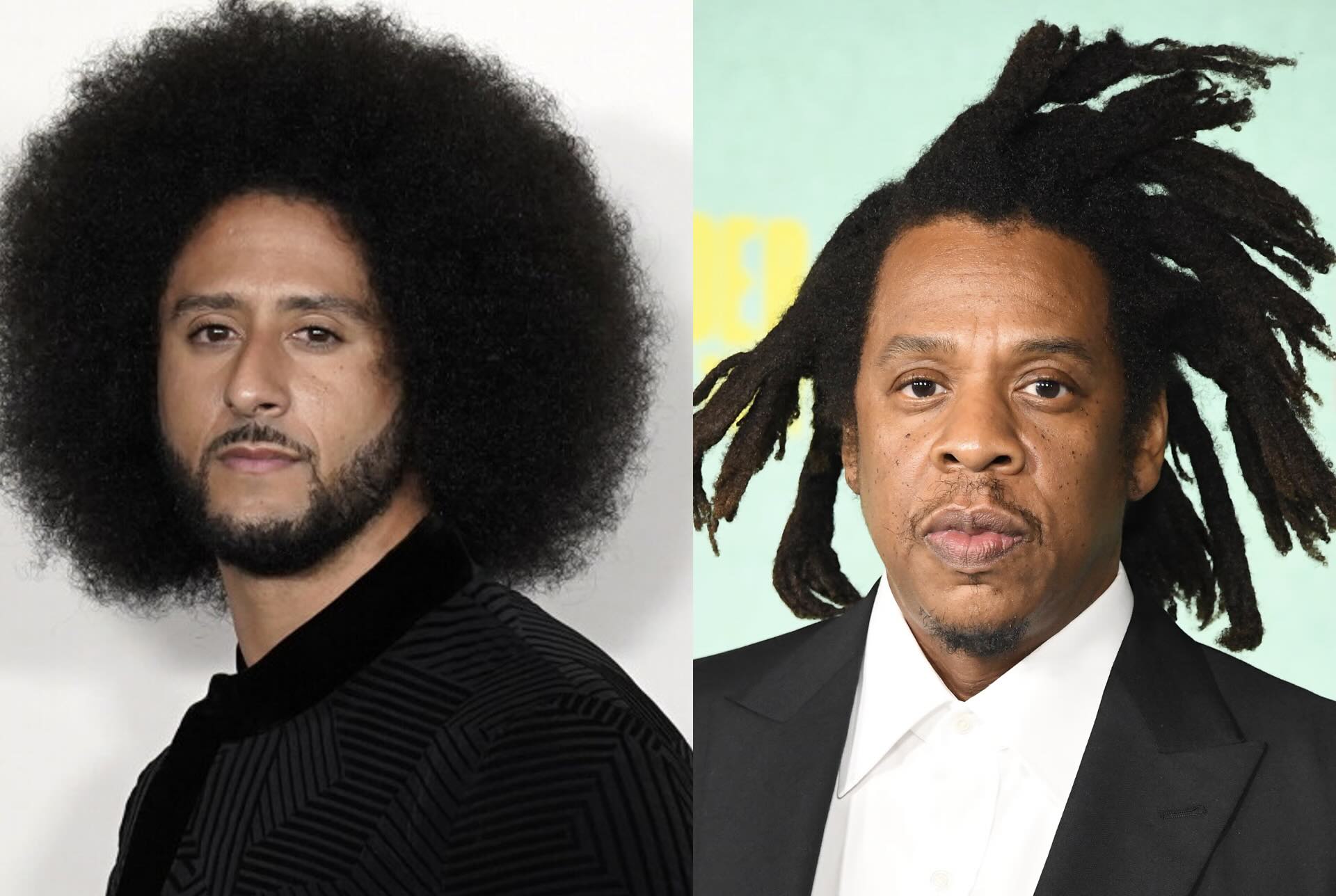
Photo: Jay-Z (right) and Colin Kaepernick (left) | Photo: Emerald Book Image
Colin Kaepernick has never been one to mince words. In a September 2026 interview with NBC News, the former NFL quarterback did exactly what he has done for the past decade: he spoke truth to power. This time, the target was Jay-Z, a man who has built a billion-dollar empire while routinely aligning himself with some of the most problematic institutions in America.
The heart of the critique regarding Jay-Z's cultural extraction versus community reinvestment and the backlash against him is the argument that his entire fortune was built on Hip Hop—a genre and culture born explicitly out of the struggles, resistance, and survival of marginalized Black communities.
"I view that as speaking to a guilty conscience and trying to reposition or reframe the conversation," Kaepernick told NBC News, responding to Jay-Z's July freestyle at Yankee Stadium where the rapper took a swipe at him. In those lyrics, Jay-Z claimed Kaepernick "took a check" in his 2019 legal settlement with the NFL and signed a non-disparagement agreement, while boasting that he himself was "the one [the NFL] can't control."
The contrast between Jay-Z and Colin Kaepernick reveals two fundamentally different relationships to the community. Those who share this critical view see a stark divide in how both men treat their connection to the culture that made them. On one side, you have cultural extraction—using the music, the aesthetics, and the trust of the culture to secure elite corporate status, and then turning around to tell the community they are hypocrites for surviving within the system. On the other, you have cultural defense—using a massive mainstream platform to explicitly defend the community, willingly sacrificing an elite career when that platform demanded silence, and actively redirecting corporate resources to independent Black spaces.
This reveals the entire structural argument against Jay-Z's brand of "billionaire activism." Once an individual's primary function becomes converting the culture's art, struggles, and aesthetics into corporate leverage, extracting value is no longer just a business strategy—it becomes their entire function. By this metric, everything else—the philanthropy, the social justice partnerships, the high-profile legal defense funds—is viewed not as subversion, but as the necessary overhead cost to keep the machine running. It serves as "reputation management" to ensure the culture keeps buying the music, the apparel, and the streaming subscriptions that fund the corporate empire.
The NDA Lie: Jay-Z's False Accusation
Perhaps the most egregious part of Jay-Z's Yankee Stadium freestyle was his claim that Kaepernick signed a non-disparagement agreement as part of his 2019 settlement with the NFL. "Buddy took a check, I ain't even mad at him, but along with that check you gotta sign a non-disparagement," Jay-Z rapped. "I'm the one they can't control."
Kaepernick flatly denied this accusation. Sources close to the quarterback confirmed that while he signed a standard confidentiality agreement to keep the financial details of the settlement private, he never signed a non-disparagement clause that would have legally gagged him from criticizing the league. If he had, his years of public commentary calling out the NFL for "actively blackballing" him would have triggered massive legal penalties.
By making this false claim, Jay-Z attempted to rewrite history and position himself as the true independent figure while painting Kaepernick as a hypocrite who took money to stay silent. The reality is the opposite: Kaepernick has spent a decade speaking truth to power, while Jay-Z has spent that same period accumulating corporate partnerships that require him to play nice with the very institutions Kaepernick has been protesting.
A Pattern of Corporate Co-optation
This is not an isolated incident. Jay-Z's entire career trajectory reveals a pattern of prioritizing corporate profit over community solidarity. From his minority ownership of the Brooklyn Nets, which critics accused him of using to legitimize the displacement of Black and brown residents during the Atlantic Yards development, to his Grammy partnership after years of boycotting the institution, Jay-Z has consistently chosen the inside game.
In 2019, when Jay-Z's Roc Nation partnered with the NFL to oversee the Super Bowl halftime show and advise on social justice initiatives, many viewed it as a betrayal. Kaepernick remained completely frozen out of the league for his peaceful protests against police brutality, and Jay-Z famously justified the deal by stating, "I think we've moved past kneeling and I think it's time to go into actionable items." This comment was widely criticized as dismissive of the ongoing movement and an attempt to erase the very protests that brought these issues to national attention.
The Whataboutism Defense: A Billionaire's Disconnect
When confronted with criticism, Jay-Z's response has been to deflect and attack. During his Yankee Stadium freestyle, he rapped: "You shop at Amazon, or you boycott? You post on Instagram, that's Meta, boy, stop it... You pickin' and choosin' the politickin' as usual." This argument collapses under any serious scrutiny. There is a vast difference between an average person using Amazon or Instagram because monopolies have made them hard to avoid, and a billionaire actively choosing to sign an exclusive marketing deal with a boycotted corporation to clean up its image.
Consider the contrast. In 2019, Jay-Z's Roc Nation signed a deal with the NFL, a league that was actively blackballing Kaepernick, earning him massive backlash from activists. More recently, Jay-Z defended his exclusive deal with Target despite the retailer scaling back its DEI initiatives, while Kaepernick supported the consumer boycott and refused to sell his memoir at the store. And when critics pointed out the hypocrisy, Jay-Z mocked Black consumers for shopping on Amazon or using Instagram, equating everyday survival choices with his elite, optional corporate partnerships.
For his detractors, that moment cemented the idea that Jay-Z no longer views systemic struggle from the ground up. Instead, they argue he views it from the top down, where everyone is deemed compromised by capitalism anyway, so "selling out" is rebranded as just doing business.
The Philosophy of Selling Out
What Jay-Z fails to understand—or chooses to ignore—is that true systemic change requires leverage, not philanthropy. When Kaepernick knelt, he was engaging in a form of collective action that, if followed by other players, would have threatened the NFL's multi-billion-dollar revenue streams. That is real power. That is what forces institutions to change.
Jay-Z, on the other hand, operates entirely within the confines of the system. His power is conditional and dependent on the approval of the very institutions activists are trying to dismantle. He can fund charities and launch social justice initiatives, but he is structurally blocked from organizing the kind of disruptive collective action that could actually dismantle inequality. His seat at the table is only secure as long as he doesn't threaten the table itself.
This is the definition of selling out. It's not just about making money; it's about allowing oneself to be integrated into a system of control. When an individual's status, wealth, and platform are entirely dependent on the approval and financial backing of institutions historically rooted in exploitation, their power is not truly their own—it is leased. And the system uses these highly visible, successful individuals to defend itself. By pointing to a few Black billionaires, the dominant power structure can claim it is fair and merit-based, which actively undermines the collective struggle for systemic change.
The Contrast: Kaepernick's Uncompromising Stance
While Jay-Z has been collecting checks and defending corporate partnerships, Kaepernick has been doing the real work. Through his Know Your Rights Camp, he has funded 150 independent autopsies for families seeking police accountability, provided extensive legal defense grants, and offered immediate bail relief. He has supported the boycott of Target by refusing to sell his memoir, The Perilous Fight, at the retailer, opting instead to partner exclusively with independent, Black-owned bookstores.
Even his corporate partnership with Nike is fundamentally different from Jay-Z's deals. Nike maintained its diversity, equity, and inclusion programs even under federal investigation, defending its initiatives against the Equal Employment Opportunity Commission rather than retreating. They stood by Kaepernick's message when it was politically and financially inconvenient. Target, by contrast, scaled back its DEI commitments, and Jay-Z defended them anyway.
The distinction is clear: Kaepernick uses corporate platforms to amplify his message and force uncomfortable conversations into the mainstream. Jay-Z uses his platform to pacify those exact conversations and legitimize institutions that are actively harming Black communities.
Why Jay-Z Can't Stop Talking About Kaepernick
Kaepernick is right: Jay-Z's need to keep bringing up his name years later speaks to a guilty conscience. Despite his billions, Jay-Z is clearly bothered by the "sellout" narrative that has followed him since he signed that NFL deal. He knows, on some level, that history will judge him differently than it will judge Kaepernick.
Kaepernick sacrificed everything. He walked away from a lucrative NFL career at its peak because he refused to compromise his principles. He understood that true liberation cannot be achieved through corporate capitalism, that playing inside the rules of a rigged system makes you part of the problem.
Jay-Z, by contrast, has accumulated billions while routinely partnering with some of the most racist organizations in America. He then has the nerve to chastise Black people for simply surviving within a system that offers them no alternatives. That is not solidarity. That is not activism. That is self-preservation masquerading as subversion.
The Defining Cultural Divide
This exact realization is why the rift between Colin Kaepernick and Jay-Z has resonated so deeply. It moved past a simple disagreement between two celebrities and became a definitive historical marker. It forced a massive, public choice between two completely incompatible ideas.
On one side stands the uncompromising outsider, believing that the only way to truly defend the community is to refuse to let its struggle be commodified or sold back to it by corporate giants. This is the path Kaepernick chose, sacrificing his career to maintain his integrity.
On the other side stands the corporate insider, believing that playing the game at the highest level of capitalism is the only power that matters, even if it requires exploiting the culture to get there. This is the path Jay-Z has walked, accumulating billions while partnering with institutions that harm the very communities that made him.
With Kaepernick actively pushing this conversation forward through the release of his memoir, The Perilous Fight, the culture is being forced to reckon with this divide like never before. As he continues his tour with independent, Black-owned bookstores, he is not just selling a book—he is modeling what actual community reinvestment looks like.
The debate over their legacies ultimately reflects a broader question: Can systemic change truly be bought from within the rooms of corporate power, or does the pursuit of that power inherently require selling out the movement? Jay-Z's track record suggests the latter. Kaepernick's entire career proves the former.
No Ads. By Us. For Us.
This article was made possible by readers like you. We hope it inspired you to support Emerald Book, so we can continue producing content like this.
We will never show you ads, sell your data, or require a subscription to consume our content. Your gift helps us keep the truth accessible.
Click the Support button to give a gift of any amount today.
Thank you for making this work possible.