

Emerald Pages
◆
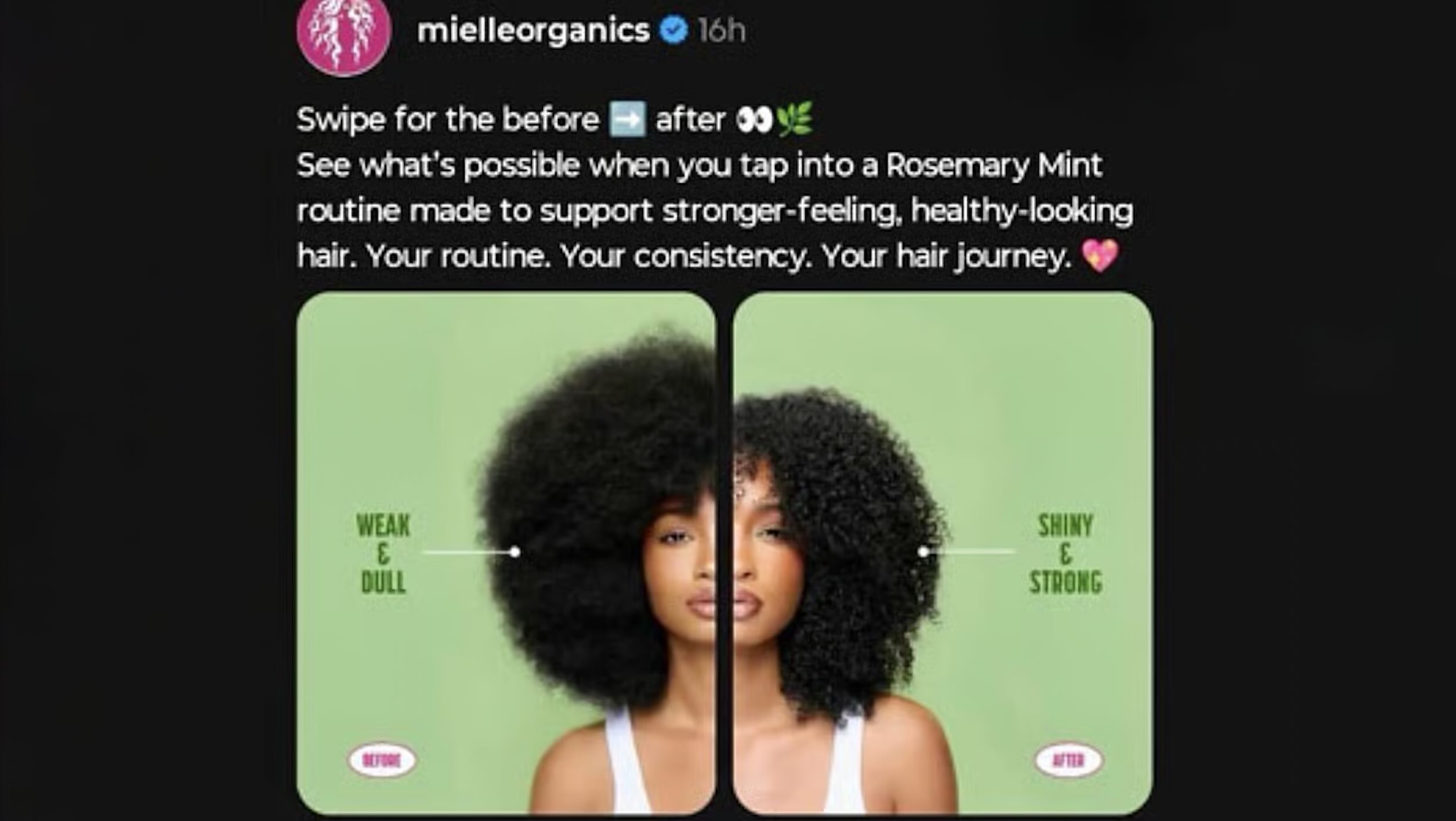
Photo: Mielle Organics | Threads
In August 2026, Mielle Organics—a Black-founded hair care brand—found itself at the center of a firestorm. An advertising carousel showed a Black woman's full, voluminous Afro labeled "WEAK & DULL" beside an "after" image of the same woman with highly defined, elongated curls labeled "SHINY & STRONG." The backlash was immediate and fierce. Critics accused the brand of texturism and internalizing the very Eurocentric beauty standards the natural hair movement has fought for decades to dismantle.
The company apologized, deleted the ad, and claimed the text had been rejected during internal reviews but was mistakenly published anyway. But that explanation only raises a more urgent question: How did a company built on serving textured hair allow a marketing team to get the science so catastrophically wrong?
The answer is that the beauty industry—including many brands that market themselves as inclusive—has spent generations conditioning both consumers and executives to view natural Black hair through a distorted lens. They have systematically confused alteration with improvement. They have labeled the healthiest, most structurally intact state of Black hair as a "problem" in order to sell products and services that actually cause damage, weakness, and dullness.
When we step back from marketing narratives and look strictly at structural biology, materials science, and nutritional biochemistry, the picture is unambiguous: Unaltered, naturally textured hair—supported by a healthy diet—is the strongest, most resilient, and most protective state human hair can achieve. Any product, chemical, or style that deviates from that natural state is, by definition, a compromise.
The Structural Biology of Hair Strength
To understand why natural hair is scientifically stronger, we have to look inside the hair shaft itself. Hair is composed primarily of keratin, a fibrous protein held together by disulfide bonds—chemical links that act like the rungs of a microscopic ladder. These bonds are the primary determinant of a hair strand's elasticity, tensile strength, and resilience.
When a Type 4 hair strand emerges from the follicle in its natural, unaltered state, every single one of its disulfide bonds is intact. The cuticle—the overlapping protective armor on the outside of the strand—is smooth and sealed. The cortex, or inner core, is dense with keratin and hydrated from within. This is the baseline of maximum structural integrity.
Chemical relaxers, texturizers, and even high-heat styling tools break those disulfide bonds to force the hair into a straighter, smoother configuration. Sodium hydroxide, the active ingredient in many relaxers, literally dissolves the hair's internal protein structure. Heat styling above 350°F denatures keratin and permanently lifts the cuticle scales. These are acts of structural destruction, not improvement.
The Mielle Ad: A Complete Inversion of Reality
When Mielle labeled a natural Afro as "weak and dull," they got the science exactly backward:
- The "Before" Afro: A full, voluminous Afro with intact disulfide bonds, a sealed cuticle, and natural elasticity. This is the structurally strong state.
- The "After" Defined Curls: Hair that has been manipulated, coated in heavy products, and stretched to create definition. This state often requires extra manipulation, product buildup, and sometimes heat—all of which increase breakage risk.
The textured coils of Type 4 hair are not "damaged." They are geometrically complex, with sharp bends and twists that create a spring-like mechanical system. This structure grants natural Black hair remarkable elasticity and expansion power, allowing it to compress and stretch dramatically without breaking its internal shape. It is a biological marvel, not a manufacturing defect.
The Physics of "Shine" vs. "Dullness"
One of the most insidious lies in beauty marketing is the equation of shine with health. Straight hair reflects light in a focused, mirror-like way because its cuticle is flat and smooth. Type 4 hair, by contrast, has a flat, elliptical cross-section and grows in a zigzag or tight helix pattern. Instead of a mirror, it acts like a prism—diffusing light in multiple directions and creating a soft, beautiful matte or satin finish.
Demanding that natural Type 4 hair have a glass-like shine is like demanding that a rose bush reflect light like a polished mirror. It is physically impossible without heavy chemical manipulation—and that manipulation destroys the very cuticle structure needed for any kind of healthy reflection. Natural Type 4 hair isn't dull; it's structurally designed to scatter light safely.
Diet: The Ultimate Protective System
This is where the science becomes truly undeniable. No topical product can replace the nutritional foundation that builds strong hair from the inside out. Hair is a "non-essential" tissue; if your body is deficient in key nutrients, it will redirect resources to vital organs and starve the hair follicle. The result is weak, brittle strands that break easily—regardless of what product you put on the surface.
Protein is the building block of keratin. Without adequate dietary protein, the hair shaft is structurally fragile. Iron delivers oxygen to the follicle; low iron levels literally suffocate the hair root, causing shedding and thinning. Essential fatty acids lubricate the scalp and support natural sebum production. Vitamins C, B7 (biotin), and zinc act as molecular co-factors for keratin synthesis and follicle health.
When you eat a nutrient-dense diet, your body manufactures flawless keratin at the root. The hair emerges with 100% of its internal bonds intact and its cuticle perfectly sealed. It doesn't need "repair serums" or "strengthening creams" because it was built correctly from the inside out. This is the ultimate protective system—one that no wig, braid, or chemical treatment can replicate.
The Dangerous Irony of "Protective" Styles
The beauty industry has redefined the word "protective" to mean hiding natural hair under synthetic fibers, glues, and heavy products. But these "solutions" often cause the very damage they claim to prevent:
- Wigs: The friction of lace and elastic bands grinds down fragile edges, and the trapped heat and sweat create a breeding ground for scalp fungus.
- Tight Braids: The constant gravitational pull weakens the root, leading to traction alopecia—permanent follicle death.
- Synthetic Hair: Consumer Reports found that 100% of tested synthetic braiding hair contained carcinogens like benzene and methylene chloride, with lead levels exceeding safe limits by 600%.
Leaving natural hair alone—in its chemical-free, unmanipulated, well-nourished state—is the safest, strongest, and healthiest choice. It is the only state where the hair's internal bonds, cuticle armor, and follicle integrity are fully intact.
The Ad Is Actually Backward
If Mielle Organics' marketing team had consulted a trichologist or read a single materials science paper on hair, the ad would have looked completely different. The Afro would have been labeled "STRUCTURALLY INTACT & RESILIENT." The chemically defined curls would have been marked "CUTICLE-DAMAGED & BOND-COMPROMISED."
The 2026 Mielle ad was not an isolated mistake. It was the latest symptom of a multi-billion-dollar beauty industry that has built its profit model on scientifically lying to Black women about their own hair. It is the same playbook used by TRESemmé in 2020, by decades of relaxer advertisements, and by every brand that has profited from making Black women feel like their natural texture is a problem to be fixed.
Natural Black hair is not weak, dull, or damaged. It is the baseline of strength, the gold standard of structural integrity, and the ultimate protective system—especially when nourished from within. The only thing that is weak, dull, and damaged is the marketing logic that tells you otherwise.
No Ads. By Us. For Us.
This article was made possible by readers like you. We hope it inspired you to support Emerald Book, so we can continue producing content like this.
We will never show you ads, sell your data, or require a subscription to consume our content. Your gift helps us keep the truth accessible.
Click the Support button to give a gift of any amount today.
Thank you for making this work possible.