

Emerald Pages
◆
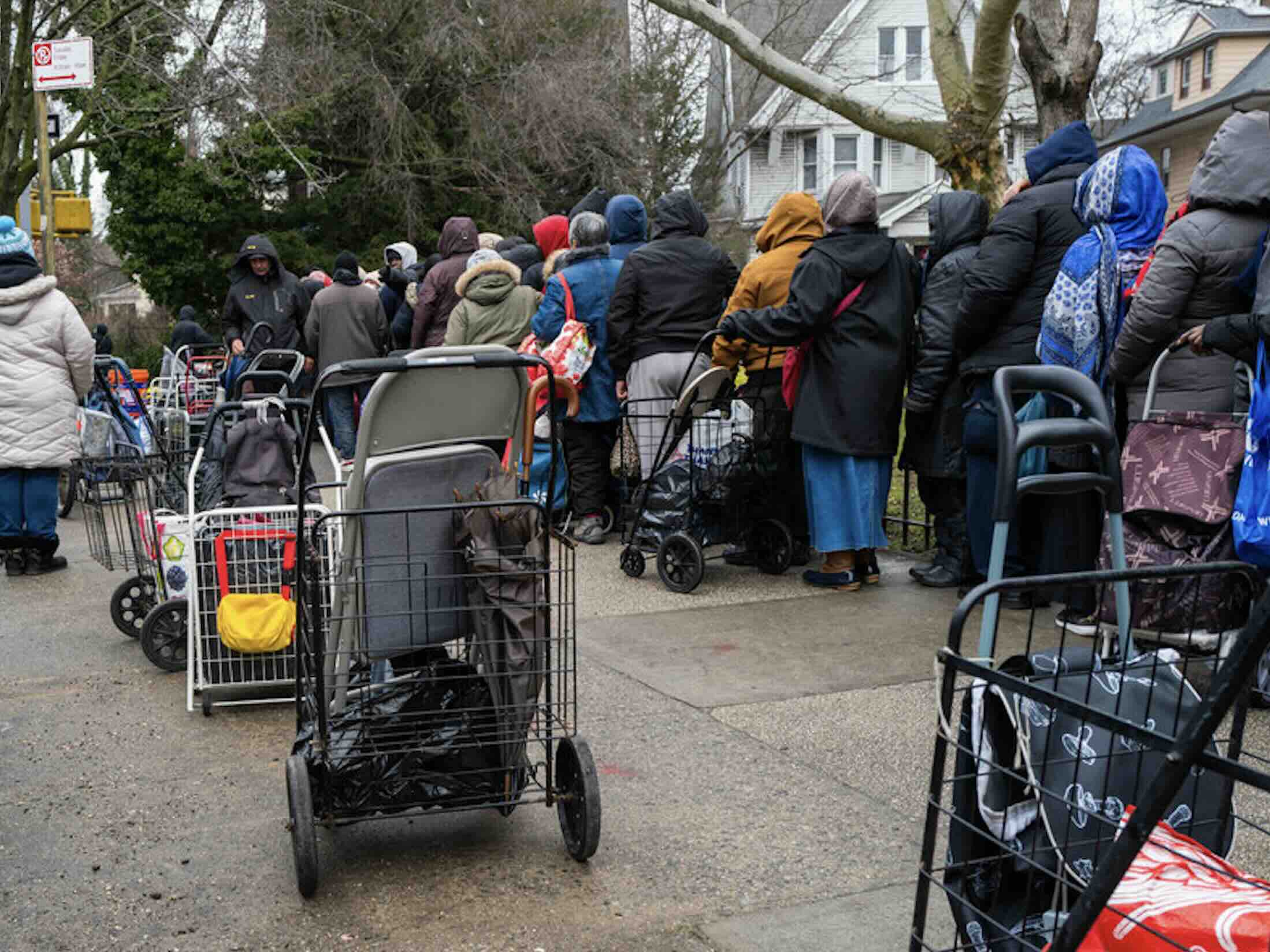
Photo: New York Residents waiting in line at food pantry | Getty Images
New York City has officially retained its crown as the wealthiest city in the world, according to the latest global wealth reports from Henley & Partners. The data shows an astonishing 1 out of every 22 residents in NYC is a millionaire. Driven by massive expansions in finance, tech, and real estate, the city's private wealth pool now totals over $3 trillion. Yet, as the city celebrates its financial dominance, a record-high 2.2 million New Yorkers—26% of the population—are living in poverty, a rate that is double the national average of 13%.
The paradox is as glaring as the neon lights of Times Square. While Manhattan's Billionaires' Row reaches toward the sky with empty penthouses used as "safe-deposit boxes" for global elites, the average New Yorker is drowning in an affordability crisis. The city is the most unaffordable rental market in the United States, with the average rent for a one-bedroom apartment hovering at a staggering $4,188 per month. With the city's median household income at $71,116, the average renter is forced to spend 70% of their gross annual income just to cover rent.
According to the 2026 Annual Poverty Tracker Report compiled by the Robin Hood Foundation and Columbia University, NYC's poverty rate has climbed to 26%. This means that more than 1 in 4 New Yorkers are living below the poverty line. The crisis spans across age groups, families, and demographics: nearly 450,000 children in NYC live in poverty, and when broadening the metric to include low-income households, 69% of all children in the city (1.1 million) live in financially insecure homes. Roughly 1.7 million adults are living below the poverty threshold.
The "Nearly Poor" Hidden Millions
The standard federal poverty line—roughly $23,304 for a single adult and $50,283 for a family of four—does not accurately reflect how expensive it is to survive in New York. Because of this, Columbia University's Center on Poverty and Social Policy highlights that if you look at those making up to $100,000 for a family of four, nearly 5 million New Yorkers (roughly 60% of the city) are actively struggling to make ends meet. They earn too much to qualify for welfare or food stamps, but not enough to withstand the city's skyrocketing costs for groceries, rent, and utilities.
The risk of poverty is deeply stratified across racial lines. According to the report, 33% of Latino New Yorkers live in poverty, 30% of Asian New Yorkers, 27% of Black New Yorkers, and 14% of White New Yorkers. Beyond pure income metrics, 50% of all New Yorkers (roughly 4.2 million people) experienced at least one severe form of material hardship, such as being unable to afford food, housing, or medical care.
Where the Trillions Are Actually Trapped
The core reason the "richest city on Earth" feels so broke to the people actually living in it comes down to a phenomenon economists call a K-shaped economic structure. In NYC, wealth is vertically consolidated rather than horizontally shared. The city's private capital sits primarily in three places:
- Institutional Balance Sheets: The majority of the city's $3+ trillion is corporate wealth tied up in the New York Stock Exchange and global banking empires. It exists as electronic capital and hedge fund assets, not liquid cash circulating in the local economy.
- The Top 1% Income Capture: The wealth gap is accelerating rapidly. The top 1% of earners capture over 53% of all income growth in the city. While the millionaire class expanded by over 34%, real wage growth for the remaining 99% of residents completely stalled.
- Real Estate as a Currency: Wealthy global elites treat Manhattan apartments like gold bars. They buy luxury high-rises purely to park international cash, driving property values up so high that the average working resident gets priced out into tiny, subdivided spaces.
How the "Richest City" Traps 1 in 4 of Its People
The relationship between NYC's massive wealth pool and its 26% poverty rate isn't accidental; the wealth actively creates the poverty through three structural pressures:
- Wealth-Driven Inflation: Because the global elite treat Manhattan as a luxury asset playground, the cost of basic baseline survival skyrockets. Groceries, utilities, insurance, and transit costs are priced for high earners, forcing low-wage workers into severe material hardship just to exist in the same space.
- The Complete Eradication of Affordable Housing: As luxury developers build "ghost towers" for billionaires, the city's working-class housing stock is systematically demolished or priced out. This forces families into overcrowded, substandard spaces or drives them directly into the city's overflowing shelter system.
- The Sub-Living Wage Economy: The city relies entirely on a massive underclass of service workers, delivery drivers, health aides, and sanitation staff to function. However, the corporate wealth concentrated on Wall Street rarely filters into these sectors, leaving millions working 60-hour weeks while still landing below the poverty line.
The Human Wealth View: A Tale of Two Cities
If you measure a city's wealth by the financial security and standard of living of its average citizen, New York fails the definition. The median net worth for all New York State residents sits at $132,800, but this citywide "average" is statistically misleading because New York City has one of the most severe racial and geographical wealth gaps in the nation.
According to a landmark study by the Robin Hood Foundation and the NYC Health Department, the economic divide is starkly illustrated when looking at the median wealth held by different communities. While Chinese New Yorkers hold a median net worth of $320,000 and White New Yorkers hold between $142,000 and $320,000, the median net worth for Black New Yorkers is just $2,800. For Latino New Yorkers, the median net worth is effectively $0, meaning the median Latino household owes exactly as much as or more than they own in total assets.
This extreme stratification comes down to structural realities like the homeownership barrier. The overall homeownership rate in NYC is only about 32% (compared to nearly 65% nationally). In Black and Latino neighborhoods like the South Bronx or Central Brooklyn, that rate drops under 15%. Without property, median wealth cannot grow; residents are simply paying rent that builds someone else's wealth.
A 'World City' vs. A Livable City
Ultimately, New York is best understood not as a wealthy community, but as a global financial utility. It is a place designed to generate, trade, and protect capital on a global scale. While other wealthy global capitals like Tokyo or Vienna use aggressive public housing and strict rent controls to insulate their average citizens from global capital flights, New York functions as an open economic funnel. It allows billions to flow in and pool at the top, creating a city that looks like a gilded playground from space, but feels like an absolute economic vice grip on the ground.
The numbers paint a clear picture: 384,500 millionaires and 146 billionaires call NYC home, yet a record-high 2.2 million residents live in poverty. The city also has the largest homeless population in the U.S. Over 40% of families struggle to afford weekly food costs. To have the standard middle-class purchasing power of $100,000 in a normal U.S. city, you have to pull in roughly $312,000 in Manhattan. This is the ultimate paradox. New York City is the richest city on Earth, but for the millions who keep its subways running, its hospitals staffed, and its restaurants open, it is a city where survival is a full-time job.
No Ads. By Us. For Us.
This article was made possible by readers like you. We hope it inspired you to support Emerald Book, so we can continue producing content like this.
We will never show you ads, sell your data, or require a subscription to consume our content. Your gift helps us keep the truth accessible.
Click the Support button to give a gift of any amount today.
Thank you for making this work possible.