

Emerald Pages
◆
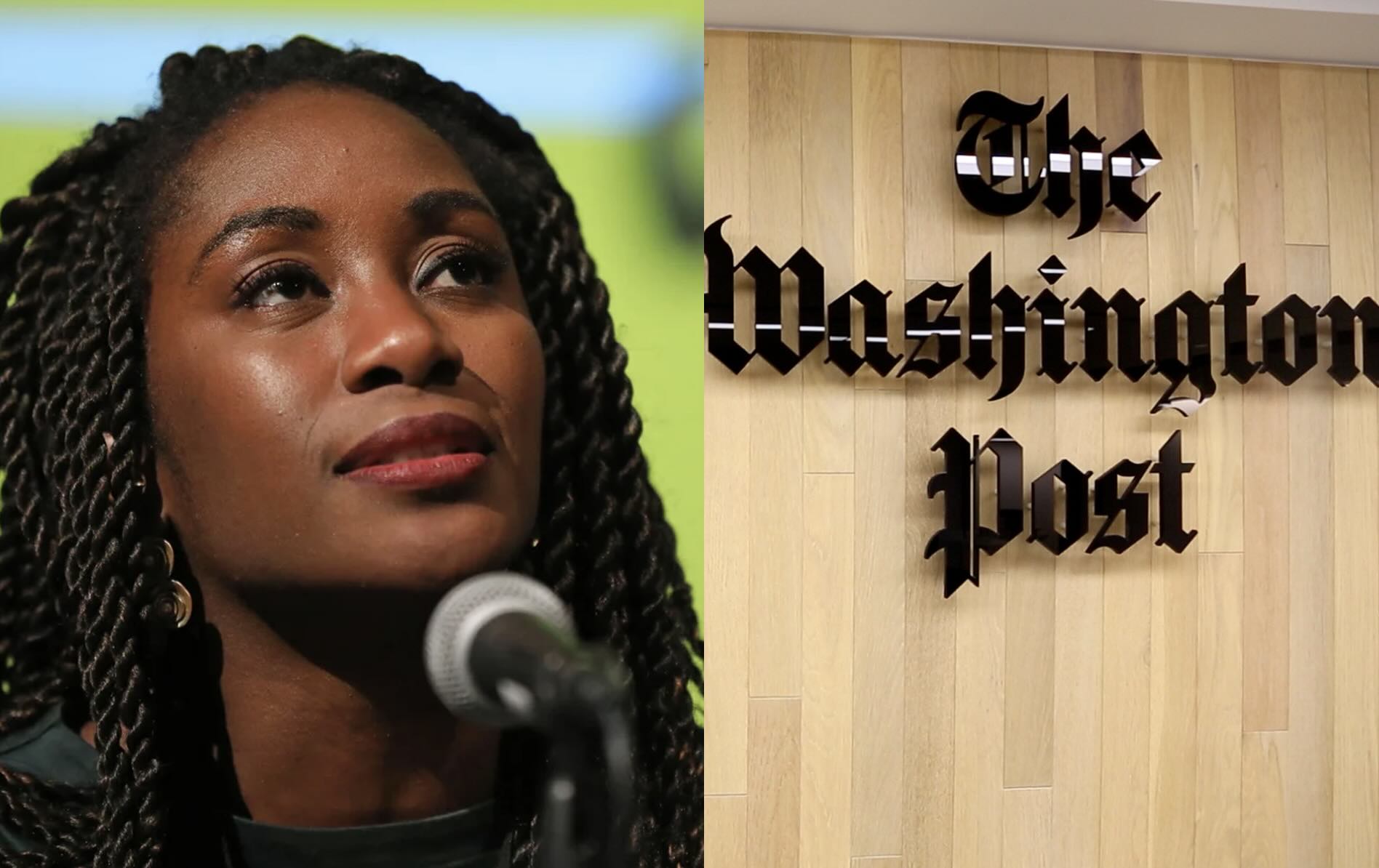
Photo: Karen Attiah (left) and The Washington Post Office (right) | Emerald Book Image
On August 24, 2026, an independent arbitrator ordered The Washington Post to reinstate Karen Attiah, a Black opinion writer and columnist who had been fired nearly a year earlier. The ruling was hailed as a landmark victory for labor rights and free expression. Arbitrator Sarah Miller Espinosa determined that The Post lacked "good and sufficient cause" for termination, finding that Attiah's social media commentary — which criticized systemic racial double standards and "performative mourning" following the assassination of conservative activist Charlie Kirk — did not disparage anyone based on race or gender. The Post was ordered to restore her position with full back pay and benefits.
And yet, Attiah's victory is far more complicated than it appears on the surface. While it corrects an individual injustice, it simultaneously exposes the profound fragility of free speech in modern America. Her case reveals a stark reality: the right to speak freely without losing one's livelihood is not a universal guarantee. It is a privilege that requires a powerful union, a massive professional network, and the capacity to survive a year-long legal battle.
The Washington Post fired Attiah in September 2025, citing "gross misconduct" over two Bluesky posts. The termination letter argued that her commentary disparaged white men, harmed the newspaper's editorial reputation, and potentially endangered staff safety — a justification the arbitrator later rejected as "absolutely disproportional." Newsroom leadership made the decision to terminate her within roughly four hours of becoming aware of the posts.
The Chilling Effect Outlives the Legal Victory
Attiah's reinstatement is a monumental win. But the strategic damage to free expression in the workplace has already been done. She spent 11 months stripped of her income, health insurance, and professional platform. Most ordinary workers cannot afford a year-long financial drought. The message sent to the rest of The Post's newsroom was loud and clear: if a coordinated internet mob targets you, leadership will abandon you instantly to protect the brand.
Even though Attiah won, her peers are left with the distinct impression that it is far safer to remain quiet, bland, and self-censoring. The deterrent effect functions precisely as intended — even when the employer loses.
- The Four-Hour Window: The Post fired a veteran columnist within hours of discovering her posts, showing that corporate leadership panicked and bypassed standard, thorough investigations.
- The Weaponization of Safety: Instead of defending their workers against online mobs, corporations treat the targeted employee as the security threat and eliminate them.
- No Penalties for Corporate Panic: The Post was ordered to give her back pay and her job, but corporate leadership faces no structural penalties for their knee-jerk reaction. Back-pay settlements are simply the "cost of doing business."
A Three-Tiered Class System for Free Expression
Attiah's victory is a textbook example of "elite protection." If an employee lacks a powerful union, a massive professional network, and national media visibility, the exact same defense fails. This dynamic reveals a three-tiered class system for free speech in America:
1. The Protected Elite: Attiah had the full legal and financial weight of the Washington-Baltimore News Guild fighting her corner. As a prominent national columnist, her firing triggered a massive wave of solidarity from the National Association of Black Journalists and peer journalists nationwide. This level of backing is rare — it takes hundreds of thousands of dollars in union legal fees to force a multi-billion-dollar media company to back down.
2. The Constitutionally Sheltered: Government employees like public defenders or state university professors can sue under the First Amendment because their employer is the government. But they still face a grueling, expensive court process. Maria Rutenberg, a public defender in Iowa fired for posting about Kirk, regained her position through an administrative appeal and secured a $125,000 federal settlement. But she had to fight for it.
3. The Vulnerable Majority: This tier accounts for roughly 85% to 90% of the private-sector American workforce. They have no union, no public platform, and no national advocacy groups tracking their names. If an ordinary corporate worker posts a controversial opinion and an online mob targets them, they are fired instantly. They have no arbitrator to appeal to, no legal grounds for a First Amendment lawsuit, and no option but to quietly search for a new job.
A National Wave of Backtracking
Attiah's case is not an isolated incident. A nationwide wave of legal backtracking, reinstatements, and financial settlements is occurring for employees fired over social media posts following Charlie Kirk's death. Companies initially rushed to fire workers amid immense political pressure, but a massive legal backlash over First Amendment rights and labor protections has forced many to reverse course.
Consider Officer Larry Bushart, a 61-year-old retired Tennessee police officer who secured an $835,000 civil settlement after being wrongfully arrested and jailed for 37 days over a Charlie Kirk Facebook meme. Backed by the Foundation for Individual Rights and Expression (FIRE), he filed a civil rights lawsuit and won. Similarly, a federal jury awarded former Prince George's County officer Mohamad Magassouba $2.35 million after his department retaliated against him for refusing to falsify an arrest report.
But these victories share a common thread: they were achieved by individuals with institutional backing — unions, legal defense funds, or the ability to sue under the First Amendment. For the vast majority of American workers, these paths are simply unavailable.
What This Exposes About America
These cases expose a severe gap between theoretical protections and how they are actually applied. In Bushart's case, a county sheriff used a felony arrest and a $2 million bond to punish speech he disliked. Local governments routinely violate civil rights to address immediate political optics, relying on taxpayer dollars to settle lawsuits years later.
Major employers prioritize brand preservation over fair due process. When a premier news organization panics and fires a columnist in four hours, it demonstrates that institutional cowardice is the default corporate setting.
Coordinated online outrage mobs hold immense power over American institutions. Algorithms and viral social media campaigns now dictate executive HR decisions. If a political faction can generate enough outrage, institutions capitulate immediately — even if the worker's speech is legally protected.
Karen Attiah won her case. But the fact that she had to fight at all — and that so many others cannot — reveals the uncomfortable truth at the heart of this story: free speech in America does not fail because the laws are weak. It fails because the institutions trusted to uphold it are highly vulnerable to outside pressure. And for the vast majority of workers, the right to speak freely without losing your livelihood is not a guarantee — it is a luxury.
Winning the arbitration corrects the individual injustice. But it does not erase the broader systemic damage. The punishment is the process. And the system relies on the fact that the sheer cost of fighting back will force most people into quiet compliance.
No Ads. By Us. For Us.
This article was made possible by readers like you. We hope it inspired you to support Emerald Book, so we can continue producing content like this.
We will never show you ads, sell your data, or require a subscription to consume our content. Your gift helps us keep the truth accessible.
Click the Support button to give a gift of any amount today.
Thank you for making this work possible.