

Emerald Pages
◆
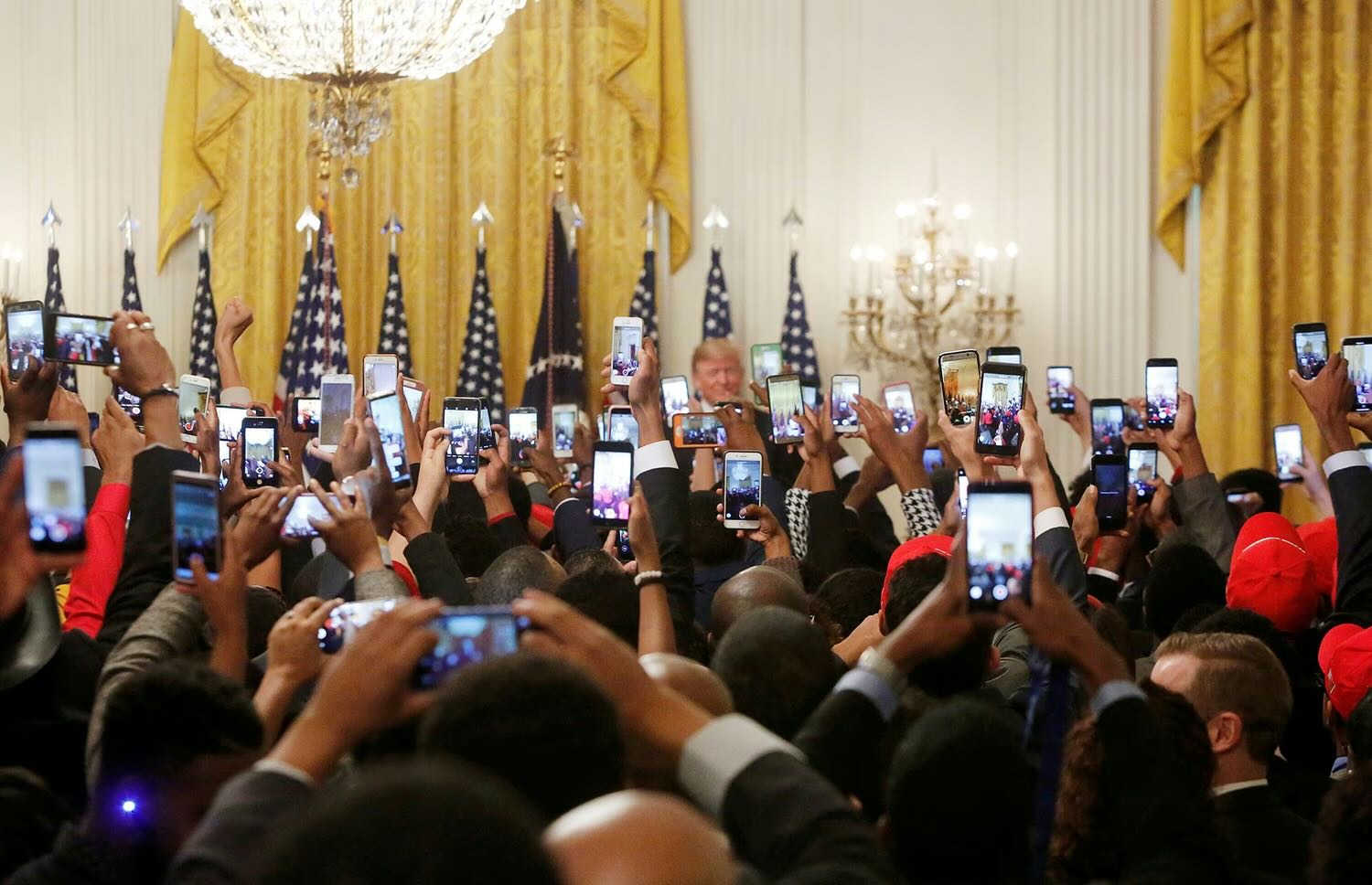
Photo: Cathal McNaughton | Reuters
This a story of two Americas. In one America, based on the hard numbers of the FBI and the Bureau of Justice Statistics, we are living in the safest period in over a hundred years. Homicide rates are projected to drop to around 4.0 per 100,000—a level not seen since 1900. Carjackings have plummeted 47%, and overall violent victimization has been cut in half compared to 50 years ago. By any objective metric, the odds of being a victim of a violent crime have never been lower for the average American.
However, in the other America—the one that lives inside our phones, dominates our television screens, and echoes through our political discourse—we are under siege. Despite the record declines in crime, a staggering 69% of Americans consistently report believing that crime is rising, a perception that has held steady for decades even as crime fell by nearly half. This is the "Perception Gap," and it is arguably one of the most significant social phenomena of the modern era. To understand how we can be objectively safer yet feel subjectively more terrified, we must look at the digital funhouse mirror that is warping our reality.
The primary driver of this disconnect is the algorithmic amplification of fear. Social media operates like a digital megaphone for bad news. Platforms like X, Facebook, and TikTok are designed to prioritize engagement, and nothing drives engagement like high-arousal negative emotions—fear, shock, and anger. A robbery that would have been a one-line police blotter entry 20 years ago is now a high-definition, visceral video that is algorithmically boosted to millions of users. This phenomenon, known as the "Availability Heuristic," means our brains remember the vivid 30-second clip of chaos far more easily than a spreadsheet of declining statistics, leading us to drastically overestimate the actual risk.
The Political Amplifier: Trump's Dual Role
No figure embodies the tension between this chaotic perception and the statistical reality more than Donald Trump. As a dominant force on social media and the political stage, Trump has played a central role in shaping how crime data is communicated and how the public internalizes it—often in contradictory ways.
During his political campaigns and public speeches, Trump has frequently relied on vivid, high-emotion rhetoric about crime to appeal to voters. He has routinely described American urban areas as "out-of-control," stating that "the cities stink" and that sidewalks are loaded with "horrible stuff." He frequently references high-profile, viral incidents of violence or retail theft to argue that American society is under threat. This messaging aligns perfectly with the "funhouse mirror" effect of social media. By repeatedly focusing public attention on localized, shocking anomalies, his rhetoric helps reinforce the psychological "Mean World Syndrome," keeping crime top-of-mind for voters even as the national statistics trend sharply downward.
Now that the massive, record-breaking drops in violent crime are undeniable, Trump has shifted his narrative to claim full responsibility for the improvements. The White House has highlighted the newest FBI and municipal crime data, with spokespeople stating that "President Trump promised to make America safe again and the data proves he has done just that." Trump attributes the historic plunge in homicides to his aggressive border enforcement, mass deportations, and a heavy crackdown on crime, frequently pointing to his deployment of National Guard troops or federal personnel into cities like Washington, D.C., claiming these interventions have entirely crushed local crime.
What Do Criminologists Say? The political debate surrounding Trump highlights the exact tension between media messaging and measurable outcomes. Critics and non-partisan researchers at institutions like the Brennan Center for Justice point out a major contradiction: when crime was falling under previous administrations, Trump insisted it was skyrocketing; now that he is in office, he claims the drop is entirely his doing. Independent data from the Council on Criminal Justice (CCJ) emphasizes that these crime drops are happening uniformly across the country, spanning cities with wildly different political leadership, local mayors, and policing frameworks. Most experts agree the historic drop is the result of long-term social normalization after the pandemic, shifting technologies, and community-driven violence interruption programs—not a single political figure's policy.
The "Empty Street" Paradox
The retreat indoors is ironically making the problem worse. Social media panic drives people to stay inside, emptying out the sidewalks and public spaces. This removes the "Eyes on the Street"—the informal natural surveillance that deters crime. When streets are empty, they feel eerie and lawless, confirming the fear that drove people indoors in the first place. This feedback loop creates a self-fulfilling prophecy of perceived danger, even as actual violent incidents remain at historic lows.
This is compounded by high-visibility property crimes. While homicides are down, retail theft remains stubbornly elevated. Walking into a pharmacy and seeing deodorant and baby formula locked behind plexiglass sends a powerful, visceral signal of societal decay that no crime statistic can counteract. Furthermore, financial anxiety is a massive magnifying glass for these fears. When people are stressed about inflation and housing costs, their tolerance for any perceived threat plummets. A brain already worried about paying rent easily interprets a dark street or a broken window as an imminent physical threat.
The 50-Year Perspective: A Safer Nation
To truly understand the absurdity of our modern fear, we must look back. Fifty years ago, in 1976, the U.S. was a far more dangerous place. The violent victimization rate was 52.3 incidents per 1,000 people. Today, it's 23.3, a drop of over 55%. Property crime has cratered even more, dropping from 551 incidents per 1,000 households to roughly a fifth of that rate. The homicide rate has been cut in half. Yet, due to the 24/7 doomscrolling cycle, we perceive the world as being just as dangerous, if not more so, than the chaotic 1970s.
- Violent Crime (Per 1,000): 52.3 in 1976 → 23.3 Today (55% decrease).
- Homicide Rate (Per 100,000): 8.8 in 1976 → ~4.0 Today (54% decrease).
- Property Crime (Per 1,000 Households): 551 in 1976 → ~100 Today (Nearly 80% decrease).
The digital ecosystem has successfully transformed a historically safe era into a psychological state of siege. The algorithm has effectively severed our connection to physical reality, replacing the quiet street outside our window with a curated feed of chaos and crisis. Understanding this mechanism—the "mean world syndrome," the distance erasure, the curated echo chamber—is the first step toward breaking the cycle of fear and reconnecting with the actual, safer world that exists just beyond our screens.
No Ads. By Us. For Us.
This article was made possible by readers like you. We hope it inspired you to support Emerald Book, so we can continue producing content like this.
We will never show you ads, sell your data, or require a subscription to consume our content. Your gift helps us keep the truth accessible.
Click the Support button to give a gift of any amount today.
Thank you for making this work possible.