

Emerald Pages
◆
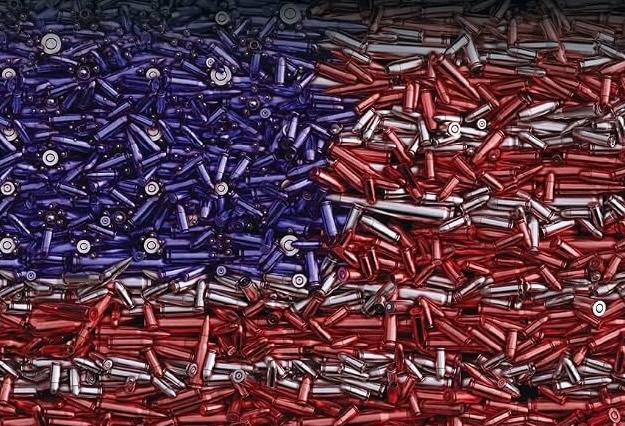
Photo: Michele W. Covington | Guns in America: An Introduction and Overview.
The numbers are almost too staggering to comprehend. American civilians spend roughly $10 billion to $20 billion annually on firearms and ammunition — a figure that exceeds the U.S. military's entire small arms procurement budget by a factor of five to ten. Private citizens now own an estimated 500 million guns, compared to just 4.4 million small arms held by the world's most powerful military. That's 113 civilian-owned firearms for every single weapon carried by the U.S. Armed Forces.
Yet for all the jaw-dropping scale of these figures, they represent only a fraction of the broader economic picture. The sporting arms industry — encompassing manufacturing, retail, and job creation — generates an estimated $91.65 billion in total economic activity and supports over 380,000 jobs across the United States. This commercial ecosystem has grown so dominant that the global civilian firearm market is now effectively tailored to the American consumer, with international manufacturers like Glock, Beretta, and Sig Sauer deriving the bulk of their profits from U.S. sales.
But this massive commercial market is a surprisingly modern phenomenon. For the first two centuries of American history, guns were largely utilitarian tools — used for hunting, pest control, and subsistence farming. The transformation into a hyper-commercialized, identity-driven consumer market only accelerated over the last 40 to 50 years, driven by a confluence of political activism, corporate marketing pivots, and state-level legislative changes.
The Numbers: Civilians vs. The Pentagon
The disparity between civilian and military gun ownership is starkest when examining the raw inventory. The entire U.S. Armed Forces — Army, Navy, Air Force, and Marines combined — maintains approximately 4.4 million small arms across its global inventory. This includes everything from standard-issue M4 carbines and M17 sidearms to squad automatic weapons and specialized sniper systems.
By contrast, American civilians own an estimated 393 million to 500 million firearms, according to the Small Arms Survey and industry projections. This means private citizens possess anywhere from 89 to 113 times more guns than the entire U.S. military. The civilian arsenal is so vast that it accounts for nearly 40% to 46% of all civilian-owned guns on the entire planet.
The spending gap is equally dramatic. The Pentagon allocates roughly $1.5 billion to $2.5 billion annually for small arms procurement — rifles, pistols, machine guns, and ammunition. Even with active modernization programs like the Next Generation Squad Weapons (NGSW) initiative, which aims to outfit troops with advanced 6.8mm rifles and integrated optics, the military's firearms budget remains a fraction of civilian retail volume.
- Civilians: $10–$20 billion per year on firearms, ammunition, and accessories
- Military: $1.5–$2.5 billion per year on small arms procurement
- Ratio: Citizens outspend the Pentagon on guns by 5× to 10× annually
- Inventory: 500 million civilian guns vs. 4.4 million military guns (113:1 ratio)
Where does the military's massive $895 billion defense budget actually go? The overwhelming majority is absorbed by hyper-expensive strategic technology. A single F-35 fighter jet costs roughly $80 million to $100 million. A single Ford-class aircraft carrier costs upwards of $13 billion. The Pentagon channels its wealth into heavy machinery, nuclear modernization, and aerospace technology, leaving the small arms market entirely dominated by everyday shoppers.
The Global Market: Tailored for America
Because of strict gun control regulations across most of Europe, Asia, and Latin America, global firearms manufacturers cannot rely on their own domestic populations for retail survival. Consequently, iconic international weapon brands shape their product development, marketing, and business models specifically to appeal to American tastes and U.S. legal compliance.
Consider the numbers. The North American small arms market — driven almost entirely by U.S. civilian and defense buying — accounts for roughly 43.5% of total global small arms revenue. Roughly one out of every four civilian firearms sold in the United States is imported from a foreign manufacturer. Countries like Turkey, Brazil, and Croatia export millions of handguns and shotguns to the U.S. annually.
The American market has become so dominant that foreign companies regularly redesign their weapons solely to clear U.S. Bureau of Alcohol, Tobacco, Firearms and Explosives (ATF) import guidelines. Under the Gun Control Act's "point system," imported handguns must score a certain number of points based on safety features, frame size, and target-shooting enhancements. Companies like Glock routinely add target-style grips or adjustable sights to compact guns exclusively for the export journey, changing them back once they land on American soil.
A Modern Phenomenon: How America Got Here
Contrary to popular imagery, America hasn't always been this gun happy. The romanticized vision of the 19th-century Wild West — where every man walked around with a revolver on his hip — is largely a Hollywood myth. Famous frontier towns like Tombstone, Deadwood, and Dodge City actually enforced some of the most restrictive gun control laws in the nation, requiring visitors to check their firearms with the local sheriff upon arrival.
Up until the 1970s and 1980s, American gun culture was heavily anchored in what sociologists call "Gun Culture 1.0" — dominated by hunting, target shooting, and outdoor sports. The shift toward "Gun Culture 2.0" began in the late 1990s, when the primary motivation for gun ownership pivoted from recreation to personal self-defense. According to Pew Research Center tracking, 72% of modern U.S. gun owners now cite protection as their primary reason for owning a firearm, compared to just 26% in 1999.
The commercial industry itself aggressively pivoted out of economic necessity. Throughout the 1980s and 1990s, demographic shifts, urbanization, and changing lifestyles caused American hunting participation to sharply decline. Traditional long-gun sales plateaued. To survive, manufacturers rewrote their marketing playbook, shifting from advertising hunting trips to promoting polymer handguns and AR-15-style modular rifles centered on personal protection and tactical preparedness.
Who Started This Shift?
The modern transformation was not sparked by a single individual but rather by a specific faction of political activists, a transformation in corporate marketing, and a wave of state-level legislative changes that converged in the late 20th century.
Harlon Carter and the 1977 "Revolt at Cincinnati" fundamentally tied firearm ownership to American political identity. Up until that point, the National Rifle Association (NRA) was led by traditionalists focused entirely on hunting, sportsmanship, and marksmanship. Carter's hardline faction staged a coup, ousted the old leadership, and shifted the organization's focus toward uncompromising legislative lobbying — introducing the rhetoric that civilian gun ownership is an absolute barrier against government tyranny.
Marion Hammer, the NRA's first female president, reshaped the physical market by engineering Florida's landmark 1987 "shall-issue" concealed carry law. This framework required the state to grant concealed weapon permits to any citizen who met basic requirements, rather than forcing citizens to prove a "special need" to local police. Dozens of states rapidly copied the framework, creating an entirely new commercial market for compact, daily-carry handguns.
The Explosive Growth in Gun Numbers
The total number of guns in civilian circulation has grown exponentially over the decades:
- 1960s: ~45–50 million guns in circulation
- 1991: Crossed 200 million for the first time
- 2017: 393 million — surpassing the U.S. population
- 2026: Projected to have breached 500 million
The rate of new guns entering the market has also accelerated dramatically. Annual manufacturing and imports hovered between 3 million and 5 million through the 1970s and 1990s. Following the 2008 election of Barack Obama, anxiety over potential federal weapon bans caused annual production to jump to 8–11 million. The COVID-19 pandemic and social unrest of 2020–2021 saw an unprecedented 23.4 million new guns flood the domestic market in a single year — a 442% increase over 2001 production levels.
As the total volume exploded, the physical composition of what Americans were buying shifted fundamentally. In 1970, long guns (traditional hunting rifles and shotguns) comprised 64% of all new firearms produced. By the 2020s, handguns made up nearly 60% of new firearms hitting store shelves to meet demands of the concealed carry movement.
Who Benefits Most
This hyper-commercialized market generates clear winners across multiple sectors:
Commercial manufacturers like Smith & Wesson, Sturm Ruger, and Vista Outdoor enjoy highly profitable retail demand that spikes predictably during election cycles and social unrest. Foreign exporters — Austria's Glock, Italy's Beretta, Germany's Sig Sauer — generate a massive portion of their corporate revenue from the open U.S. civilian market.
The retail ecosystem of roughly 50,000 federally licensed gun dealers captures high margins on firearms and transfers. Multi-billion-dollar outdoor retailers like Bass Pro Shops and Sportsman's Warehouse use firearms and ammunition counters as anchor departments to draw high foot traffic. The Pittman-Robertson Act levies an 11% excise tax on all firearms and ammunition sales, generating roughly $1 billion annually that funnels back to state wildlife agencies for conservation and hunter education.
Political organizations on both sides of the aisle leverage the cultural polarization for fundraising. Gun-rights advocacy groups raise tens of millions annually by framing gun ownership as a culture under constant threat, while gun-control campaigns use surges in gun sales to solicit defensive donations from their own base.
The numbers tell a story of a nation that has transformed its relationship with firearms from utilitarian tool to consumer commodity, from rural necessity to political identity. American civilians now own more guns than the next 25 countries combined, and they spend more on them than the world's most powerful military. It is, by any measure, an economic phenomenon without historical precedent — and one that shows no signs of slowing down.
No Ads. By Us. For Us.
This article was made possible by readers like you. We hope it inspired you to support Emerald Book, so we can continue producing content like this.
We will never show you ads, sell your data, or require a subscription to consume our content. Your gift helps us keep the truth accessible.
Click the Support button to give a gift of any amount today.
Thank you for making this work possible.