

Emerald Pages
◆
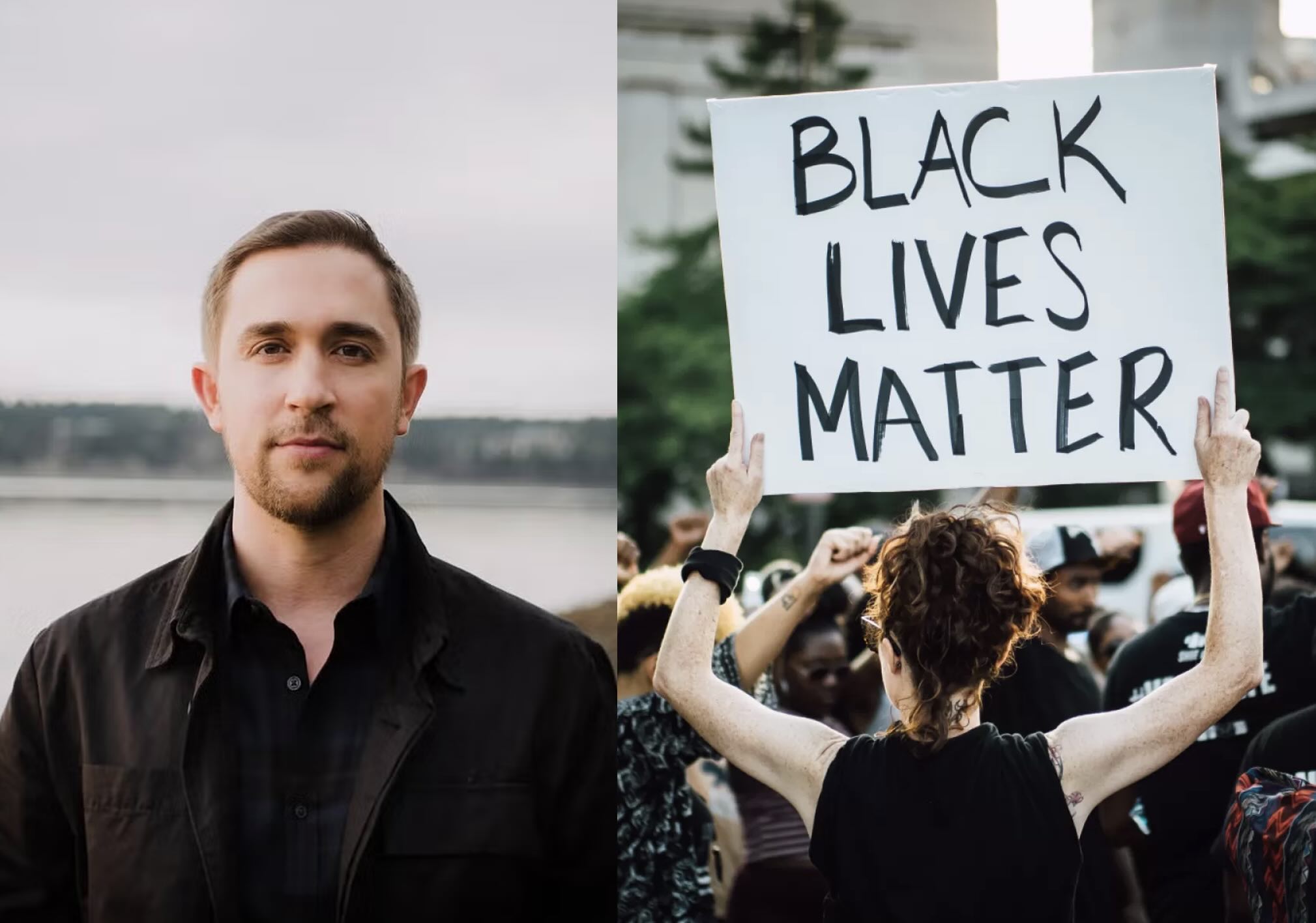
Photo: Christopher F. Rufo (left) and White BLM Activist (right) | Emerald Book Image
It was never supposed to be a badge of honor. "Stay woke" was a command—an urgent, whispered warning passed between Black Americans to keep each other alert to the physical and systemic dangers of a racist society. It was a survival tool, rooted in the blues of the 1930s and the activism of the Civil Rights era, a call for vigilance against police violence and hidden discrimination. Today, that word is a political football, and the trajectory of its destruction reveals a painful truth: white progressives, in their rush to signal virtue, handed conservative strategists the ammunition needed to harm the very people the word was meant to protect.
The shift from a grassroots warning system to a pejorative political slur did not happen by accident. It was a two-step process of cultural appropriation and strategic weaponization. First, the mainstream adoption of the term stripped it of its specific Black context, flattening a complex history of resistance into a shallow descriptor for anything remotely progressive. Then, political operatives like Christopher Rufo seized on this diluted, performative version, repackaging it as a terrifying "ideology" to mobilize voters and roll back civil rights. The result is a tragic irony: a movement that invited the world in to witness injustice ended up seeing its own language used to justify dismantling the progress it had fought for.
The appropriation began in earnest during the 2014 Ferguson protests. As the hashtag #StayWoke went viral, it was a powerful tool for sharing raw, unfiltered accounts of police brutality. However, as the phrase was adopted by mainstream culture and white progressives, its meaning shifted. It transitioned from a verb—an action of staying alert—to a noun and an identity. People began to describe themselves as "woke," bragging about their social awareness on social media, using it as a marker of moral superiority. This was the first critical misstep. They were using a word born of collective struggle to signal individual enlightenment.
The Progressive Misstep: A Badge of Trendiness
As white progressives and corporate marketing teams adopted "woke" in the late 2010s, they often used it for self-praise or superficial virtue signaling. They turned a serious warning into a casual badge of trendiness. It became a catch-all term for everything from eating organic food to liking a diverse movie cast or posting a black square on Instagram. This trivialized the word, creating a culture of hyper-vigilant "call-outs" that irritated people across the entire political spectrum, including many Black activists who felt their language had been stolen and cheapened.
This shift violated a fundamental linguistic rule: you can't call yourself "woke." In its original context, it was an exhortation to others—"stay woke"—a piece of advice implying humility and ongoing vigilance. Turning it into a static descriptor, "I am woke," transformed it from a protective action into a self-congratulatory identity. Once a word is used to say "look how enlightened I am compared to you," it naturally breeds resentment. This performative, cringe-inducing version of "wokeness" was the perfect caricature for opponents to target.
The Conservative Strategy: The Rebrand
The architect of the word's conversion into a political warhead was Christopher Rufo, a conservative activist and fellow at the Manhattan Institute, alongside right-wing media networks like Fox News. Rufo realized that debating complex left-wing academic concepts like Critical Race Theory or intersectionality with voters was too difficult. They needed a single, scary, easily memorable word to group all progressive ideas together. "Woke" was the perfect vehicle.
Rufo’s strategy was to take those cringeworthy, overly sensitive, or performative examples—created by white progressives and corporate branding—and frame them as a dominant, dangerous ideology threatening American schools, corporations, and government. By grouping complex academic concepts under this single, pre-mocked word, opponents made progressive ideas incredibly easy for the public to reject. He famously wrote on Twitter in March 2021: "We have successfully frozen their brand—'critical race theory'—into the public conversation and are steadily driving up negative perceptions. The goal is to have the public read something crazy in the newspaper and immediately think 'critical race theory.'" He applied this exact same logic to the word "woke." He didn't have to invent a caricature; white progressives had already built it.
- Dilution: White progressives expanded the definition until it meant nothing and everything, creating a unified, vulnerable target for political attack.
- Weaponization: Rufo used this diluted brand to highlight the most extreme examples of performative activism, convincing the public that a "woke takeover" was an existential threat.
- Erasure: The ultimate outcome was the complete erasure of the word's original purpose—to protect Black people from racial harm—replacing it with a political slur.
Ultimately, Rufo took a superficial, progressive brand and turned it into a powerful electoral weapon. This provided the exact rhetorical foundation, legal blueprint, and media strategy that Donald Trump and the broader conservative movement needed to build a massive, institutional anti-woke infrastructure. From Ron DeSantis's "Stop W.O.K.E." Act to Trump's campaign rhetoric, the word became a vehicle for mobilizing voters and passing laws.
The Harm: A Community Reaps the Whirlwind
The ultimate tragedy of this entire linguistic cycle is that Black people and grassroots civil rights efforts bore the heaviest consequences. When a survival tool was turned into a white political football, the real-world safety and systemic issues the word was meant to highlight were completely pushed out of the conversation.
The weaponization of the term harmed Black communities in several distinct, material ways. Conservative lawmakers successfully turned "woke" into a toxic political brand, gaining the legislative momentum to pass laws that directly roll back civil rights and educational equity. State laws restricting "woke" curriculums have systematically erased accurate Black history, slavery, and civil rights struggles from public school textbooks. Anti-woke legal campaigns successfully targeted and shut down minority-focused business grants, Black entrepreneurship funds, and diversity hiring initiatives designed to close the racial wealth gap.
By shifting the national debate to a superficial fight over "wokeness," politicians on both sides avoided dealing with the hard, material issues facing Black Americans. Instead of passing laws to address redlining, predatory lending, maternal mortality rates, underfunded schools, or police accountability, the national media focus shifted to debates over corporate advertising, movie casting, and social media speech codes. As a result, while the national conversation was consumed by a loud, symbolic culture war, deep, systemic economic structures remained largely untouched. This is reflected in the persistent reality that Black unemployment has historically sat at roughly double the white unemployment rate, regardless of how well the overall economy is performing.
The Coalition Dilemma
This entire debacle highlights a painful paradox for grassroots movements. How does a community invite allies into the fight without losing control of its own message? The tension between maintaining a sharp, radical focus and building a broad, inclusive coalition is one of the oldest debates in political organizing. When a movement opens its doors to everyone, it often experiences "coalition dilution." Sharp, systemic demands—like direct economic reparations or total police restructuring—get watered down into vague, universally agreeable slogans like "diversity," "inclusion," or "awareness."
The historical precedents are clear. In the 19th century, Black abolitionists like Frederick Douglass frequently clashed with white allies who wanted to end slavery but did not necessarily support full social, economic, and political equality. During the Populist movement of the 1890s, ruling-class politicians easily shattered a coalition between white and Black farmers by weaponizing racial fears. And in the push for the 19th Amendment, white suffrage leaders actively sidelined Black suffragists like Ida B. Wells to secure the political support of Southern white lawmakers.
In the end, white progressives got to look trendy, conservative strategists won elections, and Black communities were left dealing with the structural damage of the resulting laws. The word "woke," once a shield, became a weapon. And it was the white progressives who, through their well-intentioned but shallow adoption, had handed it over. The lesson is a difficult one: solidarity is not about branding, it is about bearing the weight. And when you co-opt a survival tool without understanding its depth, you don't just look foolish—you leave a community exposed and vulnerable.
No Ads. By Us. For Us.
This article was made possible by readers like you. We hope it inspired you to support Emerald Book, so we can continue producing content like this.
We will never show you ads, sell your data, or require a subscription to consume our content. Your gift helps us keep the truth accessible.
Click the Support button to give a gift of any amount today.
Thank you for making this work possible.