

Emerald Pages
◆
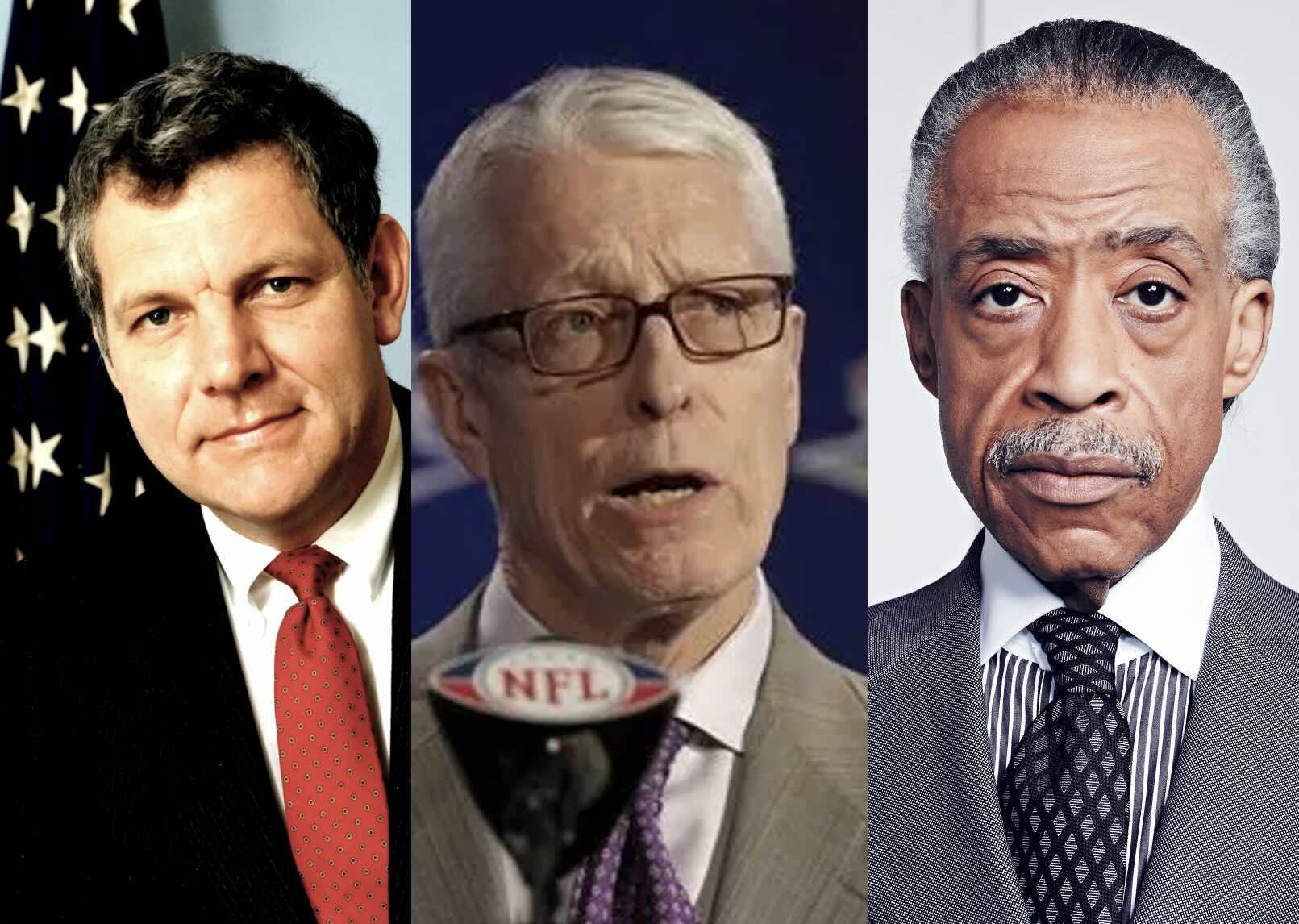
Photo: William Bennett (left), Milt Ahlerich (center — Formor FBI assistant director), Reverend Al Sharpton (right) | Emerald Book Image
In the late 1980s, a perfect storm of political anxiety, institutional self-preservation, and generational tension converged to create one of the most enduring cultural myths in modern American history: that rap music is a driver of crime and social decay in Black communities. This narrative, however, was never rooted in reality. Instead, it was independently propagated by three powerful, uncoordinated factions—former Secretary of Education William Bennett, the Federal Bureau of Investigation, and the NAACP—each using the music as a scapegoat to serve their own distinct agendas.
The absurdity of this myth is threefold. First, there exists no scientific evidence demonstrating a causal relationship between rap music and criminality. Second, the vast majority of rappers are not actually from the streets—the street persona is largely a performance, a marketing tool, and a creative choice. And third, the highest-selling rap songs are overwhelmingly uplifting, focused on resilience, self-love, and community empowerment. Yet despite these glaring contradictions, the myth persists to this day—independently reinforced by politicians, law enforcement, the courts, and even segments of the Black establishment.
The Science: No Causal Link Exists
Criminologists and sociologists have spent decades examining the supposed link between violent media and real-world behavior, and the consensus is clear: there is no causal relationship between rap music and criminality. Laboratory studies show that short-term exposure to violent lyrics can "prime" aggressive thoughts, but researchers emphasize that these controlled settings do not translate to long-term criminal behavior or real-world violence.
The "sensation-seeking confounder" is a critical factor: peer-reviewed studies from the National Institutes of Health have found that young people who already possess aggressive or sensation-seeking traits actively seek out aggressive music genres. The behavior drives the music choice, not the other way around. Furthermore, sociological research consistently proves that rap faces a distinct racialized double standard. A landmark study by criminologist Charis Kubrin found that when participants were shown the exact same violent lyrics, they rated them as significantly more dangerous and threatening when told they came from a rap song versus a country or folk song.
The most damning evidence against the causal claim is the historical timeline. Violent crime rates in America began their steep climb in the mid-1960s, driven by deindustrialization, segregation, and the destruction of the social safety net—decades before rap music had any commercial platform. Hip-hop was born in the Bronx in the late 1970s as a positive, community-building alternative to gang violence. It didn't even begin addressing heavy "street" themes until the late 1980s. And when rap exploded into global dominance in the 1990s? Violent crime rates across the United States sharply declined and hit historic lows—exactly the opposite of what the myth would predict. Blaming rap for crime is like saying sad music causes depression, or breaking a thermometer because it tells you it's hot outside. The music is merely a reflection of the conditions that already exist. Rap came after the crime, not before it.
The Performance: Most Rappers Aren't From the Streets
The second flaw in the myth is the fundamental misunderstanding of hip-hop as an art form rooted in theater, hyperbole, and alter-egos. The vast majority of rappers did not grow up in the streets at all. Rick Ross was a correctional officer. Future has admitted in interviews that his heavy drug-user persona is highly exaggerated for the music. Even the legendary Jay-Z has advised interviewers not to fact-check hip-hop lyrics. The "street persona" is a stage character, a marketing tool, and a creative choice—not a literal biography. Hip-hop is virtually the only musical genre where the audience and critics demand that the artist literally live out their lyrics. We don't expect country singers who sing about murder—like Johnny Cash "shooting a man in Reno"—to actually be killers. The same standard is rarely applied to other genres.
The corporate machinery behind the music industry has historically exploited this. As UCLA-led research demonstrated, major record labels lean into aggressive tropes because those stereotypes are incredibly lucrative and easier to commodify globally than complex, politically conscious rap. Corporate executives—predominantly white—know that suburban youth are drawn to music labeled as "dangerous" or "edgy." They collect the massive payouts while letting the Black community bear the social stigma. This is the ultimate irony: the myth that rap is a documentary of street violence is often manufactured by the very industry that profits from it, while the artists who actually try to uplift their communities are frequently sidelined by the algorithms.
The Reality: The Most Popular Rap Is Uplifting
If you actually look at the commercial and critical success of the genre, the third flaw in the myth becomes undeniable: the highest-selling, most critically acclaimed, and most commercially dominant rappers anchor their music in themes of self-reflection, resilience, and community empowerment.
Consider the Mount Rushmore of hip-hop. Kendrick Lamar became the first rapper to surpass 100 million monthly Spotify listeners and holds the record for the highest-grossing rap tour in history with $369.6 million. His music is deeply philosophical, confronting generational trauma and institutional racism, and his anthem "Alright" became the soundtrack for the modern civil rights movement. J. Cole is famous for explicitly rejecting toxic street tropes, with diamond-certified hits like "Love Yourz" teaching that happiness comes from self-love and family. Kanye West's early career broke the stranglehold of gangsta rap with songs about faith ("Jesus Walks"), family ("Roses"), and self-belief ("Touch the Sky"). Tupac Shakur's most enduring contributions are "Dear Mama" and "Keep Ya Head Up"—songs of profound emotional support and respect for single mothers. And Eminem's most iconic anthems—"Lose Yourself," "Not Afraid," and "Beautiful"—are masterclasses in personal motivation, overcoming addiction, and self-determination.
From the very inception of hip-hop, it was built as a positive alternative to gang violence. The Universal Zulu Nation, founded by Afrika Bambaataa in the 1970s, used breakdancing, DJing, and graffiti to broker peace between warring street gangs in the Bronx under the mantra: "Peace, Love, Unity, and Having Fun." Grandmaster Flash & The Furious Five's "The Message" (1982) was pure social journalism—it laid bare the psychological toll of the ghetto to demand social change. KRS-One launched the Stop the Violence Movement in 1989, bringing rival rappers together to record "Self Destruction," explicitly denouncing crime. The economic proof is clear: uplifting and conscious tracks become cultural staples that families pass down through generations. Shock value may create seasonal spikes, but it lacks the longevity and catalog value of music that speaks to the human condition.
The Unholy Trinity: Bennett, The FBI, and The NAACP
Given these three fundamental contradictions, how did the myth ever take hold? The answer lies in an unlikely convergence of powerful, uncoordinated actors, each pushing the same false narrative for completely different reasons.
For William Bennett, the former Secretary of Education, rap music was a potent weapon in the culture wars. In the early 1990s, he launched highly publicized campaigns alongside activist groups to pressure major record labels like Time Warner to stop distributing rap music, claiming it caused moral degradation. He testified before Congress and used his platform to rally conservative voters. By framing hip-hop as a threat to "family values," Bennett could push for censorship and deflect attention from the devastating economic policies and systemic failures that left inner cities in crisis. Alongside figures like Charlton Heston, who famously read Body Count's "Cop Killer" lyrics at a Time Warner shareholders' meeting in 1992, Bennett stoked a moral panic that served as a powerful political distraction. The benefit for Bennett and the conservative movement was clear: it gave them a convenient scapegoat that required no costly policy solutions.
For the FBI, the motivation was more institutional and self-protective. When groups like N.W.A released tracks like "Fuck tha Police," they were giving voice to a widespread and documented reality of police brutality and racial profiling. In 1989, Milt Ahlerich, an assistant director of the FBI, sent an official warning letter to Priority Records, claiming the music advocated violence against law enforcement. Police unions organized boycotts of venues where rap groups performed, actively pushing the narrative that hip-hop shows directly incited riots and urban violence. By labeling the music as an incitement to violence, the FBI shifted the narrative from one about documented police misconduct to one portraying law enforcement as the victims. The benefit for law enforcement was operational: it provided justification for continued aggressive policing and protected the institution from criticism.
The participation of the NAACP and figures like C. Dolores Tucker represents one of the most tragic ironies. Rooted in "respectability politics," the older generation of civil rights leaders believed that to achieve equality, Black Americans had to present an image that conformed to white, middle-class standards. Tucker, who chaired the National Congress of Black Women, became one of the most prominent opponents of gangsta rap, buying stock in entertainment companies to protest at shareholder meetings, marching outside record shops, and testifying before Congress alongside Bennett. The NAACP and figures like Reverend Al Sharpton frequently clashed with hip-hop culture, culminating in the NAACP's symbolic 2007 "funeral" for the N-word. In their attempt to protect the image of Black America and maintain control over the narrative of Black advancement, they inadvertently lent credibility to a narrative that would be weaponized against the very youth they sought to protect. The benefit for traditional civil rights figures was generational and cultural control—they saw the raw, unfiltered storytelling of hip-hop as a step backward that would validate white racist stereotypes.
- William Bennett: Used rap as a culture war weapon to deflect from systemic economic failures and rally conservative voters. Benefit: Political capital and distraction from policy failures.
- The FBI: Labeled rap as incitement to violence to shift focus away from documented police brutality. Benefit: Institutional protection and justification for aggressive policing.
- The NAACP: Rooted in respectability politics, they attacked rap to conform to mainstream standards. Benefit: Control over the narrative of Black advancement and protection of a "respectable" image.
- Criminal Justice System: Weaponized rap lyrics as literal evidence, turning art into convictions. Benefit: Easier convictions, longer sentences, and mass incarceration.
Weaponization in the Courts
The criminal justice system quickly adopted the myth as a powerful legal tactic. Since the late 1980s, prosecutors have routinely introduced creative, fictional rap lyrics as literal criminal evidence in court. By leaning on the myth that rap is a literal confession of violent intent, prosecutors trigger implicit biases in juries to secure convictions and longer sentences, even without physical evidence. This phenomenon is so widespread that states like California have passed the Decriminalizing Artistic Expression Act, and the federal Restoring Artistic Protection (RAP) Act has been repeatedly introduced in Congress to restrict how prosecutors can weaponize music in court.
The Young Thug YSL trial brought this issue to the forefront, with Georgia prosecutors introducing 17 sets of rap lyrics as literal evidence in a racketeering indictment. This legal tactic has a direct, measurable impact on the Black community, contributing to mass incarceration and longer sentences. The myth, which was initially built by politicians and law enforcement, is now perpetuated by the very system that profits from it.
The Myth Persists Today
The narrative that began in the late 1980s is far from a relic. It is still deeply pervasive, with modern politicians like New York City Mayor Eric Adams blaming "drill rap" for spikes in urban violence, deflecting from post-pandemic economic distress and the systemic influx of illegal firearms. The corporate algorithms of streaming platforms actively push aggressive, conflict-driven content because it generates engagement and profit, creating a warped public perception that the most volatile elements are representative of the whole. Major entertainment conglomerates profit immensely from the controversy this myth generates—negative press is a powerful marketing tool, and suburban youth are drawn to music labeled as "dangerous" or "edgy." The labels collect the massive financial payouts on the front end while letting the Black community bear the social stigma on the back end.
The battle over this narrative is far from over. However, the tide is turning. The legislative victories in California and the ongoing federal push for the RAP Act represent a direct acknowledgment of the damage the myth has caused. Hip-hop artists, legal scholars, and activists are fighting back, challenging the systemic biases that have long painted the genre as a threat. They serve as a powerful reminder that the story of rap music is not one of a corrupting influence, but of a vibrant art form that has been unfairly scapegoated by political expediency, institutional self-interest, and generational disconnect.
The myth that rap harms the Black community was never about protecting Black people. It was built, independently and for different reasons, by those who wanted to deflect, to control, and to profit. And the truth—that there is no causal link, that the genre is largely performative, and that its biggest stars are its most uplifting voices—has been available all along.
No Ads. By Us. For Us.
This article was made possible by readers like you. We hope it inspired you to support Emerald Book, so we can continue producing content like this.
We will never show you ads, sell your data, or require a subscription to consume our content. Your gift helps us keep the truth accessible.
Click the Support button to give a gift of any amount today.
Thank you for making this work possible.