

Emerald Pages
◆
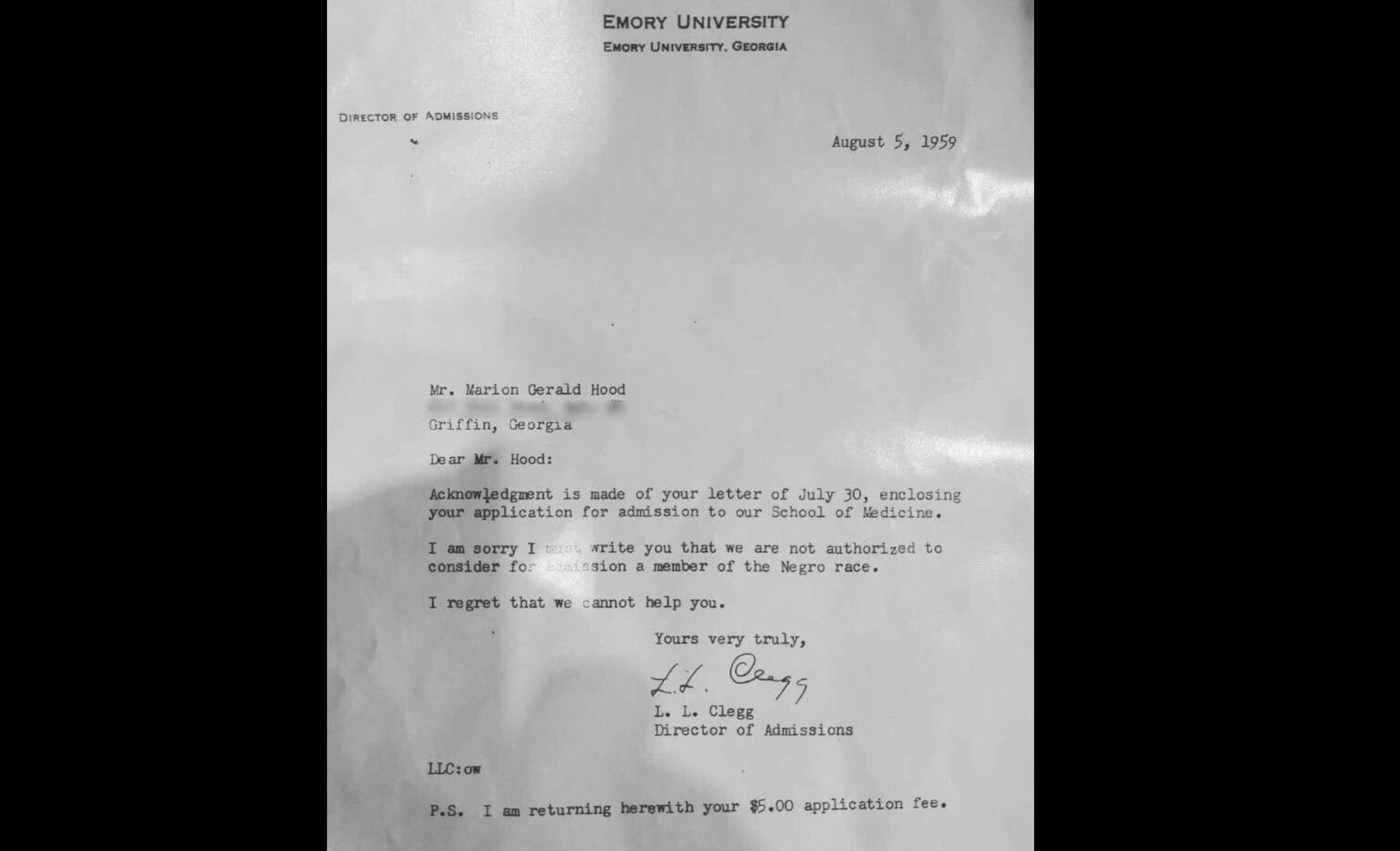
Photo: Historical archive of Emory University / Dr. Marion Gerald Hood
It was the summer of 1959, and Marion Gerald Hood, a brilliant senior at Clark College, was feeling a potent mix of pride and frustration. He had just watched an Emory University professor, a white man, receive an honorary degree from his own HBCU during the school's 90th-anniversary celebration. The image planted a seed of defiance. "I said to myself, 'Gosh, he can come over here and get an honorary degree at my school, and I can't even set foot on his campus,'" Hood later recalled. "And I didn't think that was quite right." So, he did what any ambitious 21-year-old with a dream of becoming a doctor would do. He applied to the Emory University School of Medicine.
The response was swift, arriving in under a week. On August 5, 1959, the school's Director of Admissions, L.L. Clegg, returned Hood's $5 application fee with a letter that was as brutal as it was brief. It stated that Emory was "not authorized" to consider for admission "a member of the Negro race." The rejection was not based on his grades, his test scores, or his character—it was based solely on the color of his skin.
This letter is a stark reminder that the venom of Jim Crow was not a distant history of another century. It was the living, breathing law of the land in 1959—the same year Alaska and Hawaii became states, and the year NASA introduced its first class of astronauts. The segregation that barred Hood from Emory was the same system that kept Atlanta—the city that would soon be known globally as the "Black Mecca"—strictly divided into two separate, unequal worlds.
The Paradox of the Black Mecca
Atlanta's identity as the "Black Mecca" is a testament to Black resilience and excellence, but in 1959, it was a response to enforced exclusion. Just a few miles from Emory's campus, the Atlanta University Center—a consortium of HBCUs including Morehouse, Spelman, and Clark—was a thriving epicenter of Black intellectualism. The Sweet Auburn district was a bustling hub of Black business and culture. Yet the white institutions, including Emory, remained legally walled off from this immense talent.
Hood, however, would not be deterred. He packed his bags and headed north to Loyola University Chicago School of Medicine, where he was the only Black student in his graduating class. He went on to serve as a medical officer in the Vietnam War, and in 1974, he returned to Atlanta to start a private OB-GYN practice. Over the next 45 years, he delivered over 7,000 babies. He was a pillar of the community, a living testament to the excellence Emory had so carelessly dismissed.
For decades, Hood kept the rejection letter. He used it not as a source of bitterness, but as a teaching tool for his children and anyone else who would listen—a physical reminder of the systemic barriers that once existed and the resilience required to overcome them.
- 1959: Marion Hood is rejected from Emory Medical School for being Black.
- 1962: Emory University successfully fights state laws in court to begin desegregation.
- 1974: Dr. Hood returns to Atlanta and begins a 45-year career delivering over 7,000 babies.
- 2021: Emory University issues a formal, public apology to Dr. Hood—62 years after the rejection.
A Long-Overdue Apology
It wasn't until the letter began circulating on social media in 2021 that Emory University was spurred to act. The institution tracked down the then-81-year-old Dr. Hood. During a Juneteenth event, the leadership of the Emory University School of Medicine issued a formal public apology, calling the historical letter a "somber reminder" of systemic educational barriers. Dr. Hood declined an honorary degree from the school, choosing instead to speak directly to minority medical students on campus about his journey of resilience. He wanted his legacy to be a lesson in overcoming barriers, not an award from the institution that had created them.
The fact that the apology was only five years ago in 2021, and that the rejection itself occurred 67 years ago, hits hard. It highlights that the injustices of the Jim Crow era are not ancient history; they are within the living memory of many in our communities today. The reckoning is still happening. The story of Marion Gerald Hood is a powerful narrative of personal defiance against systemic injustice, a stark critique of an institution's history, and ultimately, a story of resilience that shines a light on the path forward.
No Ads. By Us. For Us.
This article was made possible by readers like you. We hope it inspired you to support Emerald Book, so we can continue producing content like this.
We will never show you ads, sell your data, or require a subscription to consume our content. Your gift helps us keep the truth accessible.
Click the Support button to give a gift of any amount today.
Thank you for making this work possible.