

Emerald Pages
◆
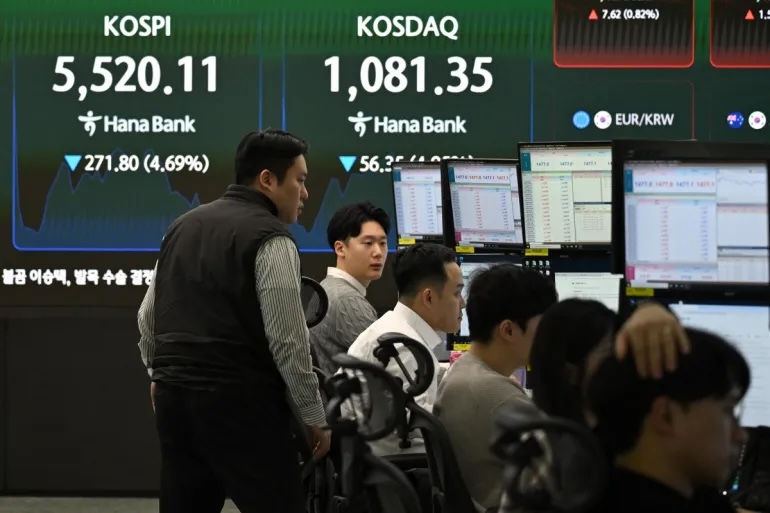
Photo: Jung Yeon-je | AFP
In late July 2026, the South Korean stock market experienced a financial cataclysm that has sent shockwaves through global markets. The benchmark KOSPI index plummeted 44% from its June peak, wiping out more than $2 trillion in market value and surpassing the severity of both the 1997 Asian Financial Crisis and the 2008 Global Financial Crisis. While the market experienced a record-breaking 18% single-day rebound on July 31 following stronger AI demand guidance from U.S. tech giants, the structural damage had been done.
For American investors, the crash in Seoul is more than just a foreign news story. It is a cautionary tale that exposes the exact vulnerabilities lurking beneath the surface of the U.S. stock market. The question is no longer if Wall Street is exposed, but how much of the same financial architecture exists in America.
The collapse in South Korea was not a random event. It was the result of a perfect storm of hyper-concentration, speculative leverage, and unrealistic AI expectations. The same ingredients are currently present on Wall Street, where just seven companies—the "Magnificent 7"—dictate the fate of nearly 40% of the entire S&P 500 index.
The Anatomy of a Collapse: What Broke Seoul
Understanding why South Korea's market imploded is critical to recognizing the parallels with the U.S. The KOSPI crash was driven by three primary factors that should sound alarm bells for any American investor.
The Leveraged ETF Trap
In early 2026, South Korean regulators approved the introduction of single-stock leveraged ETFs. This allowed retail investors to amplify their bets on tech giants like Samsung and SK Hynix. When stock prices dipped, it triggered automatic margin calls, forced liquidations, and negative account balances. The result was a catastrophic downward spiral that caught even professional traders off guard. By the time the dust settled, over 13.8 trillion won ($9.7 billion) had been wiped out from retail accounts alone.
The AI Reality Check
Investors grew wary of the massive global capital expenditure on Artificial Intelligence relative to its short-term return on investment. This triggered a massive sell-off in South Korea's semiconductor crown jewels. SK Hynix fell 52% from its June peak, while Samsung Electronics dropped 41%. The paradox was that this crash occurred despite stellar corporate earnings. SK Hynix had just posted a six-fold increase in quarterly operating profit, but it failed to satisfy sky-high market expectations.
The Illusion of Diversification
Just two companies—Samsung Electronics and SK Hynix—grew to represent over 50% of the entire KOSPI index's total market value. This meant that so-called "diversified" index fund buyers were actually just betting on memory chips. When those chips fell, the entire market collapsed with them.
The U.S. Parallel: Same Fuel, Different Engine
Wall Street analysts at firms like Evercore ISI note that the statistical correlation between South Korea's KOSPI index and the Nasdaq-100 recently hit a staggering 0.95, meaning they are essentially moving in perfect, lockstep harmony. The exact same market architecture that built up the historic bubble in Seoul is currently holding up the U.S. stock market.
- Extreme Hyper-Concentration: In South Korea, Samsung and SK Hynix grew to consume over 50% of the KOSPI. On Wall Street, a mere seven companies dictate nearly 40% of the entire S&P 500.
- The AI Hardware Over-Reliance: South Korea crashed because its tech giants dominate the High-Bandwidth Memory (HBM) chip market. If AI infrastructure spending pulls back even slightly, both U.S. chip giants like Nvidia and South Korean suppliers suffer immediate revenue shocks.
- The Retail "Casino" Mentality: In late May, South Korean regulators approved volatile single-stock leveraged ETFs. While the U.S. has strict institutional guardrails, American retail traders heavily use option contracts and margin accounts to amplify their tech sector gains in an identical manner.
Furthermore, the Magnificent 7 collectively dipped into negative territory for the year in July, wiping out over $2.3 trillion in market value. For the first time in their joint history as the absolute rulers of this bull market, their returns fell below the rest of the S&P 500. High-profile setbacks, like SpaceX slipping below its IPO price just weeks after debuting, proved that public markets are no longer willing to blindly subsidize massive, unprofitable capital expenditures based on hype alone.
Why a Mirror Crash Is Unlikely—But Not Impossible
Despite the overwhelming parallels, there is one major reason the U.S. has not seen an overnight 44% collapse: the source of money. The South Korean market is heavily driven by fast-moving retail day-traders using high leverage. Wall Street is anchored by trillions in institutional pension funds and long-term 401(k) allocations. These institutions do not get hit with automatic margin calls that force them to sell everything overnight.
However, this institutional safety net delays the pain but does not eliminate the risk. A slow-moving, multi-month correction of 20% to 25% is far more likely than an overnight freefall. South Korea is the literal "canary in the coal mine." Because the Nasdaq is mathematically linked to the exact same global tech lifecycle, Wall Street is highly exposed to the exact same volatility.
The Warning Signs: A Checklist for American Investors
The collapse in Seoul proved that no amount of corporate profit can protect a stock if investors stop believing in the timeline of the AI revolution. For American investors, the following warning signs are flashing red:
- The Concentration Trap: Buying a "diversified" S&P 500 index fund means putting 40% of your money into just seven tech stocks.
- The Infrastructure Before the Income: Tech giants funneled hundreds of billions into AI data centers without securing immediate revenue to pay for it.
- The Leverage Multiplier: While the U.S. has fewer retail-driven leveraged products, Wall Street's heavy reliance on opaque corporate bonds and private credit creates a similar hidden vulnerability.
To insulate themselves from this tech-heavy concentration risk, financial advisors generally recommend two immediate adjustments: adopting an equal-weight S&P 500 strategy (such as RSP) to ensure a crash in the top seven tech giants won't wipe out an entire portfolio, and prioritizing capital preservation by parking cash in Short-Term U.S. Treasuries or high-yield cash vehicles.
The era of easy, passive gains through basic index funds is pausing. The U.S. might avoid a sudden, violent 44% overnight crash because institutional money moves slowly, but a prolonged, multi-month correction of the tech sector is actively underway. The collapse in Seoul was not a freak accident—it was the predictable result of a market architecture that Wall Street has now fully adopted.
No Ads. By Us. For Us.
This article was made possible by readers like you. We hope it inspired you to support Emerald Book, so we can continue producing content like this.
We will never show you ads, sell your data, or require a subscription to consume our content. Your gift helps us keep the truth accessible.
Click the Support button to give a gift of any amount today.
Thank you for making this work possible.