

Emerald Pages
◆
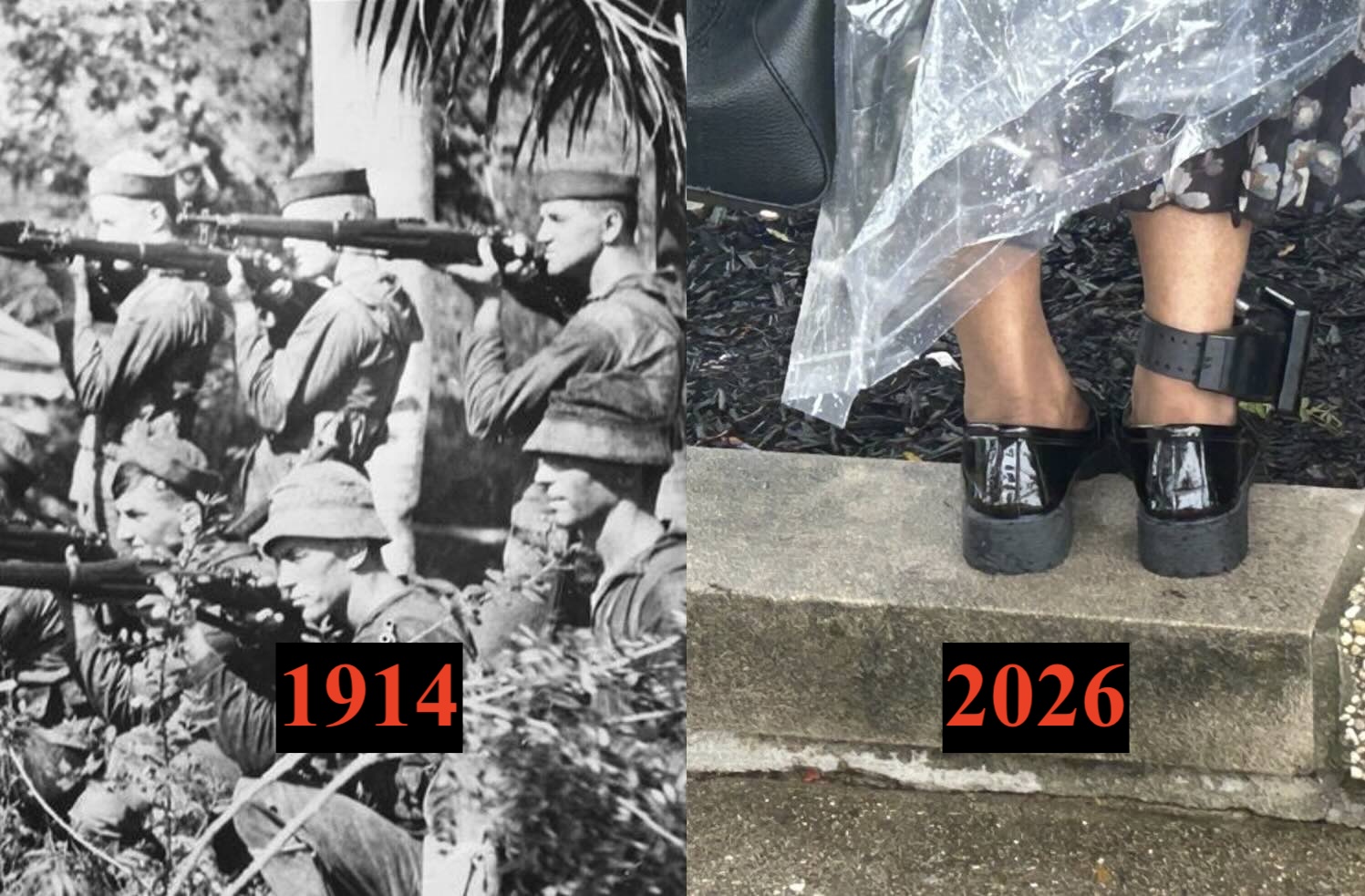
Photo: Emerald Book Image
The history of Haiti is not a tragedy of its own making—it is a ledger of American empire, written in gold bullion, broken treaties, and the blood of the dispossessed. For over two centuries, the United States has systematically dismantled the world's first independent Black republic, extracting its wealth, destroying its economy, and suppressing its revolutionary ideals. This deliberate, calculated campaign of subjugation has now reached its cruelest culmination: the United States is electronically shackling the very Haitians who fled the chaos it created, treating their existence as a crime.
The pattern of destruction began immediately after Haiti's independence in 1804. Deeply terrified that the successful Haitian Revolution would inspire enslaved people in the American South, President Thomas Jefferson and a southern-dominated Congress passed a strict trade embargo in 1806, completely banning U.S. commercial trade with Haiti. The United States refused to officially recognize Haiti as a sovereign nation for 58 years—a diplomatic boycott that denied Haiti the ability to establish commercial treaties or protect its merchants in international courts. The U.S. joined France, Spain, and Portugal in blocking Haitian ships from major ports, suffocating the young nation's ability to sell its sugar and coffee on global markets.
But economic strangulation was only the beginning. In December 1914, eight U.S. Marines walked into the National Bank of Haiti, packed $500,000 worth of gold bars into wooden crates, and shipped them directly to Wall Street vaults. This brazen act of state-sponsored theft—orchestrated at the behest of National City Bank of New York (now Citibank)—crippled the Haitian government's ability to operate independently and triggered immense political instability. The United States then used the chaos it had created as a pretext to launch a full-scale military invasion on July 28, 1915, initiating a 19-year occupation that institutionalized the extraction of Haitian wealth.
The Occupation: Forced Labor, Rewritten Constitutions, and Wall Street's Cut
During the 19-year occupation, the United States systematically dismantled Haitian sovereignty. American authorities forced Haiti to take out new loans from New York banks to pay off old ones—at one point funneling roughly 25% to 40% of Haiti's gross national revenue directly to Wall Street to service these debts. The U.S. military dissolved the Haitian parliament and rewrote the nation's constitution, striking down a post-revolution law that had banned foreign ownership of land. This allowed American corporations to seize thousands of acres of fertile land for sugar and coffee plantations.
The occupation also revived colonial-era forced labor laws. The Marines implemented the corvée system, forcing Haitian peasants into chain-gang labor to build infrastructure. Those who tried to escape or protest were frequently shot. By the time the U.S. fully relinquished control in 1947—maintaining control over Haiti's national budget and treasury until that year—over 15,000 Haitians had been killed suppressing localized rebellions against the occupation.
Reflecting on his role years later, the celebrated U.S. Marine Major General Smedley Butler famously wrote that he had spent his career operating as a "high-class muscle man for Big Business" and admitted he "helped make Haiti and Cuba a decent place for the National City Bank boys to collect revenues."
The Censorship of History and the Suppression of Revolution
To ensure that the ideals of the Haitian Revolution could never spread to American shores, the United States and Southern states aggressively suppressed knowledge of Haiti's fight for freedom. Before the Haitian Revolution, laws against teaching enslaved people to read were scattered and inconsistent. After Haiti declared independence in 1804, slaveholding states underwent a dramatic panic, passing strict anti-literacy laws making it a felony to teach any Black person—enslaved or free—how to read or write.
The Negro Seamen Acts, enacted between 1822 and 1856, mandated that any free Black sailor arriving in southern ports like Charleston be immediately arrested and jailed for the entire duration of the ship's stay. The sole purpose was to completely isolate enslaved dockworkers from hearing firsthand accounts of Black liberty and the Haitian victory. The U.S. federal government also actively allowed the weaponization of the postal system to suppress information: southern postmasters routinely intercepted, confiscated, and publicly burned mail and newspapers containing references to Haiti, with President Andrew Jackson and his Postmaster General actively supporting this censorship.
Despite this massive, multi-decade censorship campaign, the news of Haiti could not be completely contained. Word-of-mouth networks among Black mariners, refugees, and underground abolitionists ensured that the name "Haiti" still became a symbol of freedom throughout the American South.
Modern Economic Warfare: The Destruction of Haitian Agriculture
The economic manipulation did not stop in the 19th century. In the 1980s and 1990s, the U.S. government, the World Bank, and the International Monetary Fund (IMF) forced Haiti to aggressively slash its import tariffs on agricultural products. This allowed heavily subsidized American surplus rice to flood the Haitian market at prices far lower than local farmers could match. This forced trade policy completely wiped out Haiti's domestic rice industry, destroying the livelihoods of hundreds of thousands of Haitian farmers and transforming a country that was once food self-sufficient into a nation permanently dependent on importing its basic food from the United States.
American Contractors and the Killing of Children
The violence of American intervention continues into the present day. Human Rights Watch (HRW) investigations revealed that Vectus Global, an American private security company led by Blackwater founder Erik Prince, partnered with Haitian security forces to deploy explosive-equipped drones in anti-"gang" operations between March 2025 and January 2026. These drone strikes killed at least 1,243 people and injured 738 others—including at least 17 children and 43 adults confirmed to have zero ties to any criminal organization.
The most devastating single incident occurred on September 20, 2025, in the Simon Pelé neighborhood of Port-au-Prince's Cité Soleil commune. An armed drone targeting a local "gang" leader missed its target and slammed directly into a children's birthday party, instantly killing eight children ranging in age from 2 to 10 years old, along with three adults. Six more children were permanently maimed or severely injured.
The Final Cruelty: Ankle Monitors for the Vulnerable
Following a June 2026 U.S. Supreme Court ruling that cleared the way for the termination of Temporary Protected Status (TPS), over 300,000 legally present Haitians lost their protected status on July 27, 2026. These were individuals and families who had lived, worked, paid taxes, and raised U.S.-citizen children legally in America for over a decade—all while their homeland remained gripped by catastrophic "gang" warfare and political collapse.
Rather than offering protection to those fleeing a country the U.S. spent centuries destabilizing, Immigration and Customs Enforcement (ICE) began summoning these newly undocumented individuals to federal offices and presenting them with a severe ultimatum: agree to wear an electronic GPS ankle monitor or face immediate placement into an immigration detention facility. The tracking devices create a digital perimeter, barring migrants from traveling beyond a 75-mile radius from their homes without explicit authorization from ICE case managers.
The Department of Homeland Security also notified businesses that it is no longer legal to employ former Haitian TPS holders, stripping these monitored individuals of their livelihoods while confining them to their homes. Viles Dorsainvil, the executive director of the Haitian Community Help and Support Center in Springfield, Ohio, publicly compared the forced wearing of these heavy GPS ankle monitors to historical shackles and slavery.
The primary objective of these tracking measures is to prepare hundreds of thousands of people for deportation flights back to Haiti—a country that the U.S. State Department maintains a strict Level 4 "Do Not Travel" advisory for, due to severe political collapse, widespread "gang" control, and catastrophic violence. The United States is sending people back into the very chaos it created.
- 1806: U.S. imposes trade embargo and denies diplomatic recognition for 58 years, crippling Haiti's economy.
- 1914: U.S. Marines steal $500,000 in gold from Haiti's central bank.
- 1915–1934: 19-year military occupation imposes forced labor, rewrites constitution, and funnels up to 40% of revenue to Wall Street.
- 1820s–1850s: Negro Seamen Acts and postal censorship suppress knowledge of Haitian Revolution.
- 1980s–1990s: U.S.-backed trade policies destroy Haiti's domestic rice industry.
- 2025–2026: American private contractors' drone strikes kill over 1,200 people, including 17 children.
- 2026: Over 300,000 Haitians lose TPS and are fitted with GPS ankle monitors, stripped of livelihoods, and prepared for deportation.
No Ads. By Us. For Us.
This article was made possible by readers like you. We hope it inspired you to support Emerald Book, so we can continue producing content like this.
We will never show you ads, sell your data, or require a subscription to consume our content. Your gift helps us keep the truth accessible.
Click the Support button to give a gift of any amount today.
Thank you for making this work possible.