

Emerald Pages
◆
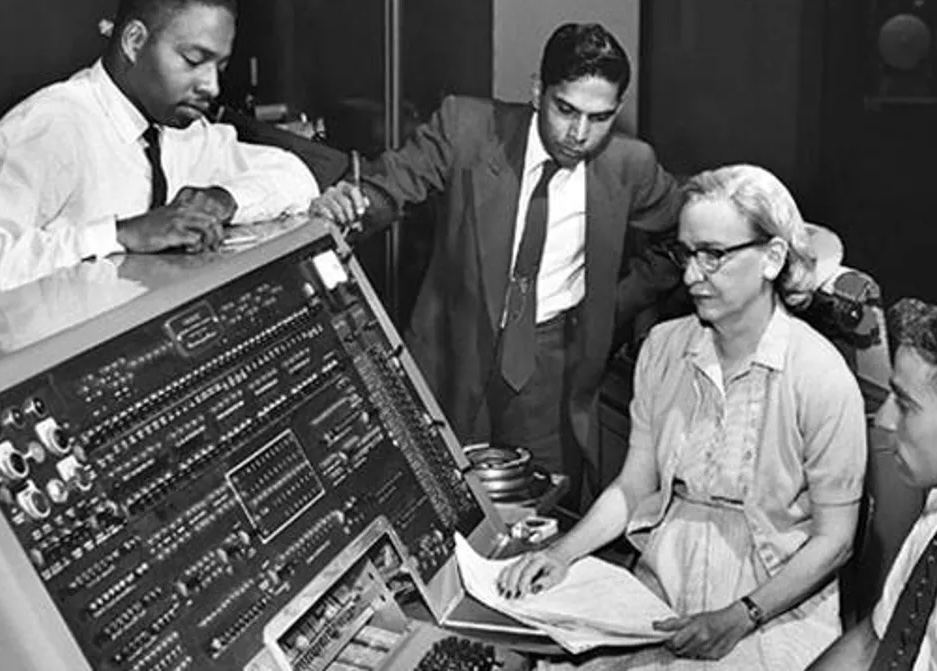
Photo: IEEE History Center
In the global economy, there is a ticking time bomb buried in the basement of every major bank. It processes 95% of ATM transactions, handles 80% of credit card swipes, and moves $3 trillion in daily commerce. It is invisible to the public, runs on technology from the 1950s, and the only people who truly understand it are retiring at a rate of 10% every single year. This is the quiet crisis of COBOL, the programming language that powers modern finance.
Most established, traditional banks still rely heavily on COBOL, with estimates showing that over 90% of global banks and 45 of the world's top 50 financial institutions use it to run their core systems. However, if you look at the total number of banking entities—which includes thousands of digital-only neobanks, newer fintech startups, and small local credit unions—many do not use it at all because they built their infrastructure from scratch using modern languages like Java, Python, or Go. This has created a two-tiered financial system: those stuck on legacy code, and those free to innovate.
COBOL (Common Business-Oriented Language) was created in 1959—before the moon landing, before the internet, and before most of today's bank executives were born. It remains the absolute backbone of global financial infrastructure. So why haven't banks moved on? The answer is a combination of technical superiority and sheer terror.
Why Banks Can't—and Won't—Abandon COBOL
Legacy financial giants like Bank of America, JPMorgan Chase, Citi, and BNY Mellon keep COBOL around for very practical reasons. First, COBOL was designed specifically for heavy batch processing and decimal arithmetic. For processing millions of transactions per second with near-zero downtime, it is incredibly efficient. Most modern languages use binary floating-point math, which can introduce tiny rounding errors—like 0.1 + 0.2 = 0.30000000000000004. COBOL uses fixed-point decimal math, tracking currency down to the exact fraction of a cent without rounding flaws.
Second, the failure rate of rewrites is catastrophic. Core banking systems are a complex "spaghetti" of rules accumulated over 40 to 50 years. Industry estimates show that roughly 74% of legacy modernization projects fail because rewriting millions of lines of undocumented business logic is too risky and complex. As industry analysts put it, it's a "heart transplant while running a marathon." Banks have layers upon layers of regulatory patches, edge cases, and emergency fixes that no one remembers writing. The original documentation is gone, and the engineers who wrote it have retired.
Third, banks use a hybrid integration model. Instead of replacing COBOL entirely, many institutions adopt a hybrid cloud model. Companies like IBM have updated their mainframe environments so that traditional COBOL can securely interface and run alongside modern programming environments like Java. Banks do not force customers to interact with a green-screen terminal; they build modern Java, Python, or Swift user interfaces for mobile apps and web banking, which then use APIs to securely send and pull data from the fast COBOL backend.
The Demographic Crisis: Where Have All the Programmers Gone?
The biggest challenge facing banks isn't the performance of the language itself, but a severe skills gap. The average COBOL programmer is over 55 years old, and roughly 10% are retiring every single year. Because over 85% of universities stopped teaching COBOL decades ago, banks can no longer rely on a natural pipeline of young graduates. This demographic reality—often called the "Silver Tsunami"—is the single biggest vulnerability in the global financial system today.
- 10% Annual Retirement: The average COBOL developer is 55 to 58 years old. Roughly 10% of this specific workforce retires every 12 months.
- Massive Talent Deficit: While there are roughly 800 billion lines of live COBOL code globally, there are only about 24,000 active COBOL developers in the U.S. to maintain them.
- Loss of Institutional Memory: When senior developers retire, they take the unwritten rules, logic, and architectural secrets of the bank's core systems with them.
To prevent a total collapse of their core systems, financial institutions are aggressively using a mix of massive financial incentives, specialized retraining, and artificial intelligence. The "Boomerang" Strategy sees banks regularly hire back their own retired engineers as independent contractors, paying them anywhere from $100 to $300+ per hour just to handle routine maintenance and patches. Junior and mid-level developers who choose to specialize in mainframes can easily command starting salaries north of $125,000, with very little competition compared to overcrowded fields like web development.
The Timetable: When Does This Become a Disaster?
The talent gap will become a critical, systemic crisis for the banking sector between 2026 and 2030. While it is already a major issue behind closed doors, a combination of retiring engineers and expiring vendor support creates a hard deadline for financial institutions over the next few years.
2026–2027: The Hard Deadlines. Major legacy operating systems and foundational tools running on IBM mainframes are scheduled to lose official vendor support. Banks are forced to either migrate their code now or run their trillion-dollar systems entirely unsupported, exposing them to massive operational and compliance risks.
2030: The Climax. By 2030, the generation of engineers who originally built these systems in the 1970s and 1980s will be completely out of the workforce. If banks have not decoupled their core applications from COBOL by this point, routine regulatory updates (like tax changes or compliance modifications) could take months or years to implement due to a lack of available engineers.
The Last-Minute Savior: Generative AI
The reason the global financial system hasn't collapsed yet is that Generative AI arrived just in time. Banks are aggressively throwing specialized AI tooling—like IBM watsonx Code Assistant and Anthropic's specialized enterprise models—at the problem. Instead of waiting for human programmers to learn COBOL, banks use AI to analyze old code, automatically write documentation for it, and translate it into Java with up to 93% accuracy. This technology is effectively stretching the timeline, buying banks an extra few years to handle the transition.
However, it's worth noting that this is a hidden crisis by design. The people who know about it—bank executives, government regulators, and cybersecurity experts—are intentionally keeping quiet because public panic would devastate consumer trust. If a major bank openly admitted, "We don't actually know how our core deposit system works anymore, and the only person who does is an 82-year-old contractor named Bob," stock prices would plunge and people would withdraw their money.
No Ads. By Us. For Us.
This article was made possible by readers like you. We hope it inspired you to support Emerald Book, so we can continue producing content like this.
We will never show you ads, sell your data, or require a subscription to consume our content. Your gift helps us keep the truth accessible.
Click the Support button to give a gift of any amount today.
Thank you for making this work possible.