

Emerald Pages
◆
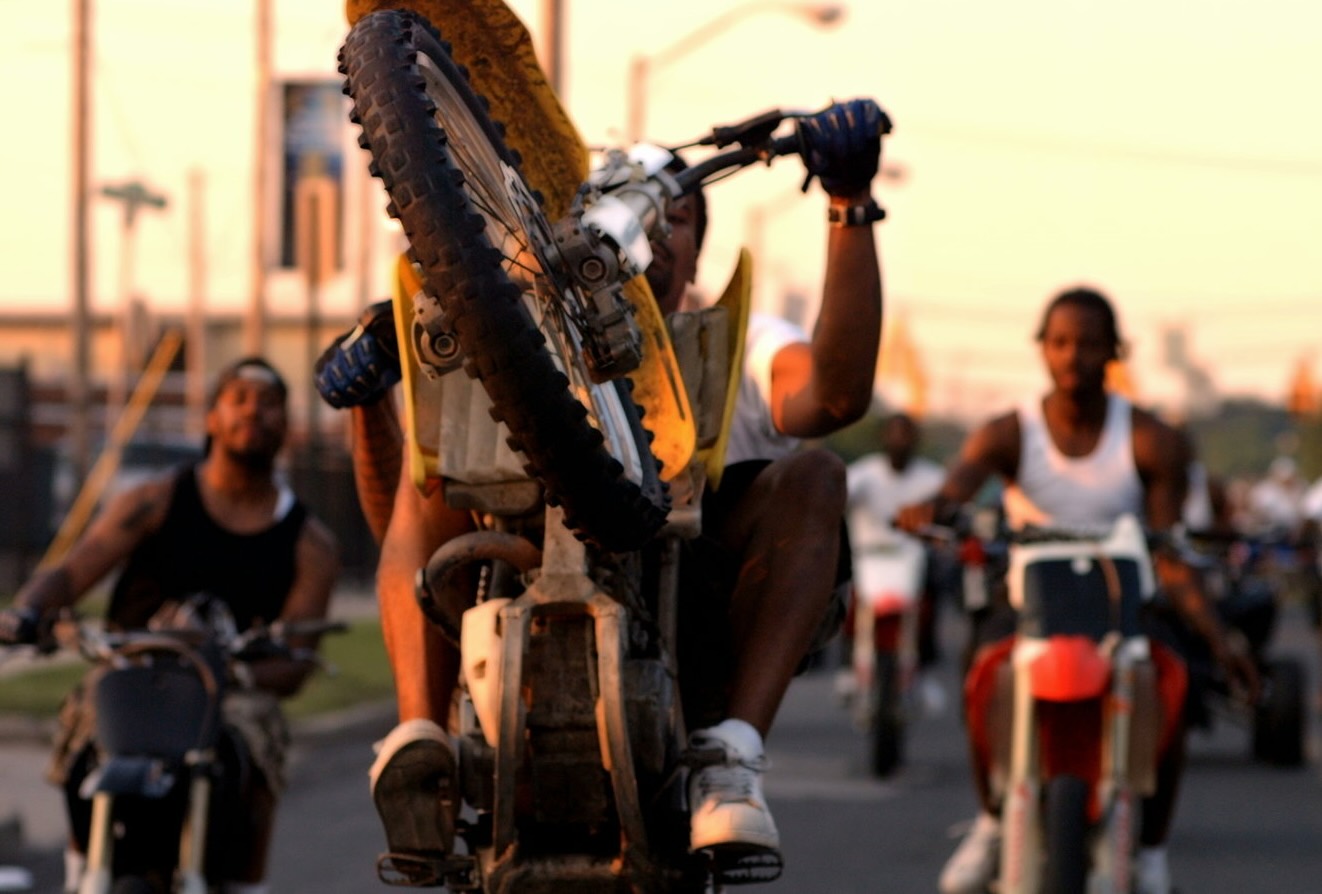
Photo: SeanMattison.com
TThey call it the "12 o'clock"—a vertical wheelie where the front tire points to the sky, mimicking the hands of a clock at high noon. For the Baltimore crew that made it famous, it was a local act of rebellion. Today, that same vertical wheelie is the logo of a massive, global, and deeply complex economic phenomenon. From the council estates of London to the banlieues of Paris, the "Bike Life" movement is not just a subculture; it is an industry.
When you aggregate the commercial, municipal, and manufacturing ecosystems that feed off and clash with this culture, the total value is estimated at roughly $15 billion to $16 billion globally. While individual crews like the 12 O'Clock Boys operate on cash and underground trades, the wider market is a massive economic engine. This is a story about how marginalized communities bypass traditional structures, how governments spend billions to manage the resulting externalities, and how the digital age turns illegal street stunts into monetizable assets.
The Microeconomics of the Street
At its core, the popularity of urban dirt biking is a microeconomic decision based on rational choice theory. In disenfranchised neighborhoods where the opportunity cost of a minimum-wage job or expensive college education feels too high for the return, the dirt bike offers an alternative. It is a "status good"—a luxury item that signals prowess and social capital. For a young person in Baltimore or Paris, mastering a 12 o'clock wheelie is an investment in local prestige, which can later be traded for followers, sponsorships, and cash.
This informal status economy creates a vibrant underground market. Fixed costs for a rider include the upfront cash for a used bike ($3,500 to $6,000) and basic gear. Variable costs—fuel, tires, and engine parts—can run between $900 and $1,700 annually. However, the real economic weight lies in the legal penalties. In Baltimore, a single ride can result in up to $1,000 in fines and impound fees, creating a high-risk, high-reward financial gamble.
The Global Supply Chain: A $10.5 Billion Market
The primary driver of this economy is the machine manufacturers themselves. The global dirt bike market sits at roughly $10.28 billion, with the U.S. consumer market accounting for $4 billion of that total. Urban street riders globally represent a major, highly active segment buying parts, bikes, and plastics.
However, a technological shift is reshaping the industry. Low-cost, powerful electric dirt bikes (like the Sur-Ron or Talaria, retailing for around $4,500) have captured up to one-third of the entry-level dirt bike market. These quiet, accessible electric bikes have exploded in popularity across metropolitan areas because they allow riders to evade noise detection, creating a multi-million dollar tech-riding niche within cities. This "grey market" supply chain sees vehicles sold as "off-road recreational vehicles," bypassing the financial regulations—licenses, insurance, and taxes—that govern cars.
Apparel and Streetwear: A $4 Billion Aesthetic
The fashion and protective equipment sectors explicitly monetize urban bike culture. The global motorbike riding gear market is a $14.5 billion industry, and urban riding culture has completely warped a specific cross-section of mainstream fashion.
- Aesthetic Co-Opting: Major streetwear companies, high-end sneaker brands, and corporate fashion lines heavily capitalize on the "Bike Life" look—from stylized balaclavas and urban riding hoodies to armored gloves.
- Mainstream Appeal: Millions of dollars are generated by selling this subculture's aesthetic to mainstream global consumers who do not even own bikes, proving the movement's influence extends far beyond the asphalt.
The Attention Economy: Media & Entertainment
Urban street stunts have proven to be an incredibly lucrative asset in the global attention economy. With the "zero marginal cost" of digital distribution, a rider in London can film a stunt and have it viewed by millions worldwide at no extra cost. This creates a direct revenue stream.
Elite street riders often amass millions of followers across YouTube, TikTok, and Instagram. This views-to-cash pipeline funnels millions of dollars in corporate ad spend, programmatic ad revenue, and private energy drink sponsorships directly to content creators. The culture also converts into high-value intellectual property, with major media companies like Sony producing multi-million dollar feature films like Charm City Kings or acclaimed international documentaries, turning raw street culture into globally distributed assets.
The Public Sector Cost: Externalities and Enforcement
For cities, the movement is a massive negative externality—a private activity that imposes an uncompensated cost on the public. In Baltimore, police have strict "no-chase" policies, forcing the department to spend an estimated $500,000 to $1 million annually on specialized task force salaries, plus up to $3,000 per hour in helicopter fuel to track packs from the sky.
The cost is a global phenomenon. Across hundreds of cities globally (like New York, London, Paris, and Atlanta), the combined cost of police helicopter fuel, specialized drone enforcement, dedicated traffic task forces, and vehicle impound storage adds up to hundreds of millions of dollars annually. Every dollar spent on enforcement is a dollar taken from schools, housing, or healthcare; it is a stark example of the "Tragedy of the Commons."
However, the financial footprint is so significant that governments are allocating massive funding packages to build legal alternatives. The Baltimore-based nonprofit B-360—which channels the 12 O'Clock Boys' culture into engineering and career skills—operates on a $29 million master budget funded by a mix of state, corporate, and federal Department of Justice grants to build a legal campus. The economics are forcing a pivot from pure enforcement to diversion.
The 12 O'Clock Boys and their international counterparts are more than a traffic nuisance. They are a visible symptom of institutional failure, a rational economic response to systemic disinvestment, and the driving force behind a $15 billion global industry. They are not a problem to be solved, but an economic signal that can no longer be ignored.
No Ads. By Us. For Us.
This article was made possible by readers like you. We hope it inspired you to support Emerald Book, so we can continue producing content like this.
We will never show you ads, sell your data, or require a subscription to consume our content. Your gift helps us keep the truth accessible.
Click the Support button to give a gift of any amount today.
Thank you for making this work possible.