

Emerald Pages
◆
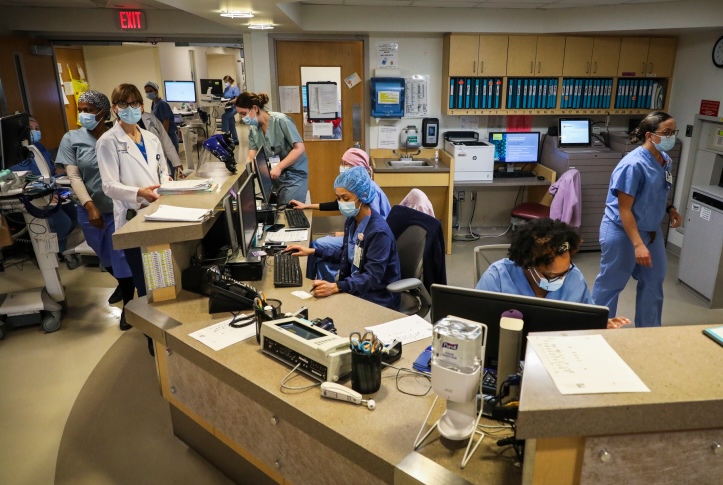
Photo: Erin Clark | Boston Globe | Getty Images
T here is a profound irony at the center of the American labor market right now. As millions of white-collar workers anxiously await the inevitable disruption of artificial intelligence, the healthcare industry is facing a crisis of human attrition. The U.S. is experiencing a major nursing shortage, but experts and frontline healthcare workers disagree on whether it is a crisis of supply or a crisis of retention. Data from the Health Resources and Services Administration (HRSA) indicates an overall 8% national shortage of Registered Nurses (RNs). However, unions and nursing organizations emphasize that millions of licensed nurses are actively choosing to leave the bedside due to chronic burnout.
The narrative of a simple "shortage" is misleading. While federal agencies and healthcare executives attribute the crisis to a mathematical deficit—noting that nursing schools turned away over 65,000 qualified applicants in 2025 alone due to faculty shortages—frontline organizations like National Nurses United (NNU) argue that a true shortage of qualified bodies does not exist. Bureau of Labor Statistics data indicates there are over 1.1 million actively licensed RNs in the U.S. who choose not to work as nurses. They point to unsustainable hospital environments as the reason professionals flee the field. The question is not "Where are the nurses?" but rather, "Why are they leaving?"
The 2026 Nurse Salary and Work-Life Report highlights the reality of what is keeping nurses from staying at the bedside. A staggering 53% of active nurses explicitly report experiencing burnout, while 60% state they feel chronically overwhelmed at work. Alarmingly, 24% (nearly 1 in 4) are currently considering leaving the profession entirely. An Advisory Board workforce survey further reveals that only 36% of current bedside nurses plan to still be working at the bedside in three years.
The Five Core Drivers of Bedside Burnout
Nurses do not generally cite a lack of passion for patient care as their reason for leaving. Instead, specific organizational failures drive them out. According to the 2026 Nurse Salary and Work-Life Report, the crisis is driven by five concrete, interlocking factors.
Unmanageable patient ratios top the list, with 48% of burned-out nurses citing this as a primary concern. A recent study published in Medical Care found that 67.4% of nurses report having too few staff to safely complete their work, pushing average medical-surgical loads up to six patients per nurse. This forces nurses into a state of constant, high-stakes panic, where the fear of missing a critical medical change becomes a daily reality.
Lack of responsive leadership is another major factor, with 48% of nurses reporting that hospital executives and administrators are disconnected from the realities of the floor. When frontline staff sound the alarm about unsafe conditions, they are frequently met with superficial wellness gestures—like free pizza or mandatory resilience modules—rather than actual structural support or increased hiring.
Salary and wage policy dissatisfaction affects 49% of nurses. While nursing is a relatively high-paying field on paper, regular hospital staff salaries have failed to keep pace with the massive spike in inflation and the sheer intensity of post-pandemic workloads. This economic strain is compounded by watching hospitals spend massive sums on short-term travel nurses while refusing to offer permanent, long-term raises to their loyal, core staff.
Overwhelming documentation workloads consume 43% of nurses' energy. Electronic Health Record (EHR) systems have turned clinical professionals into data-entry clerks. A substantial portion of a nurse's 12-hour shift is spent clicking boxes and navigating complex software to satisfy hospital billing and legal compliance. This takes them away from the bedside and causes "moral injury"—the psychological distress of knowing what a patient needs but being prevented by bureaucracy from providing it.
Finally, escalating workplace violence is a rapidly growing driver. Data from National Nurses United shows that a staggering number of bedside nurses face physical assault, verbal threats, and aggressive behavior from frustrated patients and family members. Because security is often understaffed, nurses bear the brunt of an increasingly stressed and angry general public.
The compounding effect of these factors means that nearly 60% of nurses report they rarely or never feel fully recovered before starting their next shift. Strikingly, 2026 data from Nurse.org shows that 41% of nurses staying at the bedside right now are only doing so out of sheer financial necessity, rather than job satisfaction—a reality that experts warn makes the current healthcare system highly unstable.
The Heavy Burden on Black Women
While the burnout crisis affects all nurses, it does not affect them equally. Black women bear a disproportionately heavy weight of this crisis. Because they are concentrated in the most understaffed sectors of healthcare, the structural failures of the nursing industry impact them first and hardest.
While Black women make up about 6.9% of the total United States labor force, a study published in Health Affairs reveals they comprise 13.7% of the healthcare workforce—meaning their representation in healthcare is exactly double their footprint in the general economy. However, tracking their distribution reveals stark disparities.
Black women are heavily concentrated in long-term care and direct support roles. They make up 23% of the entire workforce in nursing homes and long-term care facilities. Nearly 65% of Black women working in healthcare are employed as Licensed Practical Nurses (LPNs) or nurse aides/CNAs—positions that require the most intense physical labor, offer the lowest wages, and have experienced the highest post-pandemic attrition rates.
Conversely, when looking specifically at the higher-paying, more autonomous Registered Nurse tier, Black nurses are actually underrepresented. According to the Health Resources and Services Administration National Sample Survey of Registered Nurses, only 11% of RNs in the U.S. identify as Black or African American—compared to roughly 13.6% of the overall U.S. population.
The student debt trap further compounds the crisis. A cross-sectional study reveals that Black nurses carry significantly higher student debt burdens than their peers. When combined with the fact that Black women are heavily concentrated in lower-paying LPN and CNA roles, they face a severe imbalance: massive financial pressure without the financial flexibility to cut their hours or leave an unsafe environment.
Compounding discrimination adds yet another layer of stress. According to data compiled by the American Nurse Journal, 63% of minority nurses have explicitly encountered racism or microaggressions on the job from peers, supervisors, or patients. Experiencing constant, unchecked bias creates an underlying baseline of chronic stress. Black women are not just dealing with the baseline medical stresses of a standard 12-hour shift—they are also expending significant emotional energy navigating an unsupportive workplace culture.
This creates a painful paradox: Black women have historically used healthcare—particularly nursing—as a vital vehicle for upward economic mobility, finding a career that offers recession-proof stability. Yet once inside, they are disproportionately funneled into the exact corners of the system that demand the heaviest physical labor and offer the least institutional support. When Black women burn out and leave, the consequences stretch beyond the workforce—research consistently shows that health outcomes for Black communities improve dramatically when patients are treated by Black providers. The mass exodus of Black women from the field directly threatens overall community health equity.
AI Isn't Stealing Jobs—It's Trying to Save Them
While artificial intelligence is actively disrupting white-collar industries, nursing is experiencing a massive job boom. The U.S. Bureau of Labor Statistics projects that employment for registered nurses will grow 5% through 2034, adding roughly 189,100 new job openings every single year. Nursing is arguably the most AI-proof career in the modern economy because empathy, physical touch, and complex clinical judgment cannot be replicated by code.
However, there is a fascinating nuance to this: nursing is being hit by AI, but it is being used as a tool to save the profession, not replace the workers. According to a 2026 McKinsey workforce report, nearly 65% of surveyed nurses are already using AI tools in their daily practice. Hospitals are rushing to deploy AI specifically to solve the burnout crisis.
Ambient documentation is one of the most promising applications. AI tools listen to a nurse talking to a patient, automatically synthesize the conversation, and format it into perfect medical charts. This frees up hours of a nurse's shift, letting them focus on actual human care rather than staring at a screen.
Smart staffing predictive models are also being deployed in hospitals like UCSF Health. Instead of a human supervisor guessing who can handle another patient, AI co-pilots analyze real-time patient sickness metrics to mathematically map out assignments. This ensures no single nurse gets completely overloaded during a chaotic shift.
Early warning prediction algorithms are embedded into patient monitors to track vital signs and movements. AI can predict if a patient's condition is about to deteriorate or if they are at a high risk of falling out of bed hours before a human would notice. This takes the intense psychological pressure off the nurse to be in five rooms at once.
The tragic irony is that while hospitals are investing in AI to cut down charting times, these advanced tech rollouts are happening first in wealthy, well-funded suburban hospital systems. The underfunded urban safety-net hospitals and long-term care facilities where Black women are concentrated are the very last to get these burnout-relieving technologies. The AI cushion is unequal.
The math is brutal. When a nurse burns out and resigns, it takes an average of 78 to 102 days to recruit and onboard an experienced replacement. During those three months of vacancy, the remaining staff must pick up the extra shifts, accelerating their own burnout and triggering further resignations. This is no longer just a healthcare issue; it is a civil rights and economic justice issue. If the American economy's premier "safe-haven" profession is unlivable for the demographic that populates its front lines, the stability of the entire healthcare infrastructure is at risk.
No Ads. By Us. For Us.
This article was made possible by readers like you. We hope it inspired you to support Emerald Book, so we can continue producing content like this.
We will never show you ads, sell your data, or require a subscription to consume our content. Your gift helps us keep the truth accessible.
Click the Support button to give a gift of any amount today.
Thank you for making this work possible.