

Emerald Pages
◆
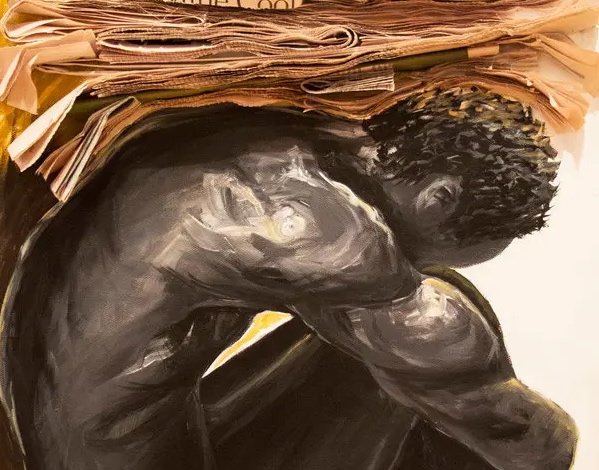
Photo: An Inner Strength" (2007) | Ernie Barnes
A pervasive narrative persists in American social discourse: that Black men, by virtue of their gender, occupy a social tier adjacent to white men. This narrative is fundamentally incorrect. It relies on a flawed understanding of patriarchy, confusing hyper-visible exceptions with structural reality. When we examine the aggregate data on wealth, intergenerational mobility, and institutional safety, a different picture emerges—one where Black men and Black women are anchored to the exact same foundational tier at the base of the American social hierarchy.
Black men do not share a tier with white men in any meaningful metric of structural power, wealth, or systemic safety. The gap between them is vast. Instead, Black men and Black women are "next-door neighbors at the bottom," separated only by a thin margin—a "step" that does nothing to change the fact that both groups are completely excluded from the penthouse of white male privilege.
The Myth of Shared Male Privilege
The idea that Black men sit near white men relies on a fundamentally flawed understanding of patriarchy. In a racialized society, gender privilege is entirely conditional on race. A white man's masculinity grants him access to institutional power, corporate leadership, and systemic protection. A Black man's masculinity is historically viewed by dominant institutions as a threat to be managed, policed, or contained. His "manness" does not grant him entry into the spaces of privilege, safety, and institutional authority that white men occupy. Instead, dominant systems weaponize his gender against him.
True patriarchal privilege is about institutional control—owning corporations, writing laws, and commanding the justice system. Black men are locked out of these levers of power just as Black women are. While a white man's assertiveness or ambition is rewarded as "leadership," a Black man's identical behavior is frequently coded by institutions as "aggressive" or "dangerous." His manness becomes a liability, not an asset. Any individual success a Black man achieves is highly conditional. It can be stripped away instantly by a single interaction with the justice system—a luxury white men do not have to worry about.
A Step Away, Not a Tier Above
When looking at the actual data of American life, Black men and Black women are bound tightly to the same economic and social floor, separated only by thin margins. The Subordinate Male Target Hypothesis argues that Black men are actually more vulnerable than Black women in certain institutional contexts—particularly regarding state violence and policing—not less. This directly contradicts the myth that Black men possess some form of "male privilege" that elevates them.
A single Black man's median wealth ($1,550) is slightly higher than a single Black woman's ($101), but both are entirely isolated from white men, whose median wealth exceeds $100,000. On the grand scale, $1,550 and $101 are on the exact same struggling tier. Both groups are locked out of generational wealth, tracked into lower-funded neighborhoods, and subjected to the same historical legacy of redlining and economic exclusion. Mass incarceration strips Black men of their wages and freedom, which directly forces Black women to become sole economic load-bearers with virtually zero wealth. The destruction of one group is the mechanism used to suppress the other.
The Median Wealth Reality
When you look at the median—the exact middle of the population, which represents the typical person—the true shape of the hierarchy becomes clear. The Federal Reserve's data demonstrates that the wealth gap between white men and Black men is immense. The typical white family holds approximately $285,000 in wealth, compared to just $44,900 for the typical Black family. The macro data shows that the wealth gap between white and Black households widened by $50,000 over recent years. The slight individual edge a single Black man might have over a single Black woman completely evaporates when compared to white wealth.
Single Black men have a median wealth of $1,550, while single Black women have just $101. Single white men hold a median wealth that is 14.6 times greater than single Black men and 224.2 times greater than single Black women. In the broader American economy, $1,550 and $101 are effectively the exact same position of extreme financial vulnerability. They are anchored to the same economic floor.
The Intergenerational Cliff
The most definitive proof that Black men do not occupy a higher, transferable tier of privilege is how the system treats their children. If a group has true systemic status, they can pass that status down. Groundbreaking longitudinal data from Harvard's Opportunity Insights project tracked millions of children over decades. It found that Black boys raised in wealthy, top-income households are overwhelmingly likely to fall into lower income brackets as adults. In contrast, white boys raised in wealthy households almost always stay wealthy. This proves that whatever individual economic status a Black man manages to build is an exception that the system actively erodes in the next generation. His "manness" provides zero protection for his sons against systemic racial tracking.
Why Some Still Believe the Myth
Those who argue that Black men occupy a tier with white men point to three main arguments. Each collapses under scrutiny.
First, the raw income gap between Black men and Black women. Proponents point to the median weekly earnings gap—$828 for Black men vs. $779 for Black women. But this thin margin is economically meaningless when a white man's earnings sit vastly higher. This is an internal community difference, not national structural power.
Second, the illusion of corporate and leadership pipelines. They point to historic figures like Barack Obama or Black Fortune 500 CEOs. But these individuals are extreme outliers, not the norm. The data shows that the vast majority of Black men are concentrated in blue-collar logistics, service, and production labor—not executive suites. They are not sitting in boardroom suites next to white men; they are working on warehouse floors, driving transit routes, and navigating the exact same underfunded communities as Black women.
Third, sociopolitical attention and "the crisis of the Black male." Some argue that because Black men dominate the narrative surrounding racial oppression, they receive a form of "narrative privilege." Major government initiatives, philanthropic foundations, and civil rights focus points have historically centered on "Black Male Achievement" or saving the "endangered Black male" from mass incarceration. But this confuses public attention with structural power. Focus on mass incarceration does not translate into wealth, safety, or institutional authority.
How Academia Perpetuates the Myth
Academia has historically created and maintained frameworks that accidentally reinforce this myth. While universities aim to map social inequality accurately, their highly theoretical models often separate Black men and Black women into different tiers.
First, the reliance on isolating variables. Labor economists and sociologists isolate gender to study the "Gender Wage Gap," while criminologists isolate race and gender to study the "School-to-Prison Pipeline." By breaking these crises into isolated academic silos, the university presents them as independent phenomena, rather than recognizing that both forces act simultaneously to trap both groups on the same economic floor.
Second, treating white patriarchal theory as universal. Traditional gender theory was constructed around the lived experiences of white, middle-class households. In those traditional white spaces, maleness acts as a highly transferable passport to institutional wealth, legal safety, and corporate executive power. When academics blindly apply those same gender frameworks to Black communities, they assume a Black man's gender functions the same way a white man's does. This completely ignores the macroeconomic data showing that the system routinely weaponizes Black masculinity as a reason to surveil, police, and economically contain them.
Third, the backlash from Black Male Studies. A growing discipline called Black Male Studies, argues that mainstream academia has trapped itself in an elite, theoretical bubble. They criticize the university for utilizing abstract gender theories that treat Black men as "patriarchal agents" or mini-white men. They point out that these academic theories are completely disconnected from the raw, historical, and material data proving Black men suffer from extreme rates of institutional violence, economic exclusion, and a total lack of generational power.
State Violence and Incarceration Data
Scholars use criminological data to prove that the system does not view Black men as "patriarchal partners" to white men, but rather treats them with intense institutional hostility. At the end of 2023, Black men were incarcerated in the U.S. at a rate of 1,862 per 100,000 people—over five times the rate of white men. Despite making up only 6% of the U.S. population, there are more Black men incarcerated than all women of all races combined. This extreme concentration of state force demonstrates that "manness" is weaponized against Black men to physically contain and economically drain them.
Unity Is Survival
This is the definitive, inescapable conclusion. Because the hard statistics smash the myth that Black men have a separate path to power through their gender, it proves their fates are entirely locked together. They do not have the luxury of fighting separate battles because they are being squeezed by the exact same structural floor.
When you look at how the system actually operates, Black men and Black women need each other as a unified front for three critical reasons.
First, the survival of the family economy. Because neither Black men nor Black women possess the massive generational wealth of white Americans, they cannot survive economically as isolated individuals. When a single Black woman has a median wealth of around $100 and a single Black man has around $1,500, neither can weather an economic emergency alone. To build any semblance of stability, homeownership, or generational protection for children, Black men and women must pool their resources. The Black family economy requires total cooperation just to establish a baseline of security that other groups take for granted.
Second, one group's crisis directly causes the other's. The system's attack on Black men is not separate from its attack on Black women; they are two sides of the same coin. When the penal state targets and incarcerates a Black man, it strips away his earning power. This instantly forces the Black woman to become the sole economic provider and single parent, draining her financial and emotional resources. Black women need Black men free, employed, and safe to help lift the community's economic burden. Black men need Black women's resilience and community organizing to survive institutional hostility. You cannot fix the material conditions of one without saving the other.
Third, protection against a hostile culture. Because traditional American institutions do not grant structural protection to either group, their only true safety net is each other. A Black man's "manness" will not protect him from a police stop or labor discrimination, and a Black woman's gender will not protect her from the combined weight of racism and sexism. Historically, the most effective civil rights and economic movements—from the Underground Railroad to the Black Panther Party's community programs—succeeded precisely because they rejected the myth of gender division and operated as a unified, fiercely protective collective.
The narrative of division is a luxury that only groups at the top of the hierarchy can afford. For Black men and Black women, unity is not just a cultural ideal; it is a strict, mathematical requirement for survival. By cutting through the academic myths and looking at the raw statistics, it becomes undeniable: they are next-door neighbors on the exact same tier, and they must stand together to move forward.
No Ads. By Us. For Us.
This article was made possible by readers like you. We hope it inspired you to support Emerald Book, so we can continue producing content like this.
We will never show you ads, sell your data, or require a subscription to consume our content. Your gift helps us keep the truth accessible.
Click the Support button to give a gift of any amount today.
Thank you for making this work possible.