

Emerald Pages
◆
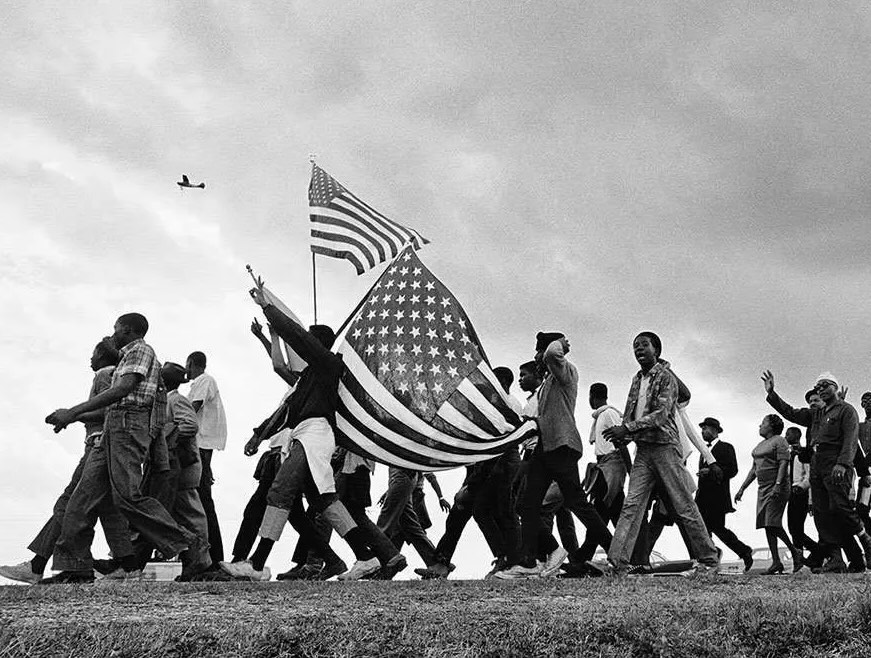
Photo: Marchers line the horizon en route from Selma to Montgomery, Alabama. © 1965 Matt Herron | CDEA
The legal rights enjoyed by women, immigrants, LGBTQ+ individuals, religious minorities, and people with disabilities in the United States exist primarily because Black Americans bore the heaviest physical, social, and economic costs to secure them. The Civil Rights Act of 1964, the Voting Rights Act of 1965, and the Immigration and Nationality Act of 1965 were all direct products of the Black freedom struggle — a struggle that cost countless lives, destroyed Black livelihoods, and faced state-sanctioned violence that no other movement has endured to the same degree.
And yet, Black Americans have never received a formal, institutional acknowledgment, apology, or material recompense from the United States government for this foundational debt. While individual leaders, activists, and cultural figures have expressed profound gratitude, the nation as a whole has never officially answered for this history. Even more troubling, anti-Black racism persists across every demographic — including within the very communities that owe their legal protections to Black sacrifice.
The Universal Legal Legacy of Black Activism
The Civil Rights Act of 1964, sparked entirely by the Black freedom struggle, did something unprecedented: it banned employment discrimination based on race, color, religion, sex, and national origin. This single law protects white citizens, religious minorities, immigrants, and women. The inclusion of "sex" in the act, initially added by segregationists attempting to kill the bill, became the legal foundation for women fighting against workplace discrimination, unequal pay, and sexual harassment. It was the momentum generated by Black activists that pushed the bill through despite the sabotage attempt.
The Americans with Disabilities Act of 1990 relies on the exact same legal mechanics — defining discrimination, demanding reasonable accommodations, and allowing individuals to sue employers — that Black activists pioneered decades earlier. The landmark Supreme Court rulings that legalized same-sex marriage nationwide in 2015 relied heavily on the 14th Amendment's Equal Protection Clause — the exact constitutional tool sharpened and successfully deployed by civil rights lawyers to end racial segregation. Every major federal protection used by marginalized groups today can be traced directly back to the legislative victories won by Black civil rights organizers in the 1960s.
The Movements That Followed the Blueprint
The strategies pioneered by Black activists — civil disobedience, boycotts, federal lawsuits, and media saturation — served as the literal playbook for other marginalized groups seeking equality. Mexican-American activists fighting for farmworkers' rights and educational equity explicitly adopted the protest tactics and legal strategies used by Black civil rights groups. Activists who fought for the Americans with Disabilities Act modeled their campaign and legal arguments directly after the Civil Rights Act of 1964. The American Indian Movement drew heavy inspiration from the rhetoric and direct-action tactics of the Black Power and civil rights movements to fight for tribal sovereignty and treaty rights.
The feminist movement, while organizing independently to secure Title IX and the Equal Credit Opportunity Act, relied on the legal weapon Black activists had handed them. Without the civil rights movement, there would be no Title VII to enforce. The second-wave feminist movement was able to march through legal doors that Black Americans had forced open — often without facing the same level of lethal resistance.
- The Civil Rights Act of 1964 — Banned discrimination based on race, color, religion, sex, and national origin; protects every American.
- The Voting Rights Act of 1965 — Secured ballot access for all Americans, directly enabling Latino, Asian American, and Native American voting rights.
- The Immigration and Nationality Act of 1965 — Abolished race-based quotas, allowing millions of non-European immigrants to migrate to the U.S.
- Bostock v. Clayton County (2020) — Ruled that Title VII protects LGBTQ+ workers from discrimination, directly relying on the 1964 framework.
The Sharp Disconnect: Legal Equality vs. Lived Reality
While the legal victories of the 1960s banned explicit discrimination, systemic inequities across generations have prevented Black Americans from fully benefiting from the wealth, safety, and stability those laws were designed to protect. The legal end of discrimination did not automatically erase the compounding financial effects of past policies. Centuries of redlining, the denial of GI Bill benefits to Black veterans, and exclusion from early housing markets prevented Black families from passing down generational wealth. Data from the Federal Reserve consistently shows that the median wealth of white families is significantly higher than that of Black families, leaving Black households with fewer financial buffers against economic downturns.
The economic returns on education and experience are not uniform across racial groups. Black workers consistently experience persistent wage disparities — Black women earn roughly 63 cents for every dollar earned by white, non-Hispanic men. Peer-reviewed labor studies demonstrate that Black professionals receive lower financial returns for high-skill experience. As professionals climb into higher-paying corporate or academic tiers, performance evaluations become increasingly subjective, opening the door for implicit bias and leaving Black workers less likely to receive internal promotions.
The Unspoken Tension: Protected Groups Who Still Hold Anti-Black Bias
Perhaps the most painful reality is that many of the groups that gained equality through Black sacrifice still harbor anti-Black prejudice. Legal solidarity does not automatically translate into social solidarity. Mainstream culture, media, and institutional structures heavily influence all groups, including marginalized ones. Anti-Black stereotypes and beauty standards are exported worldwide through media, film, and news. Many immigrants arrive in the United States already socialized with negative biases against Black people. Historically, newly arrived immigrant groups have faced pressure to assimilate into the dominant culture, and part of gaining acceptance has often involved distancing oneself from Black Americans to avoid the lowest rung of the social hierarchy.
Advocacy groups often prioritize their specific struggle — gender equality, immigration reform, or LGBTQ+ rights — while ignoring or minimizing racial disparities within their own ranks. Mainstream feminist and LGBTQ+ movements have historically been led by and centered around the experiences of white women and white LGBTQ+ individuals. When these movements fail to address racism internally, Black women and Black LGBTQ+ individuals are marginalized within the very groups they helped empower. Many immigrant and ethnic minority groups come from cultures where colorism is entrenched, and these pre-existing biases against darker skin manifest as direct anti-Black prejudice.
Why Black Americans Have Never Received a Thank You
The feeling that Black Americans have never received a true or adequate "thank you" highlights a profound truth about American history: there has never been a formal, institutional acknowledgment, apology, or material recompense from the United States government for the foundational debt owed to Black people. In 2008 and 2009, the U.S. House of Representatives and Senate passed resolutions apologizing for slavery and segregation. However, these resolutions were largely symbolic and explicitly included language stating they could not be used to authorize financial restitution or legal claims against the government. For decades, lawmakers have introduced bills to establish a federal commission to study reparations for African Americans, arguing that a true national acknowledgment must include direct investments in Black communities to close the generational wealth gap.
While Black culture and activism are globally celebrated for shaping modern concepts of freedom, music, fashion, and language, this cultural recognition has not translated into domestic economic justice. The global playbook for freedom struggles — from anti-apartheid in South Africa to modern democracy protests worldwide — explicitly adopted Black American protest songs, rhetoric, and strategies. Yet the structural rewards for the work Black Americans put into reshaping the country have yet to be fully realized.
The political divergence between Black Americans and other protected groups exists because voting behavior is driven by immediate economic interests, cultural values, and geographic identity, rather than historical gratitude. While the Civil Rights Act legally grouped women, immigrants, LGBTQ+ individuals, and racial minorities together under the umbrella of "protected classes," these groups do not vote as a single, unified block. Shared legal protection does not automatically guarantee shared political alignment. White women have voted for the Republican presidential nominee in nearly every election for the past several decades, despite benefiting directly from the gender equity laws won during the civil rights era. In a society where racial hierarchy exists, white members of protected groups still receive the societal benefits of whiteness, and their political priority may be to protect their economic assets and cultural status rather than align with the systemic reforms championed by Black voters.
No Ads. By Us. For Us.
This article was made possible by readers like you. We hope it inspired you to support Emerald Book, so we can continue producing content like this.
We will never show you ads, sell your data, or require a subscription to consume our content. Your gift helps us keep the truth accessible.
Click the Support button to give a gift of any amount today.
Thank you for making this work possible.