

Emerald Pages
◆
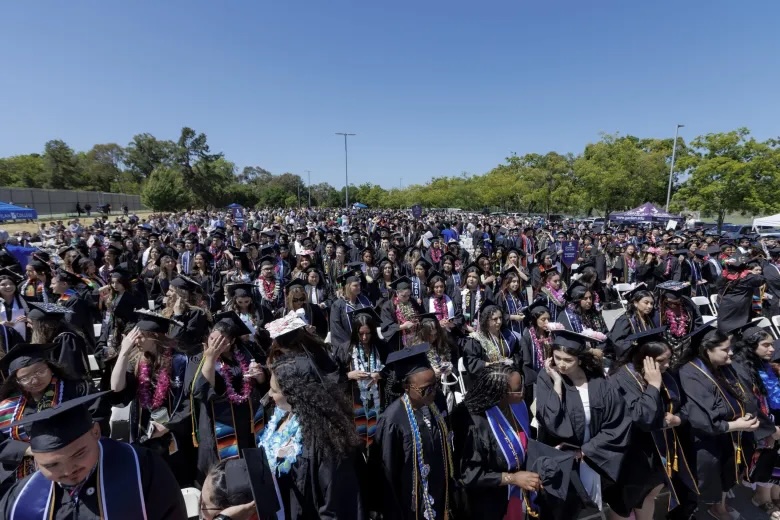
Photo: Chris Mora | 105th Annual Commencement, Gavilan College 2025
For decades, American students were told a simple story: get a college degree, and you will get a good job. This promise was the bedrock of the middle-class dream, a financial covenant between families and the institutions they entrusted with their children's future. Today, that covenant is broken. The data paints a stark picture of a massive and growing mismatch—a credential inflation that has left millions of graduates overeducated and underemployed.
The macro-economic phenomenon, often called "credential inflation" or "elite overproduction," has fundamentally reshaped the labor market. The U.S. higher education system produces over 2 million new bachelor's degrees every year. However, out of more than 800 occupations tracked by the Bureau of Labor Statistics (BLS), only 178 typically require a bachelor's degree for entry. While roughly 42.8% of younger American workers (ages 25–39) hold a bachelor's degree or higher, the BLS reports that only about 30% of total jobs in the economy actually require a four-year degree to perform.
This saturation has had drastic real-world consequences. Because there are not enough traditional "college-level" jobs, between 41.5% to 52% of recent college graduates are underemployed, meaning they work in jobs that do not require a degree. Perhaps more alarming, research shows that taking a non-degree job out of necessity often pigeonholes workers, with 45% of graduates remaining underemployed a full decade after graduation. For the first time in modern tracking, young college graduates (ages 22–27) face an unemployment rate that sits well above the national average.
Why People Feel Scammed
This structural mismatch is exactly why a growing number of Americans feel "scammed" by higher education. The feeling of betrayal stems from several compounding financial and structural realities. The core of the frustration is that the cost of the "ticket" has skyrocketed while its immediate value has dropped. Over the last 40 years, the cost of attending college has increased by nearly 170%, vastly outpacing general inflation and entry-level wage growth.
Finding oneself working a retail or administrative job that pays $40,000 a year is difficult. Doing so while carrying $30,000 to $50,000 in student loans feels financially catastrophic. Because entry-level salaries in oversaturated fields are low, many graduates can only afford minimum loan payments, which often fail to cover the accumulating interest. Furthermore, because so many people have bachelor's degrees, the credential has lost its status as a differentiator and become a minimum baseline just to get past automated resume filters. To stand out, many students feel forced to go deeper into debt for a master's degree, essentially paying double just to secure the entry-level job they thought a bachelor's degree would grant them.
- The Supply vs. Demand Math: Only 178 out of 800 tracked occupations require a bachelor's degree, yet over 2 million new degrees are awarded each year.
- The Underemployment Trap: 41.5% to 52% of recent graduates are underemployed, and 45% remain so a decade later.
- The Field of Study Glut: From 2014 to 2024, entry-level tech openings grew by only 6%, while the number of tech graduates skyrocketed by 110%.
The Path Forward: What To Do Instead
To bypass the traditional college trap, students and career-changers must shift from buying a generalized credential to acquiring specific, market-vetted skills. The goal is to build career leverage without taking on predatory debt. In digital and technical fields, proof of work has replaced the diploma. Employers increasingly care about what you can build, not just where you went to school.
Build a "Skills-First" Portfolio: Target high-demand technical certifications through Google Career Certificates, AWS, or Salesforce. These programs take 3 to 6 months and cost a fraction of a single college textbook. Launch real-world projects and publish your work publicly on GitHub or Medium to create an un-fakeable resume.
Enter Paid Corporate Apprenticeships: Many major corporations have realized the entry-level college pipeline is broken and have built their own debt-free alternatives. Corporations like IBM, Accenture, and Microsoft offer structured apprenticeships where they pay you a full salary and cover your training from day one.
Leverage the High-Wage Skilled Trades: The structural shortage of skilled physical labor has driven entry-level blue-collar wages past many entry-level white-collar salaries. A licensed electrician, plumber, or HVAC technician frequently hits a six-figure income years before a typical liberal arts graduate breaks even on their student loans.
Will This Get Worse or Better?
The situation will likely get worse in the short term, but a dramatic demographic shift suggests it might get better in the 2030s. For the remainder of the 2020s, new college graduates face the most challenging entry-level corporate market since the Great Recession. The rise of artificial intelligence is targeting entry-level "knowledge worker" tasks like basic coding and data entry, removing the traditional corporate ladder rungs for recent grads.
However, further out, a combination of shifting demographics and retirement math will finally ease the oversupply. Due to a sharp drop in birth rates during the 2008 financial crisis, the population of traditional college-aged students will plummet by approximately 15 percent between 2025 and 2029. This "Enrollment Cliff" will shrink the annual factory of college degree-holders. Simultaneously, as the last baby boomers reach retirement age, roughly 18 million college-educated workers will leave the labor force, creating a massive vacuum of talent.
If you are entering the white-collar workforce right now, the market is highly competitive and requires a portfolio-first mindset. However, if you are looking a decade down the line, systemic worker shortages mean a college degree will likely regain its structural premium as the supply of graduates shrinks.
No Ads. By Us. For Us.
This article was made possible by readers like you. We hope it inspired you to support Emerald Book, so we can continue producing content like this.
We will never show you ads, sell your data, or require a subscription to consume our content. Your gift helps us keep the truth accessible.
Click the Support button to give a gift of any amount today.
Thank you for making this work possible.