

Emerald Pages
◆
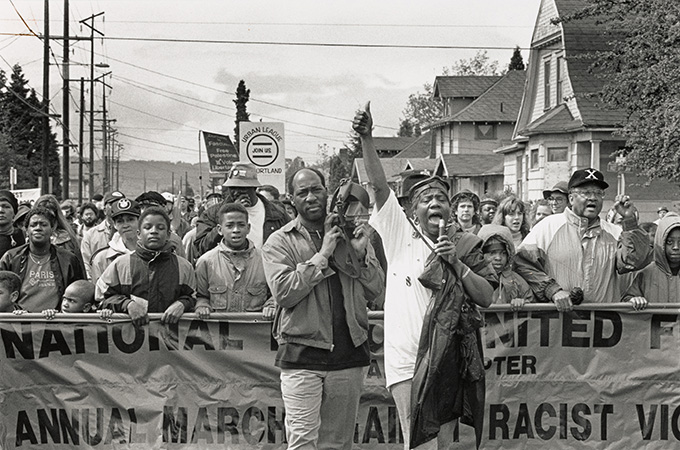
Photo: Julie Keefe | OHS Research Library
Portland, Oregon, is often celebrated as a beacon of progressive politics in the 21st century. Yet, beneath the veneer of bike lanes, craft breweries, and counter-culture activism lies a dark and foundational paradox. Historians frequently cite Oregon's early history as a blueprint for white supremacy in the Pacific Northwest. The city's current reputation masks the fact that it was originally envisioned and legally constructed as a white utopia, built on a single, chilling principle: to hate slavery for economic reasons, but to hate Black people even more.
This is the stark contradiction at the heart of Portland. In the 1850s, as the nation fractured over slavery, Oregon's founders made a calculated decision. They voted heavily against the institution of slavery, but with an even greater majority—8-to-1—they voted to ban free Black people from entering the state entirely. The goal was not racial justice, but the creation of a homogenous white society, free from what they viewed as the "troublesome" racial conflict tearing the rest of the country apart.
The logic was brutally simple: slavery was an economic threat, but Black people themselves were a social and racial threat. This deep-seated hierarchy of hatred showed up clearly in the proportions of the 1857 constitutional vote. While a strong majority of 75% voted to ban slavery, an even more overwhelming 89% voted to ban free Black people. To the voters, keeping Black people out of the state entirely was a much more popular and urgent issue than stopping the institution of slavery itself.
The Economic Fear: Why They Hated Slavery
To understand the mindset of early Oregonians, it is crucial to separate "hating slavery" from "liking Black people." Their opposition to slavery was driven entirely by white supremacy and economic anxiety.
Most Oregon immigrants were poor, independent farmers from the Midwest. They knew they could never financially compete with wealthy Southern plantation owners who could utilize free, forced labor. If a rich slaveholder moved to Oregon with a large enslaved workforce, they could clear forests and harvest crops at a fraction of the cost, driving free white laborers into poverty. Banning slavery was a protectionist measure to keep the job and land markets exclusively for white men. They also wanted to avoid the national "slavery question" entirely, viewing Black people as a source of political chaos.
- The Economic Threat: Wealthy slaveholders would monopolize the best land and undercut white workers' wages.
- The "Free Soil" Ideology: They believed manual labor was honorable and didn't want it "stained" by its association with slavery.
- Racial Purity: They believed banning slavery would cut off the primary pipeline for Black populations coming to the region.
The Ultimate Solution: Total Exclusion
Since they saw Black people themselves as the threat, they chose the most extreme option available. They banned the institution of slavery to protect white profits, and they banned Black human beings to protect white supremacy. The cruelty of this was enshrined in laws like the "Lash Law" of 1844, which gave free Black men two years to leave the territory and Black women three. If they stayed past the deadline, they were to be flogged with a whip—between 20 and 39 lashes—every six months until they left.
The exclusion clause in the 1857 Oregon Constitution didn't just tell Black people to leave; it systematically stripped away their ability to survive if they stayed. The law explicitly stated that Black people could not hold real estate, make legal contracts, or file lawsuits. By making it illegal to own a home, get a job, or use the legal system, Oregon's founders created an environment where it was functionally impossible for a Black person to live. They wanted the economic benefits of a "free market" without the racial diversity that usually came with it.
This legacy of exclusion was reinforced for generations. In the 1920s, Oregon had the highest per capita KKK membership in the country outside of the South, successfully electing both the governor and Portland's mayor. Photographic evidence shows Portland police officers openly posing with hooded Klansmen. Later, when Black workers arrived for wartime shipyard jobs in the 1940s, the city used aggressive systemic tools like redlining to confine them to a single square mile called the Albina district. This community was then systematically destroyed through "urban renewal" projects that built the Memorial Coliseum and Interstate 5 directly on top of thriving Black businesses and homes.
The Modern Echo: Why Portland is Still So White
Today, Portland remains the "whitest major city in America," with roughly 65% to 66% of its population identifying as non-Hispanic white and a Black population of only about 5% to 6%. This demographic reality is not an accident; it is the direct legacy of the 19th-century exclusionary laws. Because Oregon explicitly banned Black people during the critical decades of westward migration, the state completely missed out on the demographic shifts happening across the rest of the country.
The paradox of Portland's progressive reputation is that its liberalism evolved separately from issues of racial diversity. For generations, Portland's progressivism has been overwhelmingly white-led, centered on counter-culture, environmentalism, and labor rights. White Portlanders champion progressive issues like bike lanes and reproductive rights, but as sociologists note, it is easy to hold abstract, liberal ideals about racial equality when you do not actually live near people of color. This explains why a state with a progressive reputation took until 2002 to vote to remove racist language from its constitution—and even then, 28% of voters opposed the cleanup.
The city's modern housing crisis has only exacerbated this historical displacement. Portland’s progressive Urban Growth Boundary, while environmentally sound, strictly limited housing supply, driving up prices and pricing out the city's remaining Black families. The foundational goal of the state—to be a white utopia—has proven incredibly resilient, shaping a city that is both one of the most liberal in the nation and a testament to the enduring power of a racist past.
No Ads. By Us. For Us.
This article was made possible by readers like you. We hope it inspired you to support Emerald Book, so we can continue producing content like this.
We will never show you ads, sell your data, or require a subscription to consume our content. Your gift helps us keep the truth accessible.
Click the Support button to give a gift of any amount today.
Thank you for making this work possible.