

Emerald Pages
◆
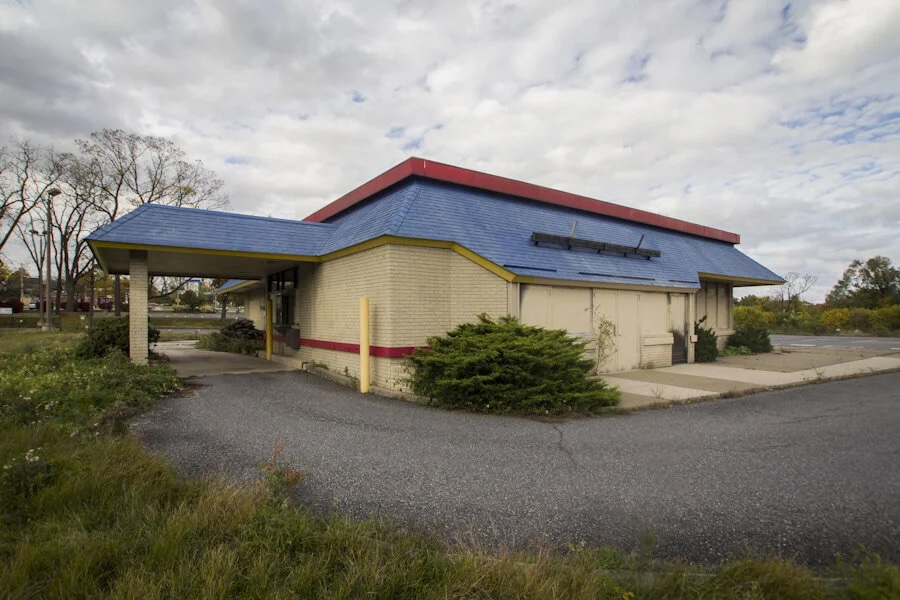
Photo: RonnySalerno.com
The golden arches are dimming. Across America, thousands of fast-food restaurants are shuttering their doors, and while the corporate press frames this as a routine market adjustment, the reality is far more troubling. These closures represent the visible edge of an economic fracture that traditional metrics are designed to hide — and by 2027, the hidden recession already crushing working-class families will become undeniable.
The fast-food industry has long served as the economy's canary in the coal mine. When times get tough, consumers "trade down" from expensive sit-down restaurants to cheaper drive-thru options. But the current wave of closures tells a different story: the bottom is falling out entirely. Lower- and middle-income households are so financially exhausted that they can no longer afford to "trade down" at all. They're eating at home, maxing out credit cards, and dropping out of the consumer economy that fast food depends on.
This isn't a story about corporate greed or poor management. It's a story about math — the brutal arithmetic of an economy where the cost of everything has skyrocketed while wages for the bottom 70% have stagnated. Restaurant operating costs have jumped 36% to 40% compared to pre-pandemic levels. Food commodities are up 34%, labor costs have surged 39%, and energy, maintenance, and insurance have all followed suit. Fast-food chains operate on razor-thin margins of just 3% to 9%. When their input costs explode, they have no choice but to raise prices — and when their core customer base can no longer afford those prices, the stores close.
The K-Shaped Economy: Two Americas, One Dashboard
The official economic metrics tell a story of resilience. GDP is growing. Unemployment sits near 4%. Corporate profits are strong. But these numbers are mathematical illusions created by a deeply divided economy — what economists call a "K-shaped" recovery. The top leg of the "K" includes wealthy asset-holders whose stock portfolios and home values have appreciated. They continue spending on luxury goods, travel, and premium services. The bottom leg includes working-class families crushed by cumulative inflation, record-high credit card interest rates exceeding 21%, and a housing market that has priced them out of basic stability.
This divergence explains why the headline numbers look stable while Main Street crumbles. The top 10% of earners now account for roughly 49% of all consumer spending. If the wealthy increase their spending by 15% while the bottom 50% cuts their food budget to zero, the GDP metric still goes up. The aggregate number shows "economic resilience" purely because the top leg of the economy is heavy enough to lift the average.
The Proxy Indicators: Reading the Real Economy
If you want to understand where the economy is actually heading, you have to look past the lagging, distorted government metrics and track the non-obvious proxies that measure physical economic activity. These indicators are un-fakeable — they track real volume, real physical movement, and real financial distress. And right now, they are all flashing red.
- The Cardboard Box Index: Corrugated containerboard capacity has been slashed by nearly 10% as producers permanently retire mills. Since 75% of non-durable goods travel in cardboard boxes, this predicts a sharp decline in physical retail volume within 3 to 6 months.
- RV Shipments: The RV Industry Association slashed its wholesale forecast by 35,000 units as monthly shipments tumbled over 18% year-over-year. The middle class is out of discretionary credit.
- Small Business Bankruptcies: Subchapter V restructurings have skyrocketed by 50% to 67%, with retail, food service, and transportation suffocating under high interest rates and a 4.8% household debt delinquency rate.
- Commercial Real Estate Debt: Roughly $875 billion in commercial real estate debt is scheduled to mature, with office CMBS delinquency rates approaching 9.7%. More than half of these loans are unlikely to qualify for refinancing.
The AI Mirage and the GDP Distortion
One of the most dangerous illusions in the current economy is the artificial intelligence capital expenditure boom. Tech conglomerates are funneling hundreds of billions of dollars into data centers, microchips, and infrastructure. In traditional accounting, this counts as "economic growth" — it injects massive numbers into GDP calculations, making the economy look like it's booming.
But this spending creates massive value for a few tech companies and their wealthy shareholders while generating comparatively few middle-class jobs. It's happening alongside significant corporate tech layoffs and hiring freezes for entry-level graduates. The historical parallel is the 1990s fiber-optic boom, where massive infrastructure investment vastly outpaced consumer monetization — followed by a sharp correction when investors realized the revenue wasn't coming.
By mid-2027, corporate boards will demand to see profits from these massive AI investments. When the software fails to generate enough revenue to justify the expenditures, tech monopolies will aggressively slash their capital budgets. Because this tech spending has been single-handedly bloating the nation's production figures, its sudden halt will cause aggregate GDP growth to officially contract.
The Timeline: From Proxy Pain to Official Recession
Economic pain always flows from the bottom up. The working class is already living in a functional recession — they've been there for years. By 2027, the rest of the economy will finally catch up.
Phase 1: NOW (2026)
Working-class consumers hit the wall. Fast-food closures accelerate. Credit cards are maxed. Black unemployment reaches recession levels while headline numbers stay low.
Phase 2: Late 2026 – Early 2027
Middle-class savings deplete. RV shipments collapse, travel cools, and mid-tier retailers feel the squeeze. Commercial real estate defaults begin to surface.
Phase 3: Mid-to-Late 2027
AI capex halts, tech stocks correct, and white-collar layoffs begin. The $875B CRE debt wall triggers a credit freeze. Headline unemployment spikes. The recession becomes official.
The corporate stock market and AI capital spending are acting as a temporary lid, keeping the traditional aggregate metrics looking artificially inflated. But on the ground, the closing of fast-food restaurants is concrete, undeniable proof that the foundational engine — the American consumer — is running on empty.
The Invisible Jobless: Underemployment and the U-6 Rate
The official unemployment rate of 4% completely masks the reality of underemployment and workforce dropout. The U-6 rate — which includes part-time workers who want full-time hours and discouraged workers who have stopped looking — paints a much darker picture at over 8%. Millions of people are working two or three part-time gig jobs just to make rent, or have given up looking entirely because wages don't cover the cost of childcare and transportation.
THE LABELED ECONOMY VS. INDIVIDUAL REALITY
The Black unemployment rate has climbed past 7% for most of 2025 and 2026 while white unemployment sits around 3.6% to 3.7%. This 2-to-1 ratio has persisted for decades, and it acts as a canary in the coal mine — marginalized communities are hit first and hardest when the economy shifts down. When these segments face a 7%+ jobless rate, it's a warning sign of broader, unmeasured stress that will eventually spread upward.
Why Traditional Metrics Hide the Truth
Traditional economic metrics were designed nearly a century ago for a uniform, industrial economy. Today, they fail to reflect the modern world for four structural reasons:
- Disproportionate Spending Weight: GDP tracks total spending but doesn't care who is spending. If the top 10% increase luxury spending by 15% while the bottom 50% cuts food spending to zero, GDP still goes up.
- Inflation Illusion: If a restaurant sells 100 burgers at $5 ($500 revenue) but inflation forces prices to $10 while losing 40% of customers (60 burgers sold), revenue becomes $600 — a 20% "growth" boom on paper, but a 40% drop in real physical volume.
- Binary Employment: The U-3 rate treats a $200,000 software engineer exactly the same as a worker forced into two part-time gig jobs with no benefits. Millions of underemployed workers make the labor market look "historically tight" while families are financially suffocating.
- CPI Substitution Bias: When steak prices rise 50%, the government assumes consumers will buy cheaper ground beef instead — and swaps the item in its calculation basket. This understates inflation while completely ignoring the erosion of standard of living.
The Bottom Line
The closing of thousands of fast-food restaurants isn't a sign of a healthy market correction — it's the visible smoke from an engine room fire. The proxy indicators are tracking structural damage right now that will inevitably break the dashboard numbers by 2027.
This isn't a sudden 1929-style crash. It's something potentially more destabilizing: a slow-motion train wreck that hits the vulnerable first, works its way through the gears of the economy, and eventually brings down the entire track. The working class is already living in a functional recession. By 2027, the rest of the country will join them.
The question isn't whether a recession is coming — the proxies have already answered that. The question is whether we'll recognize the signs before the headline metrics finally admit what millions of Americans already know: the economy stopped working for most of them a long time ago.
No Ads. By Us. For Us.
This article was made possible by readers like you. We hope it inspired you to support Emerald Book, so we can continue producing content like this.
We will never show you ads, sell your data, or require a subscription to consume our content. Your gift helps us keep the truth accessible.
Click the Support button to give a gift of any amount today.
Thank you for making this work possible.