

Emerald Pages
◆
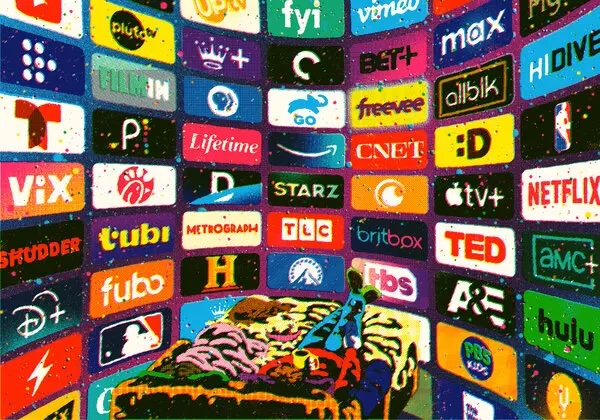
Photo: Lia Sued C. | The New York Times
The economics of streaming do not merely influence the quality of movies and television; they mathematically guarantee a lower average quality. In economic terms, this is a textbook example of misaligned incentives: when a company's revenue is completely uncoupled from the quality of its individual products, the structural motivation to make those products excellent disappears. Silicon Valley's disruption of Hollywood has, in essence, replaced a high-risk, high-reward art business with a low-risk, zero-upside tech utility, and the audience has lost in the process.
Tech giants like Netflix, Amazon, and Apple didn't enter the entertainment industry because they loved cinema; they entered it to acquire user data, lock consumers into broader ecosystems, and maintain a constant stream of subscription revenue. By forcing a century-old creative industry to follow the laws of software engineering, streaming disruption broke the traditional entertainment model in several irreversible ways.
The "Retention vs. Attraction" Trap
The fundamental shift is the move from a transactional model to a utility model. In the traditional system, a studio's revenue was directly tied to the specific success of a project—theater tickets sold, DVD purchases, or advertiser dollars driven by weekly ratings. If a movie or show was great, it made more money. The streaming subscription model completely breaks this incentive structure.
Because users pay a flat monthly fee, a platform makes the exact same amount of money whether a subscriber watches a transcendent, high-art masterpiece or 40 hours of cheap reality television. The primary goal is simply to keep users from hitting the "cancel subscription" button. To prevent churn, platforms do not need to provide excellent television; they just need to provide a constant stream of "good enough" content to keep users pacified. This is the rise of "Ambient Media"—content engineered to be watched while scrolling on a phone, prioritizing predictability over artistic risk.
The Death of Syndication and the "3-Season Curse"
The financial incentives that once drove creators to craft timeless work have been erased. In traditional television, creators, writers, and actors were highly motivated to make a show a classic because of syndication. If a show like The Fresh Prince of Bel-Air or Living Single hit 100 episodes, it could be sold into reruns for decades, generating massive wealth through residuals.
Streamers, however, use "cost-plus" models, buying out long-term rights upfront. Creators get a bigger paycheck on day one, but they receive almost nothing later, regardless of the show's success. This removes any financial incentive to make something that stands the test of time.
This explains the infamous "3-season curse." Season 1 brings in new subscribers. Seasons 2 and 3 retain them. By Season 4, a show rarely brings in anyone new, but production costs and cast salaries have risen. Because the platform cannot sell extra tickets for Season 4, a successful, high-quality show becomes a financial liability. It is mathematically better for their bottom line to cancel it and launch a cheap, new reality show that might attract a different batch of subscribers. It is a complete inversion of how Hollywood operated for a century.
How the Algorithm Killed the "Mid-Budget" Film
Because streamers track exactly how users watch, data algorithms heavily influence what gets greenlit. Studios realized that high-concept, deeply artistic shows require intense focus. Passive, formulaic content allows users to multi-task. The metric of success is often the "completion rate"—how many users finish a season within 28 days. Complex, challenging narratives often have lower completion rates than predictable, binge-able formulas, leading to the cancellation of superior art in favor of high-volume filler.
- Loss of the "Second Window": Streaming killed the physical media market. Without DVD/VOD revenue, studios only take theatrical risks on massive IP like superheroes, effectively killing the mid-budget drama or comedy.
- IP Over Star Power: A decade ago, movies were sold on the charisma of actors. Today, the intellectual property (Marvel, Star Wars) is the star, with acting and dialogue often treated as secondary to franchise world-building.
- Writing for the Scroll: The "mini-room" system drafts entire seasons in weeks, resulting in scripts filled with filler and cliffhangers designed to trigger the "Next Episode" autoplay, rather than delivering a satisfying, self-contained story.
The Irony: Rebuilding Cable
The ultimate irony of this disruption is that after a decade of trying to replace Hollywood, tech-driven streaming services spent the mid-2020s introducing commercial breaks, launching bundled packages, and embracing weekly release schedules. They didn't actually invent a better version of entertainment—they just reinvented cable television, stripped it of its artistic quality, and ruined the financial ecosystem that made great storytelling possible in the first place. By 2026, the tech-fueled thesis that streaming could expand infinitely has collapsed, leading to subscription plateaus, massive budget cuts, and a desperate reliance on ad-supported tiers.
The model naturally rewards the cheapest possible content that still manages to prevent a cancellation. When content is treated as a cheap commodity, consumers lose patience with slow-burn storytelling and artistic risks, accelerating the demand for low-effort filler. The industry is learning the hard way that while an algorithm can accurately measure a "completion rate," it cannot manufacture the cultural relevance, prestige, and long-term value that only high-quality filmmaking can create.
No Ads. By Us. For Us.
This article was made possible by readers like you. We hope it inspired you to support Emerald Book, so we can continue producing content like this.
We will never show you ads, sell your data, or require a subscription to consume our content. Your gift helps us keep the truth accessible.
Click the Support button to give a gift of any amount today.
Thank you for making this work possible.