

Emerald Pages
◆
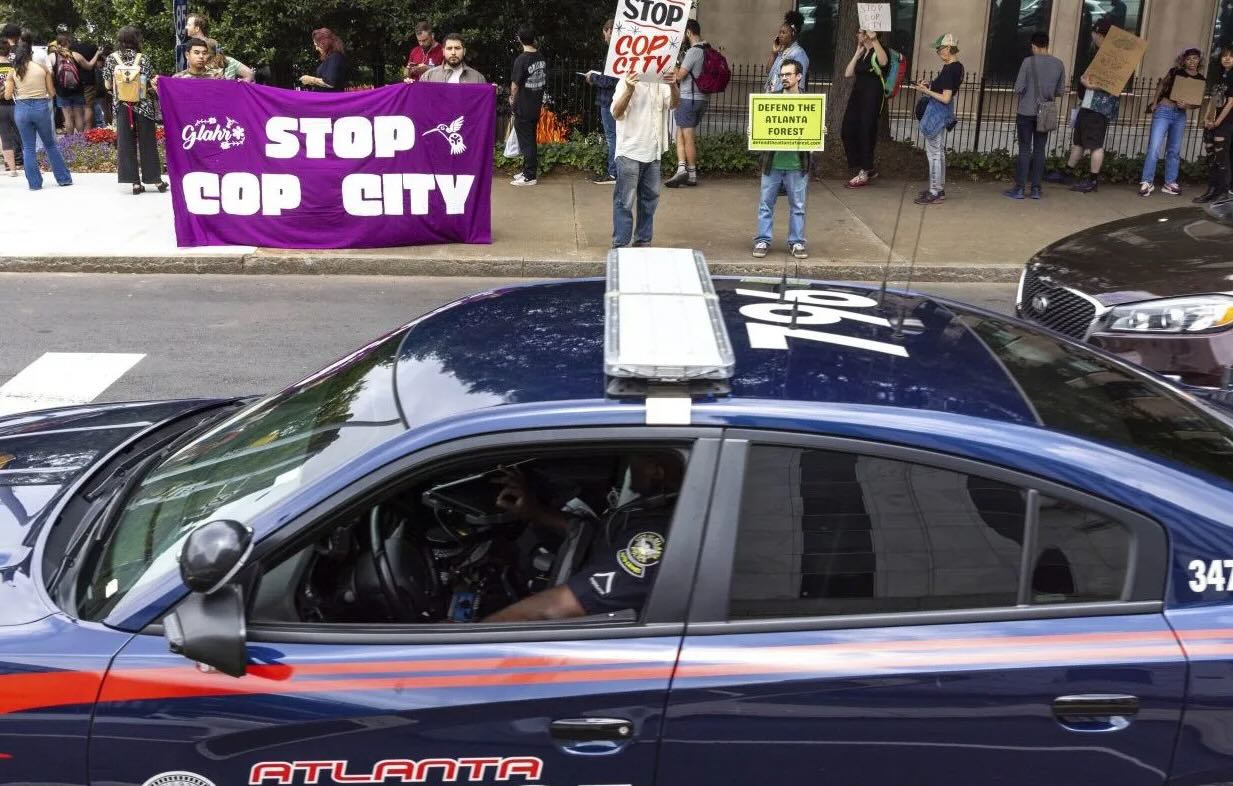
Photo: The New York Times
Tucked into 85 acres of unincorporated DeKalb County, the Atlanta Public Safety Training Center — better known as "Cop City" — opened its doors to much fanfare from city officials in April 2025. But what looks like a state-of-the-art police training facility with mock city blocks, simulated burn buildings, and virtual reality classrooms is, according to many civil rights advocates and investigative journalists, something far more ominous: a live laboratory where AI-driven policing systems are being trained on the Black residents of Atlanta's west and south sides before being exported to police departments across the country.
The facility is the physical hub of a sprawling surveillance infrastructure that has been quietly built over nearly two decades. At its core is "Operation Shield," a public-private partnership launched in 2007 by the Atlanta Police Foundation that has grown into one of the densest surveillance networks per capita outside of China. Today, the system taps into over 60,000 public and private cameras, license plate readers, and real-time crime center data feeds — all heavily concentrated in Atlanta's predominantly Black neighborhoods.
The technology driving this network is primarily supplied by Axon Fusus, a centralized AI surveillance platform that is already deployed in more than 200 communities across America. Investigative reporting from Capital B News documents that the machine-learning baselines perfected using Atlanta's disproportionately surveilled Black communities are embedded directly into the software updates pushed to police departments from California to New York.
The Four-Step Bias Pipeline
There is a clear, four-step pipeline that begins with the over-surveillance of Atlanta's Black neighborhoods and ends with the nationwide deployment of racially biased algorithms.
- Step 1: Live Testing — Massive camera grids are heavily concentrated in Atlanta's Black neighborhoods, tracking residents' daily movements, vehicles, and behaviors.
- Step 2: Biased Training Data — AI systems feed on this lopsided tracking data, mistaking "more surveillance" for "more crime" and learning to associate normal activities in these communities with suspicious behavior.
- Step 3: Codified Systemic Bias — The algorithm hardwires these racially skewed patterns into its code, presenting them as objective, mathematical science.
- Step 4: National Export — The perfected AI model and tactical training are packaged and shipped to police departments nationwide through commercial software contracts.
Garbage In, Garbage Out
The fundamental problem, experts warn, is that the AI is only as good — or as biased — as the data it's trained on. Because the camera networks and license plate readers are disproportionately placed in Black neighborhoods, the AI learns that those communities are "high-risk" simply because they are heavily surveilled.
This creates a dangerous "feedback loop": the AI directs officers back to the same over-policed neighborhoods, they find more crime there (because that's where they're looking), and the AI becomes more convinced that those areas are dangerous. As civil rights advocates have noted, this process effectively "launders" human bias through an algorithm, giving discriminatory policing the appearance of objective science.
The problem is compounded by well-documented racial biases in facial recognition technology, which misidentifies Black and brown faces at significantly higher rates than white faces. When these systems are linked to thousands of cameras, it inevitably leads to a higher volume of wrongful stops, detentions, and aggressive police encounters for innocent Black and brown residents.
A Lab Without Consent
What makes the situation particularly troubling is the lack of democratic input from the people most affected. The "Cop City" facility sits in an unincorporated section of DeKalb County, meaning the residents living next door have no voting representation on the Atlanta City Council that pushed the project through despite widespread public opposition.
Local residents report navigating a daily gauntlet of AI-enabled cameras that track their vehicles, scan their movements, and flag "suspicious behavior" in real time — even when no crime has occurred. They are subjected to this data extraction without their consent, serving as unwitting test subjects for systems that will ultimately be deployed in other cities across the nation.
The National Rollout Is Already Happening
This is not a future threat. The Justice Department estimates that approximately 90% of law enforcement agencies in the United States are now utilizing some form of AI. Axon Fusus, the central platform powering Atlanta's surveillance grid, is already deployed in more than 200 cities. Its public safety AI revenue has skyrocketed, with multi-million dollar software bundles expanding into departments from California to Washington.
When a police department in another state buys this AI software, they are buying a system whose baseline definition of "suspicious behavior" was trained on Atlanta's data. The algorithm will automatically flag traits, vehicle types, and movement patterns common in minority communities as "high risk" — regardless of the actual context in the new city.
This creates a highly dangerous pipeline. A policing algorithm that is fine-tuned within a heavily surveilled, majority-Black ecosystem in Georgia will inevitably retain those biased baselines when it is deployed to scan communities in New York, Chicago, or Los Angeles. The biased algorithmic baselines refined in Atlanta are systematically becoming the national standard for American policing.
No Ads. By Us. For Us.
This article was made possible by readers like you. We hope it inspired you to support Emerald Book, so we can continue producing content like this.
We will never show you ads, sell your data, or require a subscription to consume our content. Your gift helps us keep the truth accessible.
Click the Support button to give a gift of any amount today.
Thank you for making this work possible.