

Emerald Pages
◆
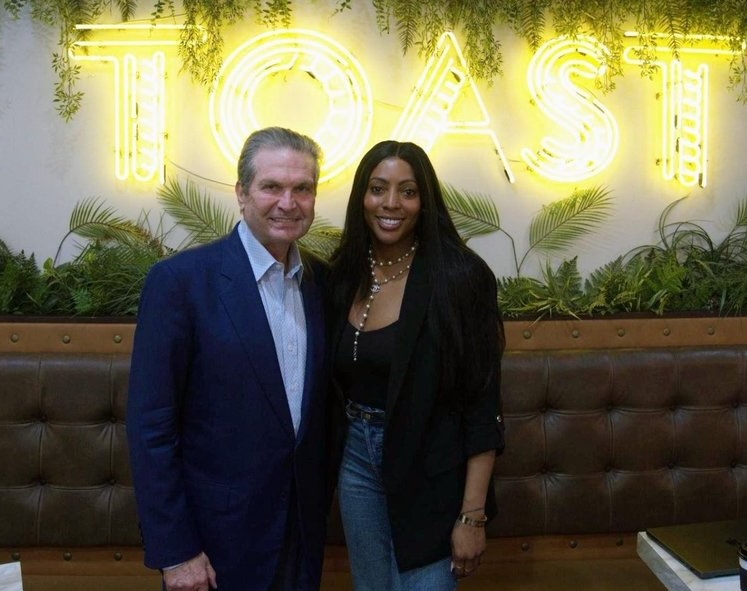
Photo: Rick Jackson | X.com
In a city as politically charged as Atlanta, optics are everything. So when a photo surfaced of Tamara Young, co-owner of the iconic Black-owned brunch spot Toast on Lenox, smiling next to Republican gubernatorial nominee Rick Jackson, the backlash was immediate, fierce, and entirely justified. While the owners have since tried to downplay the image as a simple act of "customer service," the damage is done. By allowing herself to be used as a political prop for a candidate who openly compares himself to Donald Trump—a figure widely viewed as the biggest threat to Black progress in modern history—Young didn't just make a business misstep; she broadcast a dangerous message of weakness to the community that built her brand.
Let’s be clear: no one is arguing that a public restaurant should turn away paying customers. The issue is not that Rick Jackson and his team were seated and served at Toast on Lenox. The issue is that the owners voluntarily paused to pose for a promotional photograph, a move that handed a MAGA-aligned candidate invaluable political currency. Rick Jackson, who has explicitly vowed to be "Trump with a Southern tone," immediately weaponized the image, posting it on social media with a caption praising Young's business success as an example of the "opportunity" he wants to fight for as governor. It was a classic bait-and-switch, using a beloved Black institution to project a false image of inclusivity while running on a platform that historians and political analysts have repeatedly linked to policies that historically harm Black communities.
The response from Toast on Lenox co-owners Tamara Young and Virgil Harper was a masterclass in damage control that missed the point entirely. In their official statement, they claimed that hosting the event was an act of customer service and that any political claims made by the candidate "do not represent our personal beliefs." This passive, neutral stance is precisely the problem. In an era where Black communities are under constant assault—from voter suppression laws to attacks on critical race theory and economic disparity—a refusal to condemn a harmful political agenda is, in itself, a political act. It signals a willingness to be a prop for anyone who walks through the door, regardless of the damage they do to the community.
Critics on social media were quick to point out the hypocrisy. "A discussion is not a vote!!!" co-owner Virgil Harper defensively posted, trying to deflect the outrage. But this is a willful misreading of the public's anger. It’s not about who she voted for; it’s about allowing herself to be used as a political weapon. Black people need to stop allowing themselves to be props for politicians that do not have their best interest in mind. It looks like weakness. The image of a successful Black business owner, a pillar of the Atlanta community, grinning next to a man who champions policies that exacerbate the racial wealth gap and undermine voting rights, is a demoralizing sight. It projects a lack of strategic boundary-setting and a willingness to prioritize momentary, superficial gain over the long-term political and economic health of the community.
The argument that this was simply "hospitality" doesn't hold water. We are not talking about serving a meal; we are talking about stopping to participate in a carefully staged political production. By allowing Jackson to take and post that photo, Young handed him a powerful tool. He and his campaign were able to use the image to tell his base and swing voters that he has support from Black business leaders. This is the oldest trick in the political playbook, and it is deeply irresponsible for a community leader to be complicit in it without a single concession or policy commitment.
The Broader Betrayal of Trust
For many in the Atlanta community, the Toast on Lenox controversy is a painful example of a larger trend: Black-owned businesses being used as backdrops for political photo-ops that deliver nothing in return. When a candidate like Rick Jackson, who has spent over $100 million of his own money on a campaign built on a platform of divisiveness, can walk into a cultural staple and walk out with a smiling photo, it reinforces the idea that our spaces are easily bought. It signals that access to our community is cheap. This is particularly egregious in a city like Atlanta, which has a rich history of using economic power as a tool for political accountability.
- Failure of Optics: In a politically active city like Atlanta, a high-profile Black owner should have known that a smiling photo with a MAGA candidate would be weaponized. Ignorance of political optics is not a defense.
- Failure of Leverage: By granting a photo-op without demanding explicit policy commitments, the owners failed to extract any political or economic value for the community in exchange for their platform.
- Failure of Principle: The refusal to condemn a candidate's politics—specifically his comparison to Donald Trump—signals a troubling lack of principle and a prioritization of perceived neutrality over clear community advocacy.
The viral boycott movement that has erupted is not an overreaction; it is a necessary act of economic self-defense. The local community is sending a clear message: we will not be used as props. As the Georgia general election approaches, with Rick Jackson facing off against Democrat Keisha Lance Bottoms, the stakes could not be higher. Black voters are facing a clear choice: one candidate aligned with a vision of progress and inclusion, and another aligned with a vision of division and regression. The owners of Toast on Lenox may have thought they were staying out of politics, but by smiling for that photo, they made a political statement, loud and clear. The resulting backlash is a direct consequence of that poor judgment.
A Call for Accountability
This controversy serves as a critical teachable moment for Black business owners and community leaders everywhere. The era of political neutrality is over. When a politician whose policies are detrimental to the Black community seeks to use your establishment as a backdrop, the only acceptable response is a firm and unequivocal refusal. There is a world of difference between serving a meal and serving as a political prop. The former is business; the latter is a betrayal.
Tamara Young and Virgil Harper could still salvage this situation. A genuine, unqualified apology for the harm caused by the photo, combined with a direct condemnation of Rick Jackson's policies, would begin the long process of healing the rift they've created. They must acknowledge that they allowed themselves to be used, and pledge that it will never happen again. The community is watching. Our power lies in our unity and our ability to control our own narrative. We must never cede that power to politicians who seek to use us for their own gain, only to ignore us once the votes are counted. The lesson is simple: don't take the picture. It makes us look weak, and our strength is the only thing they truly fear.
It is a painful reality that we have to have this conversation in 2026. That our community is still fighting for basic respect and for politicians to see our humanity, not just our vote, is a tragedy. But it is a fight we must win. And it starts with saying "no" to the cameras, "no" to the cheap photo-ops, and "yes" to the principled, organized, and strategic political power that we have always possessed.
No Ads. By Us. For Us.
This article was made possible by readers like you. We hope it inspired you to support Emerald Book, so we can continue producing content like this.
We will never show you ads, sell your data, or require a subscription to consume our content. Your gift helps us keep the truth accessible.
Click the Support button to give a gift of any amount today.
Thank you for making this work possible.