

Emerald Pages
◆
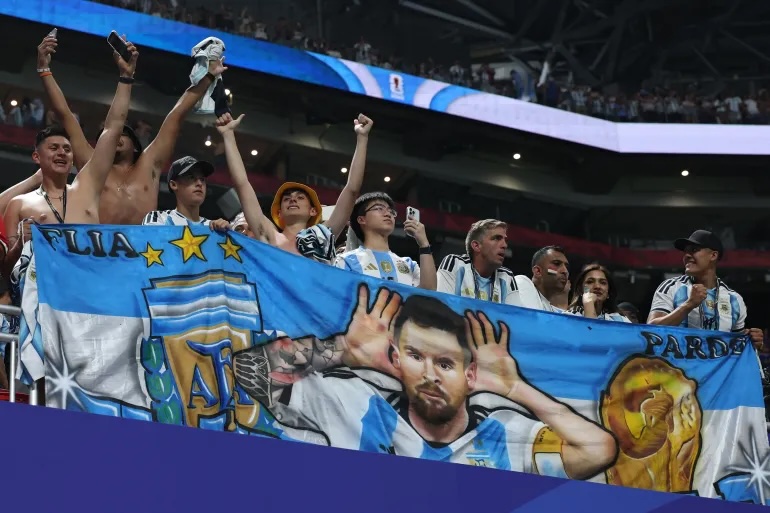
Photo: AThomas Coex | AFP
I t was supposed to be a moment of national pride. On July 3, 2026, Argentina's Round of 32 match against Cape Verde was underway in Miami. But for millions watching, the focus shifted from the pitch to a viral video. An Argentine fan, caught on a live stream with the popular Black American streamer iShowSpeed, was recorded shouting, "Go cry to the zoo." Just four days later, during a match against Egypt, another Argentine supporter was filmed making monkey-like gestures at the same streamer.
These incidents were not isolated. FIFA officially launched investigations, while Cape Verdean and Egyptian fans reported a "flood" of racist abuse, including racial slurs and having beer bottles thrown at them. For many, it was a breaking point. The question, however, has less to do with a few rogue fans and more to do with a deeply ingrained cultural pathology that has been decades—if not centuries—in the making. As Argentina charges forward in the tournament, its shadow is growing longer, revealing a nation grappling with a legacy of white supremacy that has been systematically baked into its national identity.
The 2026 tournament is merely the latest flashpoint. A closer look reveals a chronic, uninhibited pattern of racism that has followed the Argentine national team across the globe. During the 2022 World Cup in Qatar, the infamous "France Chant"—a song mocking the African heritage of Kylian Mbappé and other Black French players—first went viral. The controversy exploded in 2024 when Chelsea midfielder Enzo Fernández was filmed singing it, sparking legal action from the French Football Federation. Rather than a full-throated condemnation, Argentina's Vice President defended the chant as an attack by "colonialist" bullies, and President Javier Milei fired the Undersecretary of Sport for suggesting the team apologize.
A Legacy of Erasure
To understand the fervor of the chants and the casual cruelty of the monkey gestures, one must understand how Argentina erased its Black population. Unlike the violent Jim Crow segregation of the United States, Argentina pursued a "demographic and cultural erasure." In the early 1800s, Afro-Argentines made up roughly one-third of Buenos Aires. By the end of the century, that number had plummeted to less than 2%.
This was not a genocide by guns, but a systematic "whitening" (blanqueamiento) engineered by the state. Black men were disproportionately conscripted as "cannon fodder" during the Wars of Independence and the devastating War of the Triple Alliance, decimating the male population. Cholera and yellow fever epidemics ravaged the segregated, under-resourced tenements where Black communities lived. Meanwhile, the government aggressively subsidized the immigration of roughly 7 million Europeans (primarily from Italy and Spain), swamping the remaining Afro-descendant population.
The final nail in the coffin was bureaucratic. In 1887, the government removed racial categories from the national census. Afro-descendants were legally reclassified as "white" or "mestizo." This wasn't genocide by guns. It was erasure by paperwork. The national myth was born: Argentina had no Black people.
- Military Conscription: Black men used as front-line troops in 19th-century wars, leading to catastrophic casualty rates.
- Epidemics: Cholera and yellow fever disproportionately killed Afro-Argentines in segregated neighborhoods.
- Immigration: 7 million European immigrants flooded the country, diluting the Black population.
- Statistical Erasure: The 1887 census removed racial categories, making Black people "disappear" on paper.
This foundational myth—that Argentina is an exclusively white, European nation—is the bedrock upon which modern racism is built. When Argentine fans chant slurs or make monkey noises, they are often genuinely shocked when it is treated as a hate crime. In Argentina, such behavior is often dismissed as harmless "banter" (folclore del fútbol). The denial of racism is so deeply ingrained that many citizens truly believe they cannot be racist because "there are no Black people here."
The Nazi Sanctuary and the "Ratlines"
The reverence for European whiteness took a dark turn in the aftermath of World War II. Under President Juan Domingo Perón, Argentina became the world's largest haven for fleeing Nazi war criminals. Through clandestine "ratlines" facilitated by Perón's agents and sympathetic Catholic clerics, an estimated 5,000 Nazis escaped to South America, with Argentina taking in more than any other country.
The logic was purely economic and militaristic. Perón believed German scientists, engineers, and military minds could modernize Argentina's industry and help the country become a superpower. He actively recruited elite scientists like aircraft engineer Kurt Tank to build jet fighters. Meanwhile, top SS officials transferred millions in funds to Buenos Aires banks to establish a support network for fugitives.
Some of the Third Reich's most notorious figures lived openly in Argentina for decades. Adolf Eichmann, the architect of the Holocaust's logistics, lived under an alias in Buenos Aires, working at a Mercedes-Benz factory until Mossad agents abducted him in 1960. Josef Mengele, the "Angel of Death" from Auschwitz, fled to Buenos Aires in 1949, obtaining an Argentine passport under his real name. Erich Priebke, an SS commander responsible for the Ardeatine Caves massacre in Italy, lived for 50 years in the mountain town of Bariloche, even serving as the president of a local German school.
While Argentina is no longer a haven for living Nazis—most have died or been extradited—the cultural echoes persist. The current administration of President Milei has taken steps to unseal Nazi-era financial archives, granting the Simon Wiesenthal Center access to expose how banking networks financed the escapees. Yet the history of harboring white supremacists is frequently cited by sociologists when analyzing the roots of modern discriminatory behavior in Argentine sports and society.
A Long History of FIFA Sanctions
The pattern of racist behavior is not new to the World Cup. FIFA has repeatedly sanctioned the Argentine Football Association (AFA) for discriminatory conduct spanning more than a decade.
2022 World Cup: Following Argentina's victory over France, FIFA opened formal proceedings against the AFA for "offensive behavior," triggered by aggressive player celebrations and Emiliano Martínez's vulgar gestures.
2018 World Cup: Argentina was fined $105,000 after fans launched homophobic chants, threw projectiles, and assaulted Croatian supporters during a group stage match.
2026 World Cup Qualifiers: FIFA fined the AFA 120,000 Swiss francs for racist abuse during a match against Colombia in Buenos Aires. In a separate ruling for discriminatory chants against Ecuador and Uruguay, Argentina was forced to play its next home match with a 50% stadium capacity limit.
These sanctions reveal a systemic failure. Time and again, the "best fans in the world" are caught on camera engaging in racist abuse, yet the institutional response—both from the AFA and the government—remains one of denial and deflection.
The Weaponization of 'Negro'
In Argentina, the word negro operates with a distinct structural malice that combines classism with racism. Because the national myth holds that Afro-Argentines vanished, the term is weaponized against the poor, working-class citizens, domestic migrants, and dark-skinned Mestizo or Indigenous populations. Negros de mierda is a common slur used to dehumanize the underprivileged.
This conflation of poverty and non-whiteness was on display during a major diplomatic incident in May 2026. An Argentine tourist was arrested in Brazil for secretly photographing a seven-year-old Black boy on a train. He texted the photos to a contact with the caption: "He's Black but very cute. I could take him as a slave. I'm thinking of taking a slave, there are many here." Like the fans making monkey gestures at the World Cup, the defense was shock that the "joke" was not being treated as harmless.
The Modern Pushback
Labeling Argentina as uniquely racist overlooks a massive, growing internal movement fighting to dismantle this legacy. Afro-Argentine activist groups like Diafar and Afrodescendientes en Argentina have successfully fought to bring Black history back into school curriculums. In 2022, after more than a century of bureaucratic erasure, Argentina reintroduced the option to self-identify as Afro-descendant in its national census, forcing the state to legally recognize its diverse population.
Yet, the images from Miami and Miami-Dade—of fans hurling abuse and making monkey gestures—suggest that the battle is far from over. As the 2026 World Cup continues, Argentina may win on the pitch, but its reputation off it is increasingly tarnished by a deep-seated pattern of racism that has been decades in the making. The question is not whether Argentina has a racism problem—the evidence is overwhelming. The question is whether the nation will finally confront the ghosts of its past, or continue to pretend they do not exist.
No Ads. By Us. For Us.
This article was made possible by readers like you. We hope it inspired you to support Emerald Book, so we can continue producing content like this.
We will never show you ads, sell your data, or require a subscription to consume our content. Your gift helps us keep the truth accessible.
Click the Support button to give a gift of any amount today.
Thank you for making this work possible.