

Emerald Pages
◆
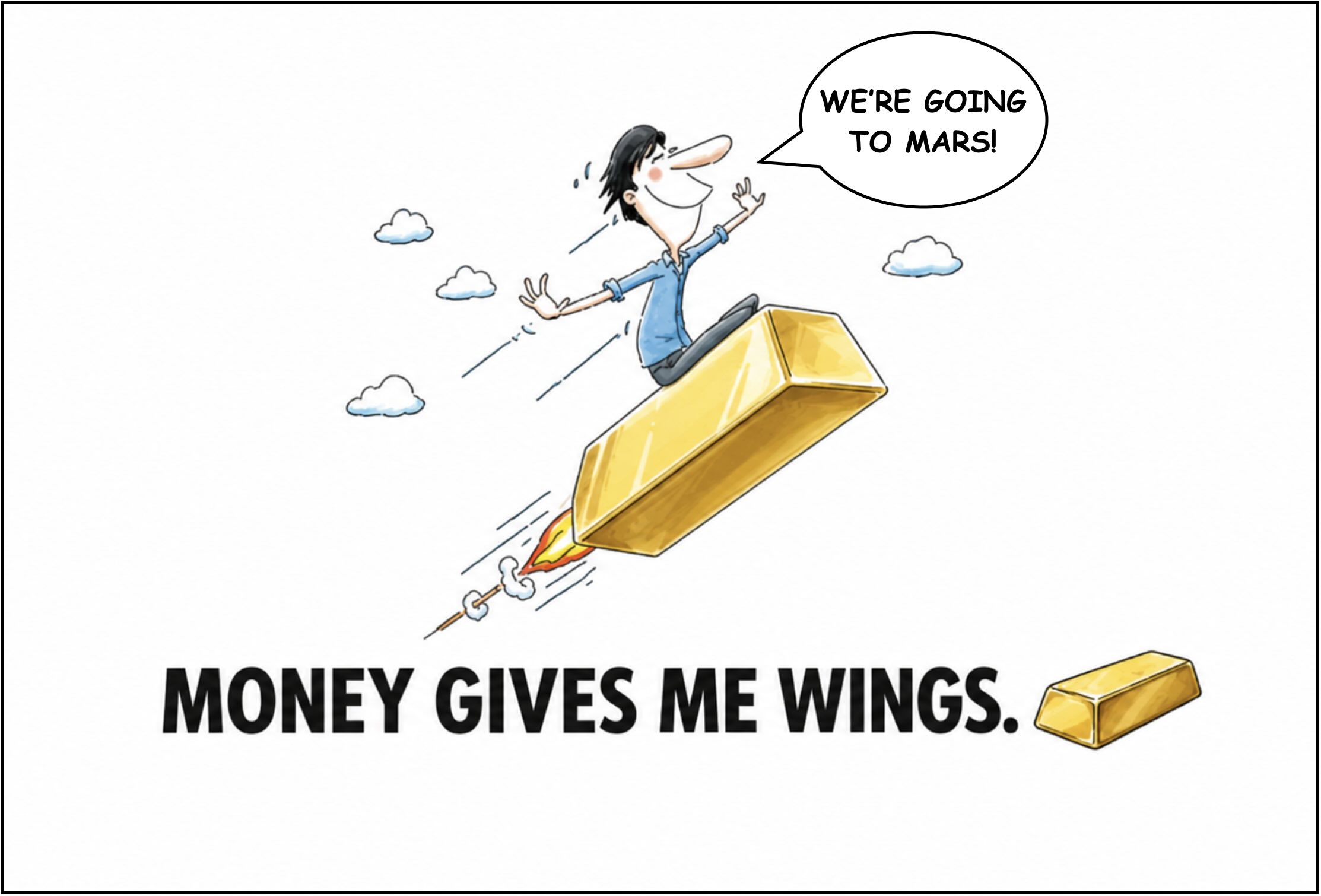
Photo: Emerald Book Graphic
Imagine you are playing a rigged game of Monopoly. You start with twice as much money, you roll two dice instead of one, and you inevitably win. When asked about your victory, you don't credit the unfair rules—you brag about your brilliant strategy. This is not just a game; it is a metaphor for how billionaires become disconnected from reality.
When people are given an unfair advantage, their minds unconsciously rewrite the narrative to credit their own intelligence and hard work. This psychological phenomenon, backed by a growing body of research, explains why billionaires so often develop a dangerous overconfidence that extends far beyond their actual expertise—into space colonization, brain-computer interfaces, and even the laws of thermodynamics.
A major study "The Social Advantage of Miscalibrated Individuals: The Relationship Between Social Class and Overconfidence and Its Implications for Class-Based Inequality" published in the Journal of Personality and Social Psychology put this theory to the test. Researchers tested thousands of people from different social classes on memory and cognitive skills. The results were striking: wealthier individuals consistently believed they had outperformed others, even when their actual test scores were completely average. This disconnect between self-perception and reality creates a powerful "illusion of competence" that becomes a self-fulfilling prophecy in social settings.
The Job Interview Trick: Confidence Over Competence
In a follow-up experiment, researchers simulated job interviews with the same participants. The wealthy individuals, radiating unearned confidence, were rated as more competent and hirable by the interviewers. Their outward certainty masked their actual skill level. This is not just a personal quirk; it is a systemic advantage. When billions of dollars give you the freedom to speak boldly and take risks, society often rewards that confidence as if it were genuine ability.
This "confidence trick" is one reason why billionaires frequently overstep into fields where they have no expertise. They are trapped in a psychological bubble where no one—not employees, not investors, not the media—is willing to say "no." The lack of pushback transforms ambitious thinking into delusional roadmaps, a pattern perfectly illustrated by Elon Musk's grandiose plans to colonize Mars and build AI data centers in space.
When Physics Meets the Billionaire Mind
Elon Musk’s plans to put a million people on Mars by 2050 and launch massive data centers into orbit are textbook examples of "billionaire-induced overconfidence." While Musk has hired talented engineers who undeniably revolutionized the rocket and electric car industries, his wealth has created a blind spot where complex biological and physical realities are treated as minor engineering challenges.
Consider the Mars colony. Musk envisions glass domes and daily Starship flights. Rocket scientists and biologists, however, call this timeline a fantasy. Space radiation will destroy human DNA, and months of zero gravity cause severe bone loss. Mars has no breathable air and its toxic soil is less hospitable than Earth after a catastrophic asteroid strike. Building a self-sustaining city there would take thousands of years—not a couple of decades. But in the billionaire's mind, sheer willpower and money can overcome biology.
The same delusion applies to space-based data centers. Musk claims that "space is always sunny," making solar energy free. But data centers generate massive amounts of heat. On Earth, we use air and water to cool computers. In the vacuum of space, there is no air to carry heat away; computers would literally melt unless wrapped in incredibly heavy radiators. If a chip breaks in orbit, you cannot send a repairman. The laws of thermodynamics and maintenance logistics do not bend to a billionaire's timeline.
The Economic Reality: Wealth Begets Wealth
This overconfidence is not just about space travel; it is baked into how billionaire wealth operates in our economy. The simple truth is that wealth is a function of wealth. Economist Thomas Piketty's famous formula, r > g, proves that the rate of return on capital almost always outpaces economic growth. In other words, money made from owning things grows much faster than money made from working a job.
- The Snowball Effect: Billionaires buy stocks, real estate, and businesses, which generate passive income that is reinvested to buy even more assets.
- Inherited Head Starts: Billionaire families can afford elite schools, provide powerful connections, and pass down fortunes, giving their children a massive advantage that has nothing to do with personal talent.
- The Racial Wealth Gap: Research from the Institute for Policy Studies confirms that the 400 richest Americans own more wealth than all Black households combined. This gap is not a reflection of intelligence or hard work, but of historical barriers and compounding generational wealth.
The data is clear: a Black individual with a college degree still faces systemic disadvantages compared to a white individual with the same degree. The system rewards existing assets far more than it rewards daily hard work. This is the economic bedrock upon which billionaire overconfidence rests.
The Moon: The Ultimate Reality Check
The folly of billionaire ambition is perhaps best summarized by the physics of a Moon colony. Musk and Bezos both talk about building permanent cities on the lunar surface, but the Moon is a death trap. It has no atmosphere and no magnetic field, leaving the surface naked to cosmic radiation. To survive, humans would have to live at least 10 feet underground, not in glass domes. The dust (regolith) is made of jagged shards of volcanic glass that destroys machinery and lungs. A single day lasts 28 Earth days, meaning two weeks of boiling heat followed by two weeks of freezing darkness.
And then there is the biology. Low gravity destroys bones, muscles, and even the heart. You cannot train your way out of fluid dynamics. Billionaires look at the Moon and see a financial frontier. Physicists look at the Moon and see a dead rock actively trying to kill anything that steps onto it.
The ultimate lesson is simple: nature does not care about bank accounts. Stock markets can be manipulated, laws can be lobbied, and people can be convinced of a fantasy. But gravity, thermodynamics, and radiation do not take bribes. The sooner society recognizes that billionaire wealth is not a proxy for competence, the better we can evaluate their grandiose and nonsensical promises.
No Ads. By Us. For Us.
This article was made possible by readers like you. We hope it inspired you to support Emerald Book, so we can continue producing content like this.
We will never show you ads, sell your data, or require a subscription to consume our content. Your gift helps us keep the truth accessible.
Click the Support button to give a gift of any amount today.
Thank you for making this work possible.