

Emerald Pages
◆
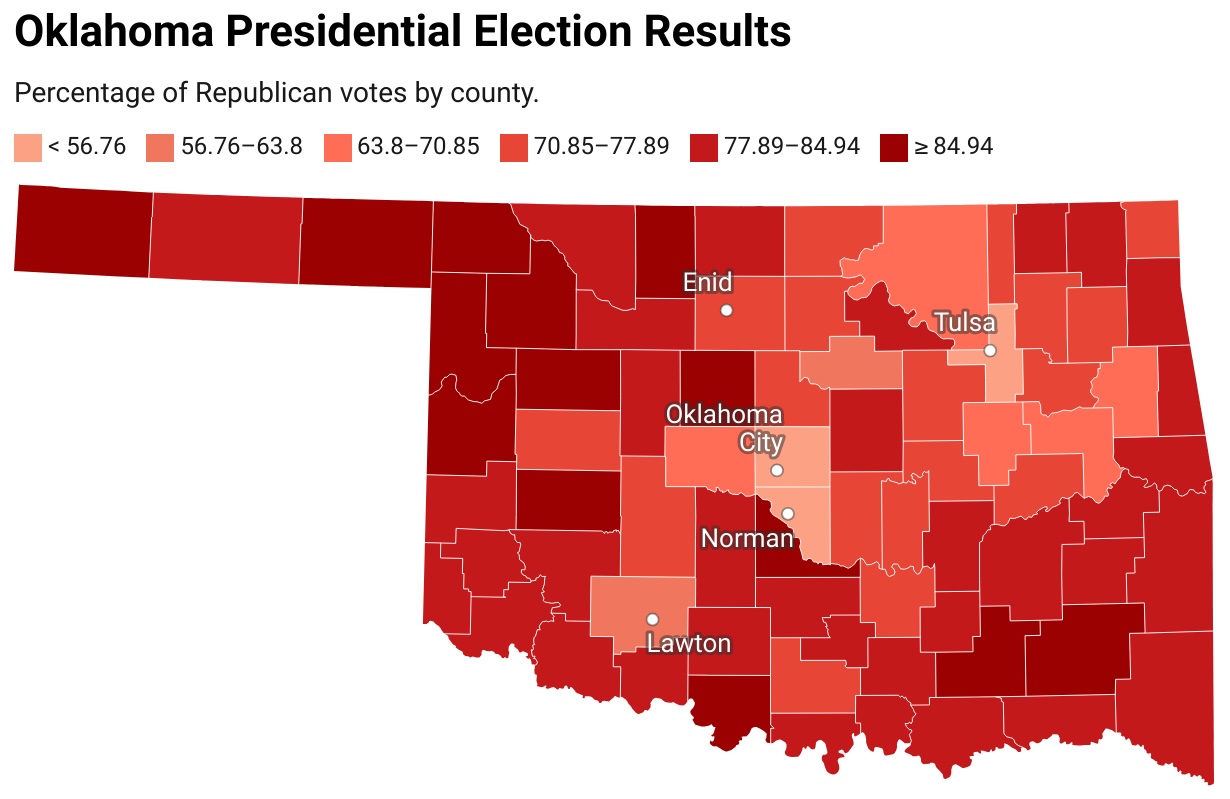
Photo: Kevin Eagleson | Gaylord News
On a humid June evening in 2026, Oklahoma voters made a decision that left economists scratching their heads and progressives throwing up their hands. State Question 832, which would have gradually raised the state's minimum wage from a stagnant $7.25 an hour to $15 an hour, went down in defeat. The outcome was decisive—and deeply revealing.
Here was a state that ranks 8th in poverty, 44th in household income, and 50th in education, voting against a policy that would have put more money directly into the pockets of over 230,000 working Oklahomans. To many outside observers, it looked like a textbook case of "voting against your own interests," a clear demonstration of blind political loyalty overriding basic economic sense.
But if you scratch beneath the surface of the election results, you find something far more complicated—and far more troubling—than simple stupidity. You find a state divided against itself, caught between two different versions of reality, and choosing to trust the warnings of their neighbors over the data of distant academics.
The Empire of Data vs. The Empire of Fear
The battle over State Question 832 was, at its core, a battle between two different ways of understanding the world. On one side stood the economists armed with empirical research—real-world studies showing that minimum wage hikes don't destroy jobs the way opponents claim. On the other stood rural voters, armed with little more than their own lived experience and a deep, gnawing fear that their fragile towns couldn't survive a sudden shock.
The empirical research is compelling. A landmark study published in the Quarterly Journal of Economics tracked what happened when states and cities actually raised their minimum wage. The results were clear: businesses didn't panic and fire people. Instead, they raised prices a tiny bit, workers had more money to spend, sales went up, and the whole system absorbed the shock. In real life, the sky did not fall.
But Oklahoma voters weren't looking at the real-world data. Or rather, they were looking at a different kind of data—the data of their own bank accounts, their own small towns, their own struggling neighbors. And that data told them a very different story.
The Oklahoma Divide: Two States in One
The election map told the story better than any poll. Oklahoma City and Tulsa—the state's two major metropolitan areas—voted overwhelmingly "Yes" on the minimum wage hike. But the rest of the state, the 59 rural counties that make up the vast majority of Oklahoma's landmass, voted "No." And because rural votes count just as much as urban ones, the "No" side won.
This wasn't a rejection of economics. It was a rejection of a one-size-fits-all solution to a problem that looks completely different depending on where you live. In downtown Oklahoma City, a $15-an-hour wage makes sense. The cost of living is higher, businesses are booming, and workers are already making close to that amount. To a town of 2,000 people in the Oklahoma panhandle, $15 an hour feels like an existential threat.
- The Urban Reality: Higher cost of living, strong business base, wages already approaching $15, greater economic resilience.
- The Rural Reality: Low cost of living, paper-thin business margins, no customer base to absorb higher labor costs, genuine fear of business closures.
- The Political Math: 59 out of 77 counties voted "No" despite the cities voting "Yes." Rural voters won the day.
Rural voters weren't rejecting the idea that workers deserve more money. They were rejecting the idea that their local diner, their hardware store, their bait-and-tackle shop could somehow afford to pay city wages when they could barely afford to stay open at $7.25. To them, a low-paying job felt safer than no job at all.
The Classic Republican Playbook
The campaign against State Question 832 followed a familiar script. Business groups, chambers of commerce, and Republican politicians warned that raising the minimum wage would trigger inflation, cause businesses to close, and ultimately hurt the very workers it was supposed to help. They pointed to the CBO's forecasts. They warned that a $15 wage was a "big city number" that didn't belong in rural Oklahoma.
What they didn't mention—or conveniently ignored—was that the empirical evidence from real-world experiments contradicted their warnings. They didn't mention that the same studies showed businesses simply raised prices slightly and that workers' increased spending covered the costs. They didn't mention that low-wage workers spend their extra money immediately, creating a cycle of economic activity that benefits everyone.
Instead, they leaned on the one thing that always works in deeply partisan states: trust. In Oklahoma, voters trust their Republican leaders. They trust their local business owners. They trust the warnings they hear on conservative media. They don't trust academic studies from Harvard.
And so, the classic Republican lie that raising the minimum wage would destroy jobs and cause inflation won the day. It's a lie that serves corporations perfectly—keeping wages low while profits soar—and it's a lie that voters in a poorly educated state are particularly susceptible to believing.
The Cost of Fear
The tragedy of the Oklahoma vote is that the state's most vulnerable workers will continue to struggle. Single mothers will continue working two jobs just to pay rent. Families will continue choosing between groceries and medicine. Young workers will continue to be trapped in a cycle of poverty because the bottom rung of the ladder is still stuck at $7.25 an hour.
The empirical evidence is clear: raising the minimum wage works. It lifts people out of poverty. It stimulates local economies. It doesn't destroy jobs. But in Oklahoma, fear won over evidence. The fear of change. The fear of the unknown. The fear that their fragile economy couldn't handle the shock. The irony of being 8th in poverty and being afraid it could get worse is almost too painful to articulate. Here was a state where one in seven people live below the federal poverty line, where nearly one in five children go to bed hungry, where households earn nearly 20% less than the national average—and yet the prevailing sentiment was that things could somehow get even worse if workers were paid a living wage. It's the logic of a drowning man refusing a life raft because he's afraid the boat might tip over.
The Oklahoma minimum wage vote is a case study in the power of misinformation, the danger of partisanship, and the tragedy of a poorly educated populace making decisions that hurt themselves. It's a demonstration that in the battle between data and fear, fear often wins—especially when the fear is carefully cultivated by those who profit from the status quo.
No Ads. By Us. For Us.
This article was made possible by readers like you. We hope it inspired you to support Emerald Book, so we can continue producing content like this.
We will never show you ads, sell your data, or require a subscription to consume our content. Your gift helps us keep the truth accessible.
Click the Support button to give a gift of any amount today.
Thank you for making this work possible.