

Emerald Pages
◆
Emerald Book Image
Stop for a moment and look closely at the next global event you watch. Whether it is the World Cup, the Olympics, the Super Bowl, or the Met Gala, ask yourself: what is the actual product being sold? The answer is not the sport, the art, or the celebrity. The true product is your attention. These events are not competitions—they are the world's most expensive and sophisticated advertising campaigns, and they have been designed from the ground up to capture the collective gaze of the human race.
This transformation did not happen by accident. Over the past several decades, a handful of corporate giants have systematically re-engineered every major cultural milestone into a commercial funnel. They have turned our celebration of human achievement into a multi-billion-dollar inventory, where the athletes, the artists, and even the fans are no longer the customers—they are the billboards. When you watch the World Cup, you are not watching a tournament; you are watching a 24/7 commercial for a select group of global brands.
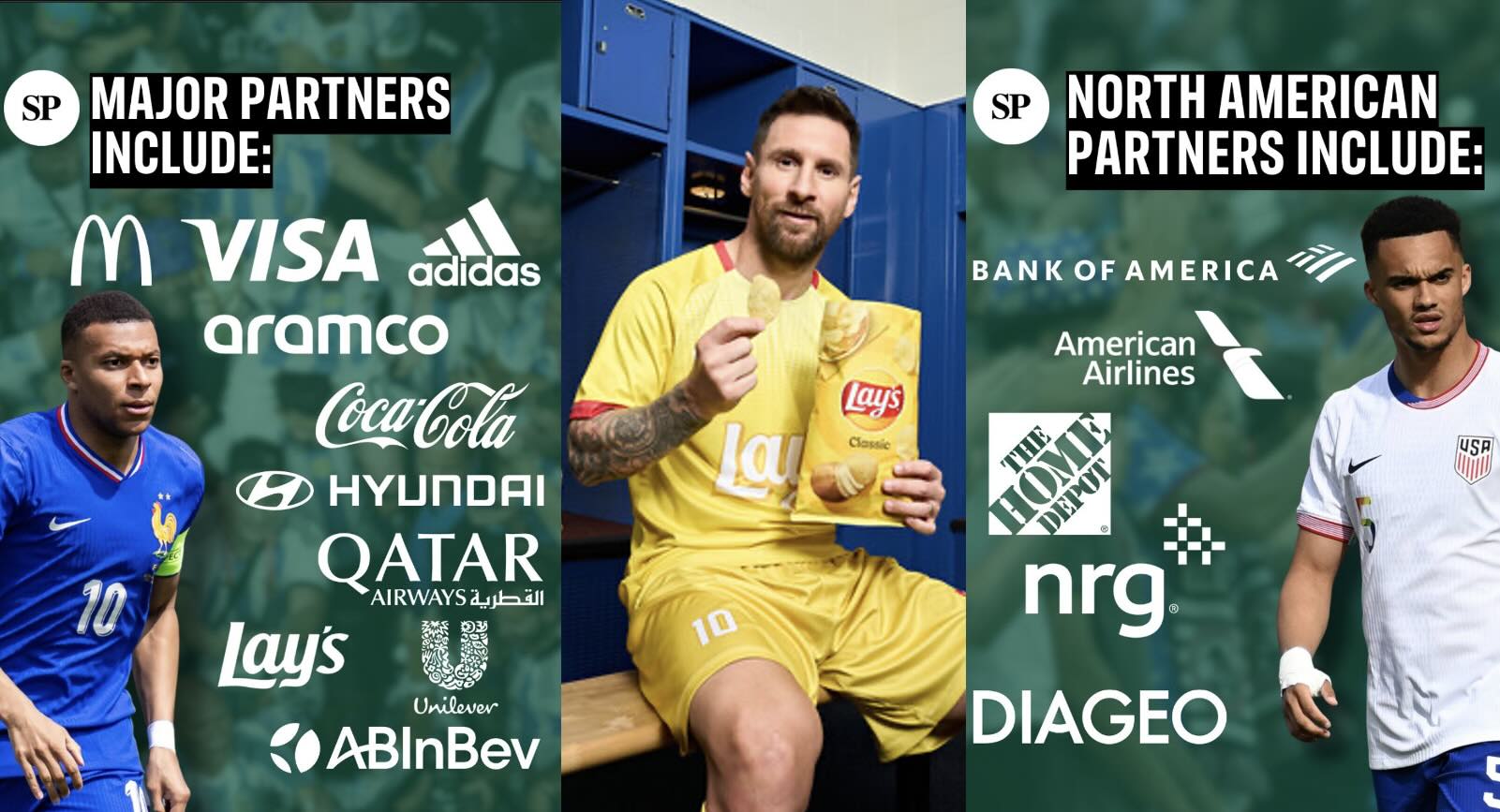
The financial blueprint is brutal in its simplicity. Consider the FIFA World Cup. FIFA is projected to generate a staggering $13 billion in revenue for the 2026 cycle—a 70% increase from the previous tournament. Where does this money come from? It comes from selling exclusive broadcast rights ($4.3–$5.3 billion) and elite sponsorship tiers ($150–$200 million per top partner). But here is the catch: FIFA takes all the revenue and passes all the operational costs onto host cities, leaving taxpayers to foot the multi-million dollar security and infrastructure bills while the corporations walk away with the profit.
A Universal Corporate Matrix
The same pattern repeats across every major event. The International Olympic Committee (IOC) operates on an identical model, generating over $12 billion in a four-year cycle through broadcasting rights and its elite "TOP" sponsorship programme. The Met Gala, meanwhile, functions as a curated promotional launchpad for luxury fashion houses, with LVMH spending over $160 million to anchor the Paris Olympics and secure a 10-year partnership with Formula 1. What we are witnessing is an interconnected web of the same money recycling through different venues.
- The World Cup: An advertising festival for mass-market consumer goods, airlines, and state-owned oil giants. The players are unpaid labor, and the federations keep the prize money.
- The Olympics: A global unity narrative sold to financial institutions, insurance giants, and logistics firms. Visa holds a literal payment monopoly inside every stadium.
- The Met Gala: A high-end fashion runway disguised as a charity event, funded by LVMH and other luxury conglomerates to promote their latest collections and films.
- The Super Bowl: The ultimate advertising festival, where brands pay $7 million for a 30-second spot and the game itself is merely the intermission between commercials.
- Formula 1: A billionaire's networking convention and moving billboard for tech infrastructure, luxury watches, and crypto exchanges.
The Power Players Behind the Curtain
The most remarkable aspect of this system is how concentrated the power is. Just five companies—LVMH, Coca-Cola, Visa, Nike, and Aramco—control an estimated 2.1% of the entire global advertising spend. While 2% sounds small, it represents over $22 billion funneled into a tiny handful of monocultural bottlenecks. These corporations do not just buy ad spots; they buy the entire ecosystem. They sponsor the event, the stadium infrastructure, the drinks, the apparel, and the VIP afterparties. They have built a closed loop where every angle of the camera captures their brand.
- LVMH: The ultimate cultural gatekeeper. They make the championship trophy trunks (Louis Vuitton), pour the celebration champagne (Moët), and time the races (TAG Heuer).
- Coca-Cola: The foundational bedrock of sports marketing, with continuous Olympic sponsorship since 1928. They buy "pouring rights," legally banning Pepsi from being sold inside official stadiums.
- Visa: The payment monopoly. Inside any official stadium, your Mastercard or cash is useless. You must use Visa, forcing millions of consumers into their transactional ecosystem.
- Nike: The world's ultimate attention engine. They bypass the event organizers to control the human beings on the stage, outfitting national teams and securing lifetime deals with the athletes who lift the trophies.
- Aramco: The state-owned energy giant using sports to pivot its public perception from oil extraction to global tech leadership, spending hundreds of millions per cycle.
By sponsoring both sides of the field, these companies have successfully hedged their bets against the uncertainty of sport. Nike sponsors one World Cup finalist; Adidas sponsors the other. No matter who wins, the winning athlete will be wearing one of their logos. The corporate winners are guaranteed before the match even begins. The house always wins.
The Mastery of the Attention Trap
The reason this works is because the trap has been perfected. These events do not feel like advertisements because they have been engineered to hook into our deepest psychological needs: our tribal pride, our fear of missing out, and our desire for collective euphoria. They trigger our dopamine by tying national identity to a Coca-Cola logo or a Nike shoe. They manufacture scarcity so that we feel compelled to watch live. They create a universal monoculture where, in a fragmented digital world, hundreds of millions of people are all looking at the exact same screen at the exact same time.
- Manufactured Scarcity: Events that happen only once a year or every four years trigger intense FOMO. You have to watch tonight, because tomorrow the matrix closes.
- The Tribal Reflex: By tying advertising campaigns to national pride, they ensure that criticizing the commercialism feels like criticizing your own community.
- The Emotional High-Jack: They don't sell product features; they buy the rights to human triumph. A logo permanently fuses itself to your euphoria in the moment of victory.
This is the ultimate corporate reality: the game is just the raw material for their marketing teams. If the favorite wins, they release a pre-packaged "Legacy of Greatness" campaign. If the underdog wins, they pivot to "Nothing is Impossible." They have written the scripts for every scenario months in advance. The athletes endure years of grueling physical labor, the fans experience intense emotional stress, and the taxpayers of the host cities shoulder the massive public debt. Meanwhile, the elite club of sponsors sits safely above the fray, harvesting the collective data, engagement, and money of billions of people.
When you watch the next global event, remember what you are truly witnessing. You are not celebrating human achievement. You are being marketed to.
No Ads. By Us. For Us.
This article was made possible by readers like you. We hope it inspired you to support Emerald Book, so we can continue producing content like this.
We will never show you ads, sell your data, or require a subscription to consume our content. Your gift helps us keep the truth accessible.
Click the Support button to give a gift of any amount today.
Thank you for making this work possible.