

Emerald Pages
◆
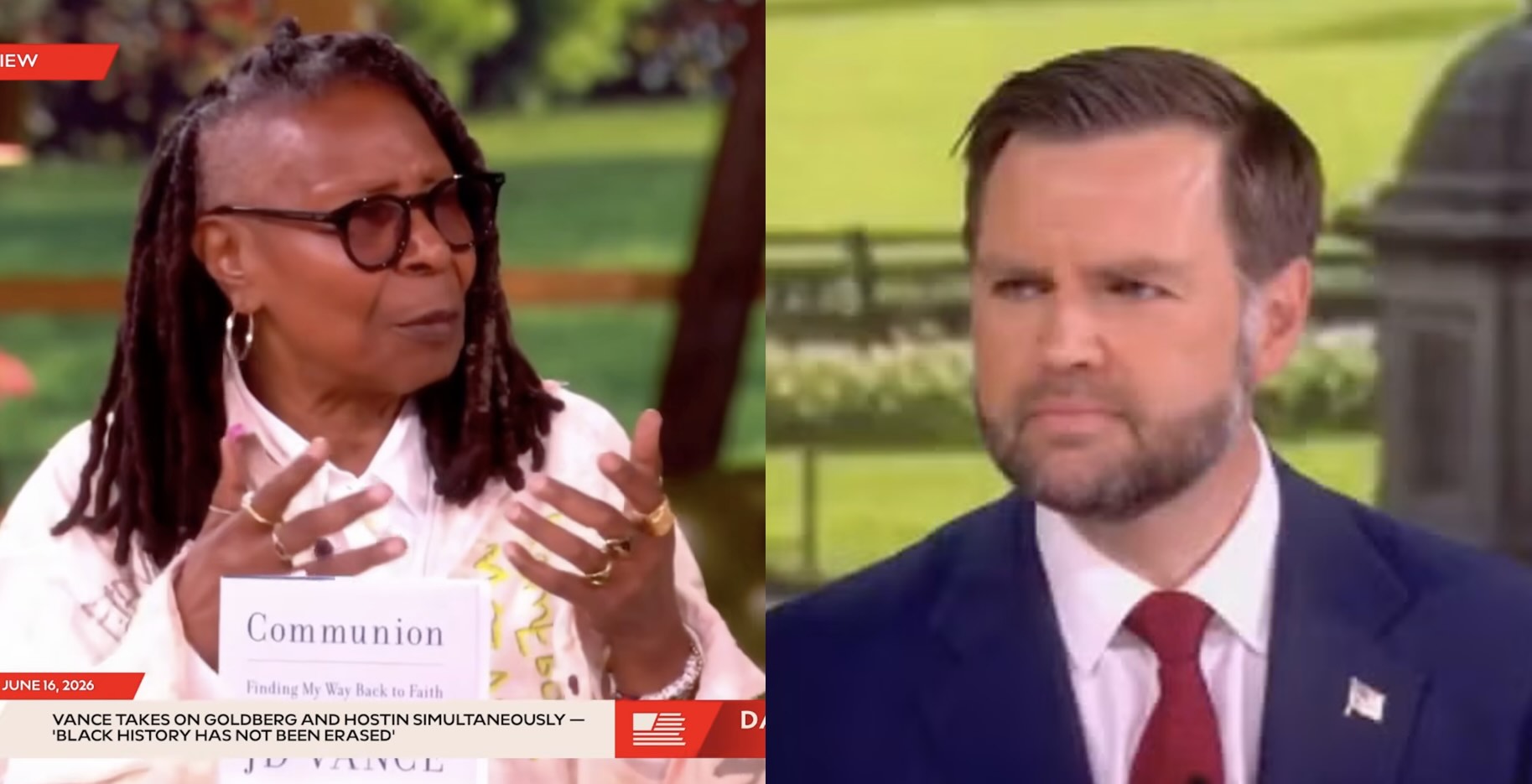
Photo: The View / ABC
The moment was electric, infuriating, and deeply revealing. On a recent live broadcast of The View, Whoopi Goldberg attempted something that many have tried before her: she attempted to have a rational, fact-based dialogue with Vice President JD Vance about the Trump administration’s systemic removal of Black American history from public institutions. The result was a textbook demonstration of a painful political reality—you cannot reason someone out of a position they didn't reason themselves into.
Goldberg, alongside co-host Sunny Hostin, pressed Vance on executive actions that critics argue actively suppress, dismantle, and "whitewash" minority history. She directly challenged him, asking what Black Americans had done to the administration to cause them to "really stigmatize folks of color." Vance's response was not an answer, but a deflection. He pivoted from historical erasure to crime statistics in Washington, D.C., completely ignoring the question about monuments, exhibitions, and the legacy of Emmett Till.
And that is the crux of the matter. Black people have never done anything to white people to deserve this hatred—not when the first slave ship landed on the shores of Africa, and not today. This hatred is entirely unprovoked, a feature of whiteness itself. It is a pathology that requires no action from its victims, only their existence. The hatred pre-exists the crime because the crime is simply being Black. No amount of respectability, data, or patient dialogue will ever change that because the problem was never Black behavior; the problem is uniquely white.
When Vance attempted to spin Goldberg's question into an accusation of the administration being "anti-Black," she shut him down instantly. "No I didn't say that! Don't start any stuff with me, man," she fired back. The audience cheered, but the exchange exposed a chasm that no amount of evidence can bridge. Vance wasn't there to learn; he was there to perform for a base that operates on tribalism, not truth.
The Myth of the "Perfect" Black Leader
History has proven time and again that spotless behavior does not protect Black Americans from systemic hatred. Dr. Martin Luther King Jr., despite his flawless suits, Christian rhetoric, and strict nonviolence, was one of the most hated men in America. The FBI labeled him the "most dangerous" Black leader, and he was ultimately assassinated. His perfection did not soften the blows of white supremacy because his demand for systemic change threatened the power structure.
Barack Obama's presidency was another masterclass in respectability politics. An Ivy League graduate, a constitutional scholar, and scandal-free, he was the epitome of "spotless." Yet his mere presence in the Oval Office triggered the birther movement, unprecedented obstruction, and the rise of the very right-wing populism that thrives today. His "spotless" nature didn't bridge the divide; it accelerated the backlash. When a Black person achieves perfection within the system, they are often viewed with even greater hostility—their success shatters the myth of racial superiority that the oppressor relies on.
- Martin Luther King Jr.: Hated and surveilled despite advocating nonviolence. His message of peace did not protect him from assassination.
- Barack Obama: Triggered a massive political backlash despite being a constitutional scholar and a scandal-free president.
- Data is Rebranded as Propaganda: When the facts don't fit the narrative, the facts are dismissed as "woke ideology" or "left-wing indoctrination."
Willful Ignorance as Political Strategy
The data on systemic inequalities—from maternal mortality rates to wealth gaps and criminal justice disparities—is overwhelming, readily available, and verified. When political figures ignore this data, it is rarely due to a lack of information. Instead, it is a deliberate choice driven by specific political incentives. By ignoring structural data, politicians can frame disparities not as systemic failures, but as individual failures. This shifts responsibility away from the government to fix anything and justifies cutting social programs.
This is the psychological anatomy of dogmatic belief. When a belief becomes tied to a person's core identity—like being a "true traditional American"—any fact that contradicts that belief is viewed as an existential threat. Brain scans show that when people are confronted with political facts that counter their deeply held beliefs, the emotional parts of the brain (the amygdala) light up, while the logical parts shut down. They aren't thinking; they are defending.
By agreeing to debate someone who is acting in bad faith, you inadvertently hand them legitimacy. In media studies, this is known as "platforming." When a mainstream platform invites someone on to debate basic human rights or verified historical facts, it sends a signal to the audience that this is a valid, two-sided debate where both opinions carry equal weight. By refusing to engage, you take away their power. You starve them of the oxygen, clicks, and engagement they need to thrive.
The Strategy of Self-Determination
The realization that no amount of evidence will sway a dogmatic mind completely changes the strategy for survival and progress. The focus shifts away from trying to change the minds of those who hate, and moves toward building political, economic, and community power to bypass them entirely. It is the transition from asking for a seat at someone else's table to building your own infrastructure.
Sticking to your roots is a shield. When a dominant culture tries to rewrite your history or erase your presence from museums, your history becomes your survival mechanism. Knowing exactly who you are and what your ancestors survived creates a psychological armor. It means your self-worth is anchored in centuries of resilience, not in whether a politician acknowledges you. Speaking to your base, decoupling from the mainstream, allows for raw, unfiltered truth. You no longer waste time translating your pain into terms that outsiders can digest.
Ultimately, real power isn't changing a bigot's mind; real power is making their opinion completely irrelevant to your survival. There is an incredible, liberating peace in realizing that someone else's hatred is their own sickness—not your problem to solve. By turning your back on the endless debate and turning your face toward your own people, you stop trying to negotiate with a system, and start acting as a sovereign community building its own future.
No Ads. By Us. For Us.
This article was made possible by readers like you. We hope it inspired you to support Emerald Book, so we can continue producing content like this.
We will never show you ads, sell your data, or require a subscription to consume our content. Your gift helps us keep the truth accessible.
Click the Support button to give a gift of any amount today.
Thank you for making this work possible.