

Emerald Pages
◆
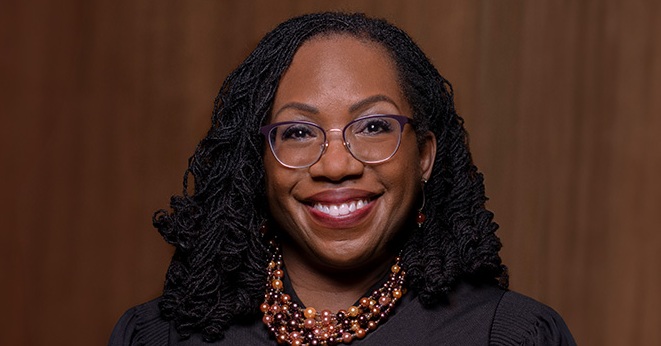
Photo: hrgrapevine.com
For generations, the path to a Supreme Court confirmation was a narrow, predictable highway: an Ivy League law degree, a prestigious appellate clerkship, and a career as a prosecutor or corporate attorney. That blueprint has governed the nation’s highest bench for decades—until Justice Ketanji Brown Jackson arrived. Her appointment in 2022 did not merely add diversity to the court’s composition; it fundamentally rewrote the definition of “qualified,” expanding the criteria to include experiences once considered political liabilities.
The current bench remains dominated by elite credentials: eight of the nine justices hold Ivy League law degrees, and six previously served as Supreme Court clerks. Yet Justice Jackson stands apart. While she possesses the traditional markers of success—a Harvard law degree and a clerkship for Justice Stephen Breyer—her broader resume includes roles no other sitting justice can claim. She is the first former federal public defender on the Supreme Court, the only current member to have served on the U.S. Sentencing Commission, and one of just two justices with experience as a federal district (trial) judge. This unique combination has quietly but profoundly shifted expectations for what a high court nominee should bring to the table.
The significance of her appointment becomes clear when measured against her colleagues. While Justices Alito, Sotomayor, and Thomas spent significant time as prosecutors, Justice Jackson worked as an assistant federal public defender in Washington, D.C., representing indigent defendants who could not afford counsel. That ground-level perspective on the criminal justice system—understanding how police interactions, bail decisions, and sentencing guidelines affect real people—had been absent from the court since Thurgood Marshall’s retirement in 1991. Her presence ensures that when the court debates search-and-seizure rules or the right to counsel, a voice with direct defense experience is in the room.
The “Full Stack” Resume
Beyond her public defender role, Justice Jackson brought two additional credentials that further distinguish her from the rest of the bench. From 2010 to 2014, she served as Vice Chair of the U.S. Sentencing Commission, the independent agency responsible for creating federal sentencing policy. During her tenure, the commission voted to retroactively reduce sentencing ranges for certain drug offenses—a decision aimed at addressing systemic racial disparities. Only one other justice in history (Stephen Breyer, whom she replaced) had served on the commission, and no current justice shares that expertise.
Equally notable is her decade as a federal district judge in Washington, D.C. While eight of the nine justices previously served as appellate judges, only Justice Sotomayor joins Justice Jackson in having presided over actual trials. District court experience brings a practical “reality check” to Supreme Court deliberations: trial judges manage witnesses, evidentiary disputes, and live defendants, rather than merely reviewing cold appellate records. Justice Jackson authored nearly 600 opinions on the district bench, giving her a deeper reservoir of on-the-ground judicial experience than any nominee in nearly a century.
- Public Defender: First and only current justice to have represented indigent criminal defendants as a full-time public defender.
- Sentencing Commission: Only sitting justice with direct experience crafting federal sentencing guidelines.
- District Judge: Nearly a decade of trial-court experience—more than any other current justice.
- Appellate Judge: Served on the influential D.C. Circuit, matching the credentials of her colleagues.
- SCOTUS Clerk: Clerked for Justice Stephen Breyer, providing insider knowledge of court operations.
Breaking the Prosecutor Monoculture
Before Justice Jackson’s confirmation, the Supreme Court had not seated a justice with substantial criminal defense experience in over three decades. That gap had practical consequences. Studies consistently show that the court rules in favor of law enforcement in the vast majority of Fourth, Fifth, and Sixth Amendment cases. Without a justice who has walked through the dynamics of an underfunded public defender’s office, the court’s perspective on criminal justice has been lopsided—dominated by former prosecutors and corporate litigators who view the system from the top down rather than the bottom up.
Justice Jackson’s appointment has begun to alter that dynamic. During oral arguments, she regularly asks questions that reflect her defense background—probing police conduct, the clarity of Miranda warnings, and the practical impact of sentencing enhancements on low-level offenders. Her written opinions, both in dissent and concurrence, frequently cite the real-world consequences of legal rules for defendants who lack resources. More importantly, her confirmation has normalized public defense as a legitimate qualification for federal judgeships, not a political liability.
The “Twice as Good” Precedent
Critics and supporters alike have noted that Justice Jackson’s resume is not merely excellent—it is overstuffed, as if designed to preempt every possible objection. Legal scholars have pointed to this phenomenon as a reflection of a broader cultural reality: Black professionals, and Black women in particular, often feel compelled to be “twice as good” to receive the same recognition as their peers. Throughout her confirmation hearings, commentators observed that Justice Jackson was subjected to scrutiny that past nominees—particularly white male nominees—had escaped. Her eight years as a district judge gave her more trial experience than several sitting justices combined, yet she faced aggressive questioning about her sentencing record in child pornography cases—a line of attack rarely directed at previous appointees.
This duality is the final way Justice Jackson has redefined qualification. By clearing a bar set impossibly high, she has demonstrated that a Black woman can not only meet the traditional standards of elite legal success but exceed them while also bringing perspectives the court has never had. Her legacy will likely be twofold: first, as a justice whose votes and opinions shape American law for decades; and second, as the person who proved that public defenders, sentencing experts, and trial judges belong on the Supreme Court—not in spite of their backgrounds, but because of them.
The precedent she has set is clear. Future presidents and senators will find it far more difficult to dismiss nominees with public defense or sentencing commission experience as insufficiently qualified. Justice Jackson has expanded the circle of what counts—and in doing so, she has made the nation’s highest court a little more representative of the nation itself.
No Ads. By Us. For Us.
This article was made possible by readers like you. We hope it inspired you to support Emerald Book, so we can continue producing content like this.
We will never show you ads, sell your data, or require a subscription to consume our content. Your gift helps us keep the truth accessible.
Click the Support button to give a gift of any amount today.
Thank you for making this work possible.