

Emerald Pages
◆
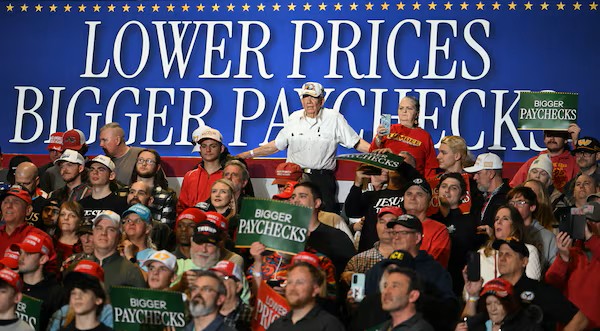
Photo: The Globe and Mail
It was one of the most potent political attack lines of the 2024 election cycle: "Bidenomics is a disaster," "the economy is in freefall," "Americans are worse off than ever." For millions of Trump supporters, the narrative of a nation in decline felt not just persuasive, but self-evident. High gas prices, soaring grocery bills, and painful mortgage rates were not abstract statistics—they were lived reality. But was the U.S. economy truly "bad" in the traditional sense of a recession or collapse? The data suggests a far more nuanced, and for some groups historically positive, picture emerges when you scratch beneath the surface.
The truth is that the post-COVID economy was a study in contradictions. It was not a recessionary horror show, but it also wasn't a pain-free boom. By traditional macroeconomic yardsticks—Gross Domestic Product (GDP) growth and unemployment—the economy performed admirably. The U.S. expanded every year of President Biden's term, with real GDP growth hovering around a healthy 2-3% annual range, avoiding a sustained recession entirely. Yet, for the average household budgeting for dinner or rent, the experience was often jarringly uncomfortable. This gap between broad economic indicators and household financial reality created the perfect petri dish for political myth-making.
The primary weapon in the anti-Biden economic arsenal was inflation. It spiked to a 40-year high, peaking around 9% in 2022, a direct consequence of post-COVID supply chain shocks, pent-up consumer demand, and global energy volatility following the invasion of Ukraine. While the inflation rate later cooled significantly, prices never returned to their pre-pandemic levels. This is the crucial psychological point that pundits often miss: slowing inflation doesn't mean prices go down, it just means they rise more slowly. The cost of a gallon of milk or a dozen eggs settled at a new, permanently higher plateau, leaving families feeling permanently squeezed even as wage growth began to catch up.
The Strongest Labor Market in a Generation
If inflation was the Achilles' heel of the Biden economy, the labor market was its superpower. While voters told pollsters the economy was terrible, employers were hiring at a breakneck pace. The United States added over 15 million jobs during the period covered in major analyses. The unemployment rate fell to roughly 4%, flirting with historic lows. Job openings often exceeded the number of available workers, giving employees leverage not seen in decades. This was not the profile of a nation in economic collapse.
Perhaps the most significant footnote in this labor market story—and one that directly contradicts the "everything is getting worse" narrative—is the experience of Black American workers. For decades, the Black unemployment rate has remained stubbornly twice as high as the white unemployment rate, a persistent scar of systemic inequality. But during the tight labor market of 2023-2024, that rate fell to about 4.8%, matching or tying the lowest level ever recorded since the government began tracking the data in the 1970s.
- Historic lows: Black unemployment hit 4.8% multiple times in 2023-2024, a level economists once thought impossible.
- Sustained gains: This wasn't a one-month fluke; it represented a sustained period of historically strong employment for Black Americans.
- The mechanism: In extremely tight labor markets, employers are forced to lower hiring barriers, raise wages, and invest in training workers they might have previously overlooked.
This data point is essential because it highlights the distributional nature of economic feelings. For a Black worker who had struggled with chronic underemployment for years, the Biden-era economy might have felt like the best of their life. For a white collar worker trying to buy a home with a 7% mortgage rate and paying $5 for a dozen eggs, it felt like a crisis. Both experiences were real, but only one dominated the political discourse.
Housing, Interest Rates, and the ‘Why’ of Anger
To understand why so many voters—particularly Trump supporters—felt the economy was in decline, you have to look past jobs and GDP and look at the cost of shelter. As the Federal Reserve aggressively raised interest rates to combat inflation, mortgage rates followed suit, climbing above 7% for the first time in over a decade. Simultaneously, a national housing shortage kept home prices stubbornly high. This created a "golden handcuffs" effect: existing homeowners who refinanced at 3% were unwilling to sell and trade up to a 7% loan, freezing inventory. For first-time buyers, the American Dream of homeownership felt like it was vanishing before their eyes.
This is where the political filter becomes crucial. While the macro economy was fundamentally strong, conservative media framing focused relentlessly on the "cost of living crisis," inflation, and high interest rates, interpreting these pressures as "economic decline" or evidence of failed leadership. Liberal media, conversely, emphasized the record job growth and wage recovery. Both sides were looking at the same mountain, but one was pointing at the sunny, green side, while the other was pointing at the rocky, difficult trail to the top.
Was It Biden’s Fault? The COVID Caveat
The final layer of the myth concerns causation. Was this "bad economy" actually Joe Biden's fault, or was he merely the captain steering through a post-pandemic storm? The honest economic consensus is: it was both. COVID was the undeniable trigger. Global supply chains broke, production stalled, and demand patterns shifted radically. However, the U.S. policy response—particularly the American Rescue Plan of 2021—added massive fiscal stimulus to an economy that was already beginning to recover. Economists debate the magnitude, but most agree that this stimulus contributed to demand overheating, amplifying inflation.
Yet, context is vital. The same stimulus prevented a prolonged, painful recession like the one that followed 2008. And the inflation spike was a global phenomenon, not uniquely American; countries with different stimulus packages still saw prices soar due to energy shocks. To say inflation was "all Biden" is inaccurate. To say it was "all COVID and unrelated to policy" is equally simplistic. It was a multi-cause episode where a global health crisis, domestic policy choices, and international geopolitics collided.
So, was the economy "bad"? Only if you define "bad" by an overly simplistic, bumper-sticker slogan. It was not a recession. There was no collapse. By the numbers that measure the nation's structural health—jobs and output—it was strong. But for millions of families facing the sticker shock of a post-inflation world, it felt punishing. The MAGA myth succeeded not because the data was false, but because the data was uncomfortable. It is easier to say "the economy is broken" than to explain the complicated reality: the economy was growing, hiring was booming, history was being made for minority workers, yet buying a house was a nightmare and a trip to the grocery store felt like a luxury. Both things can be true. And until the political discourse accepts that duality, the myth will always live alongside the reality.
No Ads. By Us. For Us.
This article was only made possible by readers like you. We hope it inspired you to support Emerald Book, so we can continue producing content like this.
We will never show you ads, never sell your data, and never require a subscription to consume our content. Your gift helps us keep the truth accessible.
Please click the Support button on the bottom right of your screen to make a gift of any amount today.
Thank you for making this work possible.