

Emerald Pages
◆
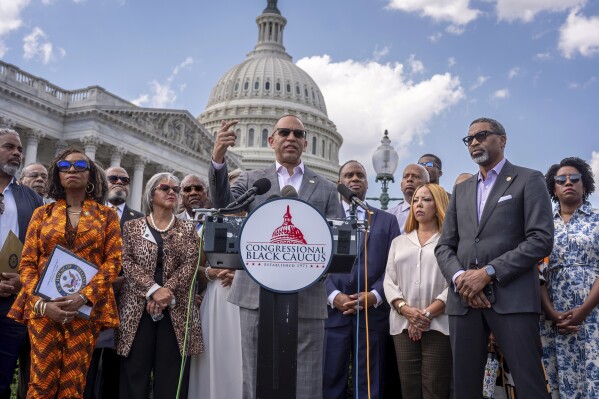
Photo: Scott Applewhite | Associated Press Photo
On paper, it sounds like the kind of thunderclap that changes history. The NAACP, armed with the moral weight of a century-long civil rights struggle, has officially drawn a line in the turf. Their "Out of Bounds" campaign, launched May 19, 2026, calls for Black student-athletes, recruits, families, and fans to withhold their talent and money from public universities in eight Southern states—Alabama, Florida, Georgia, Louisiana, Mississippi, South Carolina, Tennessee, and Texas. The reason: a coordinated legislative assault on Black voting power following the Supreme Court's ruling in Louisiana v. Callais.
The logic is elegant in its simplicity. These flagship universities—many in the SEC and ACC—generate hundreds of millions of dollars annually from television deals, merchandise, and ticket sales, largely powered by the labor of Black athletes. As NAACP President and CEO Derrick Johnson put it, public institutions should not profit from Black athletic talent while their state governments simultaneously strip political representation from Black communities. The campaign urges elite recruits to postpone commitments, current players to consider the transfer portal, and fans to redirect support toward HBCUs.
Yet for anyone paying attention to the last decade of college sports, a skeptical question lingers in the humidity of every Southern stadium: Will it actually work this time? Because this has happened before—and the athletes, by and large, did not boycott.
The Ghost of Boycotts Past
The "Out of Bounds" campaign is not the NAACP's first trip to the gridiron. In March 2024, the organization urged Black athletes to boycott Florida public universities after the state banned diversity, equity, and inclusion (DEI) programs. NFL Hall of Famer Emmitt Smith voiced support. High school recruits nodded solemnly on social media. And then? Commitments to Florida schools remained largely unchanged. The machine kept humming.
That failure wasn't for lack of moral conviction. It was structural. The NAACP itself acknowledges in its official letters that athletic scholarships remain a primary vehicle for upward economic mobility for countless Black families. For a 17-year-old from a working-class background in Mississippi, the choice between a full ride to Alabama (with a six-figure NIL deal) and a political statement is not a choice at all—it's a survival calculation.
- The Financial Chasm: Top SEC programs command NIL collectives averaging $13.95 million annually, with Texas boasting over $22 million. Add NCAA revenue sharing (up to $20.5 million) and recruiting budgets (Alabama spends $4.3 million just on logistics), and a single school wields a $35–50 million war chest to attract talent.
- The NIL Revolution: Players are no longer unpaid laborers. They are brand-builders with short career windows. Turning down life-changing money to protest congressional district maps is an intellectual luxury most families cannot afford.
- Historical Precedent: When athletes have forced change—the Mississippi flag, the Missouri protests—it happened from the inside, by players already on the roster with immediate game-day leverage, not by recruits who haven't yet signed.
The NAACP is hoping that expanding the target from one state to eight will create a unified front. But college recruiting is an intensely individual sport. And the competition for five-star talent does not pause for moral reflection.
The Ghost of Activism Past
To be fair, the idea that athletes "were never known to be activists" is a convenient myth. The history of Black athletes in America is, in many ways, the history of American protest itself. Jack Johnson shattered racial hierarchies in 1910. Jesse Owens humiliated Nazi ideology in 1936. Jackie Robinson integrated baseball as an explicit NAACP-backed campaign.
The late 1960s saw the "Revolt of the Black Athlete"—Muhammad Ali stripped of his title, Tommie Smith and John Carlos raising black-gloved fists on the Olympic podium, Kareem Abdul-Jabbar boycotting the 1968 Games entirely. College football specifically has its own proud lineage: the "Black 14" at Wyoming (1969), the Syracuse 8 (1970), and the Michigan State walkout (1968) all saw players sacrifice their careers for institutional change. In 2015, 30 Missouri football players launched a strike that forced the university president to resign within 48 hours.
So the tradition is real. The courage is real. But the NAACP is asking for something different this time. They are not asking enrolled players to strike—they are asking uncommitted teenagers to boycott before they ever step foot on campus. That is a fundamentally different tactical gamble.
What's Different Now?
Three factors suggest this time could be different—though none guarantee success.
First, the Congressional Black Caucus is now involved. The CBC has stated they will block federal college sports legislation (including a unified national NIL law that the NCAA desperately wants) unless conference leaders publicly condemn the redistricting maps. This moves the pressure from the field to the political backroom.
Second, the boycott targets fans and donors, not just players. If Black alumni and corporate sponsors stop buying tickets, merchandise, and licensed apparel, the universities feel the pain regardless of whether the athletes strike. That is a broader, potentially more sustainable lever.
Third, HBCUs are no longer afterthoughts. Unlike the 1960s, Historically Black Colleges and Universities now have national TV deals, growing NIL networks, and increasingly competitive programs. A recruit who chooses Jackson State over Alabama can still build a brand and a future.
But the countervailing forces are immense. The transfer portal is currently closed, meaning current players cannot leave immediately. The money—$35 to $50 million per school—is a gravitational force. And perhaps most critically, the campaign launched in May 2026, a dead period in the college sports calendar. By the time fall camp opens, the news cycle will have moved on.
The Bottom Line
Will the NAACP's "Out of Bounds" campaign work? The honest answer is that it depends entirely on whether a critical mass of elite recruits—the five-star quarterbacks, the generational defensive ends—are willing to do something their predecessors almost never did: say no to a life-changing payday before they ever put on a jersey.
History suggests the answer is no. The moral arc of the universe may bend toward justice, but it bends slowly—and in college sports, it usually bends toward the biggest check. The NAACP is gambling that the post-George Floyd generation of athletes is different. That they value legacy over leverage. That they will look at the empty rhetorical promises of the past and decide, finally, to empty the stadiums.
It is a noble bet. But if you are looking for evidence that it will pay off, the record so far is filled with silent stadiums—not because the fans stayed home, but because the boycott never really began.
No Ads. By Us. For Us.
This article was only made possible by readers like you. We hope it inspired you to support Emerald Book, so we can continue producing content like this.
We will never show you ads, never sell your data, and never require a subscription to consume our content. Your gift helps us keep the truth accessible.
Please click the Support button on the bottom right of your screen to make a gift of any amount today.
Thank you for making this work possible.