

Emerald Pages
◆
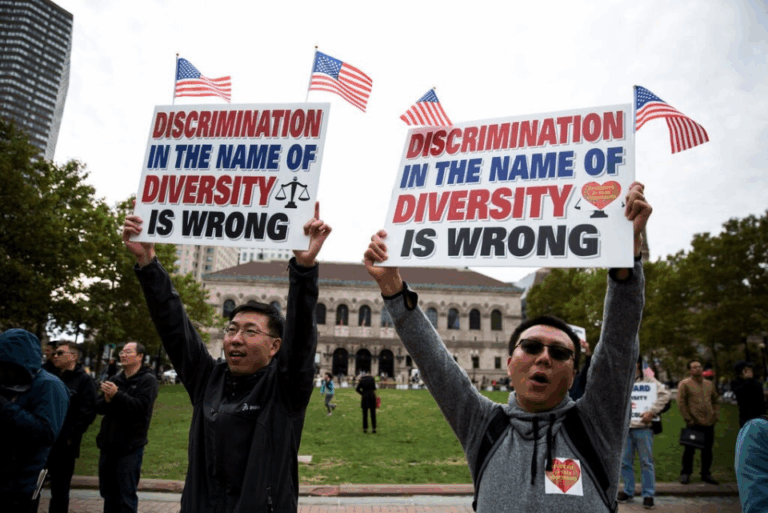
Photo: D'orazio Peterson
Let us be clear from the outset: the phrase "reverse racism" is a political invention with no basis in American statutory law. The current, highly coordinated push by conservative advocates and federal agencies to prosecute what they call anti-white discrimination is not just misguided — it is fundamentally nonsensical. Why? Because the law has never made the distinction they are fighting to create. It never has. And the government's sudden urgency to protect white Americans from "racism" ignores a more uncomfortable truth: the U.S. legal system does not protect anyone from "racism" at all.
This is not a semantic trick. It is the plain text of the Civil Rights Act of 1964 and the 14th Amendment. Nowhere in Title VII will you find the word "racism." Nowhere will you find "systemic oppression," "white privilege," or "structural inequality." What you will find is a prohibition on treating an individual differently because of their race — any race, any person, any background. The law is colorblind by design. It was written to address individual acts of discrimination, not the sprawling, centuries-deep architecture of American racial hierarchy.
This brings us to the central absurdity of the current moment. The Trump administration and its aligned federal agencies are presenting their crackdown on DEI programs as a bold new frontier in civil rights enforcement — a necessary correction to protect white Americans from "reverse racism." But here is the truth they will not tell you: white Americans have always been protected from discrimination. The Civil Rights Act was never limited to people of color. It was drafted to protect "any individual." White plaintiffs have brought — and won — discrimination claims for decades. There is nothing new about this protection.
The Distinction That Doesn't Exist
The term "reverse discrimination" suggests something peculiar: discrimination that flows backward, against the usual direction of power. But the law recognizes no such directionality. It never has. The Equal Employment Opportunity Commission (EEOC) — now aggressively pivoting to prioritize claims from white men — has always accepted such claims. What has changed is not the law but the political will to enforce it on behalf of majority-group plaintiffs.
The recent Supreme Court case Ames v. Ohio Department of Youth Services (June 2025) made this explicit. For decades, some lower courts had applied a "background circumstances" test, requiring white plaintiffs to prove that their employer had an unusual bias against the majority. The Supreme Court struck that down, ruling that the law cannot have two different standards. But here is what the Court did not do: it did not create a new right. It simply removed an improper barrier that should never have existed in the first place.
- No "reverse" in the statute: The phrase "reverse discrimination" appears nowhere in federal law. All discrimination is legally identical regardless of the target's race.
- White plaintiffs have always won: Landmark cases like McDonald v. Santa Fe Trail Transportation Co. (1976) established that white employees are protected under Title VII.
- The "any person" standard: The 14th Amendment protects "any person" — this has never been race-limited.
So why the sudden urgency? Why the executive orders, the subpoenas, the public campaigns encouraging white men to file charges? The answer is not legal — it is political. The push against "reverse racism" is not about creating new protections. It is about dismantling diversity, equity, and inclusion initiatives by re-labeling them as discriminatory. It is a strategic framing exercise, not a legal necessity.
The Law's Deliberate Refusal to See Racism
Here is the deeper irony. Even as the government mobilizes to protect white Americans from perceived bias, the legal system remains willfully blind to the phenomenon that scholars have been measuring empirically for decades: systemic racism. The law does not have a framework for it. It refuses to develop one.
Sociologists, economists, and public health researchers have produced overwhelming evidence of systemic racial disparities. The wealth gap, the housing gap, the employment gap, the incarceration gap, the health outcomes gap — these are not matters of opinion. They are measured, replicated, and published in peer-reviewed journals. The federal government itself collects data on these disparities through agencies like the Census Bureau, the Bureau of Labor Statistics, and the Department of Justice.
But the Supreme Court has repeatedly ruled that "remedying general societal discrimination" is not a compelling governmental interest. In the 2023 affirmative action decision, the Court's majority argued that societal racism is too amorphous for the law to measure or fix. This is a remarkable position: the same government that collects exhaustive data on racial disparities across every sector of American life claims it cannot possibly use that data to justify race-conscious remedies.
The result is a legal system that acknowledges individual discrimination but refuses to see the pattern. It will punish a hiring manager who says "I don't hire Black people" but will not address the structural forces that produce nearly identical racial disparities across thousands of employers. It will protect a white employee who can prove he was passed over for a specific promotion because of his race, but it will not ask why the executive suite remains overwhelmingly white despite decades of "colorblind" enforcement.
The Nonsensical Crusade
This brings us back to the current crusade. The push to prosecute "reverse racism" is nonsensical on its own terms because it pretends to be a response to a legal gap that does not exist. White Americans already have the same rights as everyone else. They always have. The government is not protecting them from something new — it is redirecting enforcement resources away from patterns of systemic harm and toward individual claims from the majority.
Consider the numbers. Even as the EEOC pivots to prioritize white male complainants, the underlying data on workplace racial disparities remains stark. Workers of color occupy only 20 percent of executive roles despite representing over 40 percent of the workforce. Pay gaps persist across every industry. Discrimination complaints from people of color continue to far outnumber those from white plaintiffs — not because of any legal disadvantage, but because the actual incidence of discriminatory treatment remains higher.
The government's current approach weaponizes the law's individualistic framework to dismantle programs designed to address systemic patterns. It argues that a diversity hiring goal is unlawful because it considers race — even if that goal is a modest effort to correct for decades of exclusion. It treats a white candidate who loses a single competitive position as legally equivalent to a Black candidate who faces discrimination at every stage of the hiring process. The law permits this equivalence because the law does not ask about context, power, or history. But the law's indifference is not an argument for its wisdom.
Two Frameworks, One Irresolvable Conflict
The debate over "reverse racism" is fundamentally a debate about which framework should govern: the sociological framework that measures systemic power and disparity, or the legal framework that sees only individual transactions. The current push represents an aggressive attempt to entrench the legal framework as the only legitimate one — to declare that because the law is colorblind, any race-conscious policy is presumptively illegal.
But the law's colorblindness is not a fact of nature. It is a choice — a choice the Supreme Court has made and is continuing to make. And it is a choice that flies in the face of decades of empirical evidence. The government can measure racism when it wants to. It collects the data. It publishes the reports. It just refuses to let those measurements matter in court.
So here is the bottom line: the push to prosecute "reverse racism" is nonsense because there is no such legal category. White Americans have always been protected from discrimination. The law has never distinguished between discrimination against white people and discrimination against anyone else. What the law has also never done — and still refuses to do — is acknowledge the reality of systemic racism, despite a mountain of empirical evidence. The current crusade is not a legal correction. It is a political project dressed in legal clothing, and it deserves to be recognized as such.
The term "reverse racism" should be retired — not because discrimination against white people never happens (it does, and the law already covers it), but because the "reverse" prefix implies a directionality that the law has never recognized and a distinction that has never existed. You cannot have "reverse" discrimination when there is only one kind of discrimination in the eyes of the law. And you cannot claim the government is newly protecting white Americans from a newly recognized harm when that protection has been on the books for sixty years. The nonsensicalness of the push is not a bug. It is the feature.
No Ads. By Us. For Us.
This article was only made possible by readers like you. We hope it inspired you to support Emerald Book, so we can continue producing content like this.
We will never show you ads, never sell your data, and never require a subscription to consume our content. Your gift helps us keep the truth accessible.
Please click the Support button on the bottom right of your screen to make a gift of any amount today.
Thank you for making this work possible.