

Emerald Pages
◆
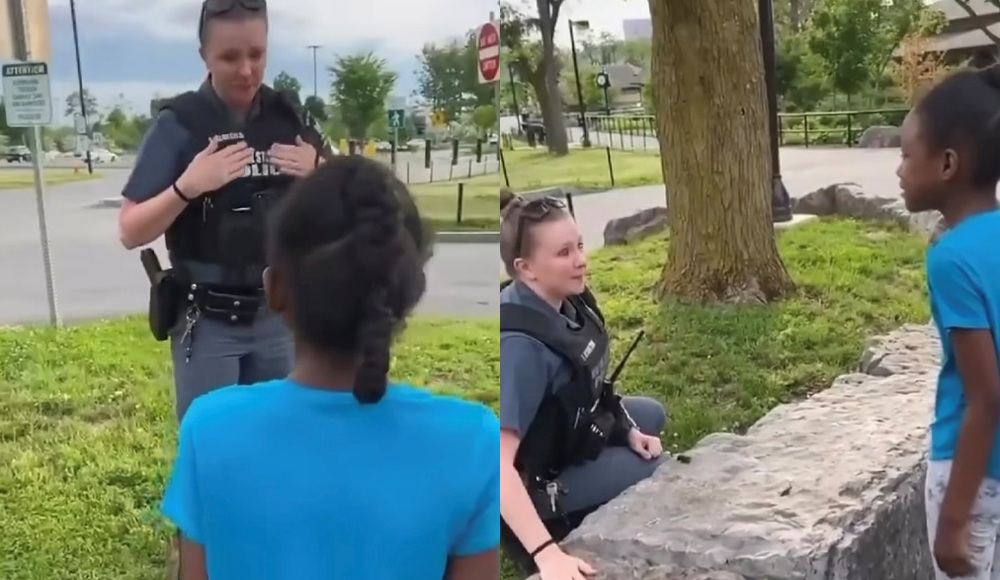
Photo: Screenshots of Family Video | Facebook
In May 2026, a mother walked through a park with her nine-year-old daughter. A police patrol car rolled into view. The girl did not run or smile. She froze, raised her hands in the air, and burst into tears. The body camera footage from Winter Haven, Florida, in March 2025 was even more chilling: a three-year-old girl, imitating her mother, laid face-down on the hot pavement with her hands behind her back—ready to be handcuffed. These are not isolated incidents of “overly dramatic” children. They are the logical, heartbreaking conclusions of a reality that Black parents have been forced to prepare their children for since birth.
The fear of law enforcement among Black children is not a narrative; it is a statistically verifiable, intergenerational trauma response. While many Americans view police as protectors, a confluence of generational survival tactics, media exposure, and a shocking lack of officer training has created a dynamic where a significant portion of Black youth see the uniform not as a shield, but as a mortal threat.
The Talk: A Survival Script
For Black families, "The Talk" is not about the birds and the bees—it is a tactical briefing. Black parents are forced to begin conversations with toddlers about how to behave during traffic stops. Children are explicitly taught to keep their hands visible, avoid sudden movements, never argue, and comply instantly, even if the order feels wrong. While this instruction is intended to keep children alive, it psychologically signals to the child that the police officer walking down their street is a potential source of lethal danger, not a helper. Sociological research confirms that this vicarious trauma—watching parents stress over interactions with law enforcement—transfers directly to the child, creating baseline anxiety that white peers simply do not experience.
The Numbers Don't Lie: Disproportionate Harm
The fear is not paranoia; it is pattern recognition. Data from the 2025 Police Violence Report reveals that Black individuals account for 26% of all people killed by police while making up only roughly 13% of the U.S. population. Black Americans are killed at a rate of 6.1 per million people—nearly three times more likely to be shot and killed by police than white Americans. Furthermore, Black people are over three times as likely to experience the threat or use of non-fatal force during an encounter.
- Lethal Disparity: Black Americans are nearly 3x more likely to be killed by police than white Americans.
- Unarmed Victims: Black individuals are heavily overrepresented among civilians who were unarmed or not threatening when killed.
- Injury Rate: Black Americans are nearly 5x more likely than white Americans to require hospital treatment for injuries sustained during a police intervention.
What Children See: Viral Proof and Vicarious Trauma
In the digital age, these statistics are not abstract. They are reels on Instagram and clips on TikTok. High-profile cases of police violence—specifically against Black youths like Tamir Rice (12 years old) or Antwon Rose II (17 years old)—are accessible on smartphones. Studies featured by the NAACP Legal Defense Fund reveal that police killings of unarmed Black Americans are linked to more than 50 million additional days of poor mental health per year among Black adults living in the same states where the incidents occurred. For children watching their parents suffer that trauma, the fear is solidified.
The Limits of Tears: When Sympathy Supersedes Accountability
In the park video that circulated widely, the female officer who stepped out of the patrol car was visibly moved. She crouched down, tears streaming down her face, and assured the little girl, "We're not all bad... I don't want you to be afraid of me." On the surface, the moment was framed as human connection—a bridge between a traumatized child and a compassionate officer. But for many Black viewers, the tears felt deeply performative. The officer's crying centered her own emotional discomfort rather than the child's terror. Where was the officer's tears for the systemic failures that taught this child to raise her hands before she was even accused of a crime? Tears are cheap. They cost nothing and change nothing. The officer returned to her patrol car and likely resumed the same duties, with the same minimal training, in the same system that produced the child's fear in the first place. Sympathy without structural change is not allyship—it is emotional theater.
The Training Gap: Barbers vs. Badges
Perhaps the most infuriating context for Black parents is understanding how little preparation officers actually receive to handle these situations. In the United States, the average police recruit receives just 806 hours of basic academy training (roughly 21 weeks). Compare this to other professions:
- Barber: 1,000 to 2,000 hours (State mandates focus on sanitation and chemical safety).
- Cosmetologist: 1,500 to 1,600 hours (Skin care, anatomy, chemical safety).
- Plumber/Electrician: 4,000 to 8,000 hours (Apprenticeships).
Furthermore, out of the average 806-hour police curriculum, less than 30 hours (under 4% of academy time) is dedicated to human relations, ethics, cultural competency, or de-escalation tactics. Meanwhile, 137 hours are dedicated strictly to firearms and defensive tactics. When compared internationally, the gap is staggering: German police train for 2.5 to 3 years, heavily emphasizing constitutional law and psychology. Finnish officers require a three-year competitive bachelor's degree. The U.S. prioritizes the weapon over the conversation.
The Cycle of Distrust
When a child sees a police car and raises their hands, they are not being disrespectful. They are displaying a trauma response honed by history—from the enforcement of slave codes and Jim Crow to the modern era of viral videos and inadequate training. The tearful officer in the park video offered a moment of individual empathy, but that empathy rang hollow for those who understand that one crying officer does not rewrite policy. As long as police academies spend less time teaching de-escalation than cosmetology schools spend teaching shampoo techniques, the fear of Black children is not a problem to be solved by a viral hug—it is a systemic wound that requires systemic healing.
No Ads. By Us. For Us.
This article was only made possible by readers like you. We hope it inspired you to support Emerald Book, so we can continue producing content like this.
We will never show you ads, never sell your data, and never require a subscription to consume our content. Your gift helps us keep the truth accessible.
Please click the Support button on the bottom right of your screen to make a gift of any amount today.
Thank you for making this work possible.