

Emerald Pages
◆
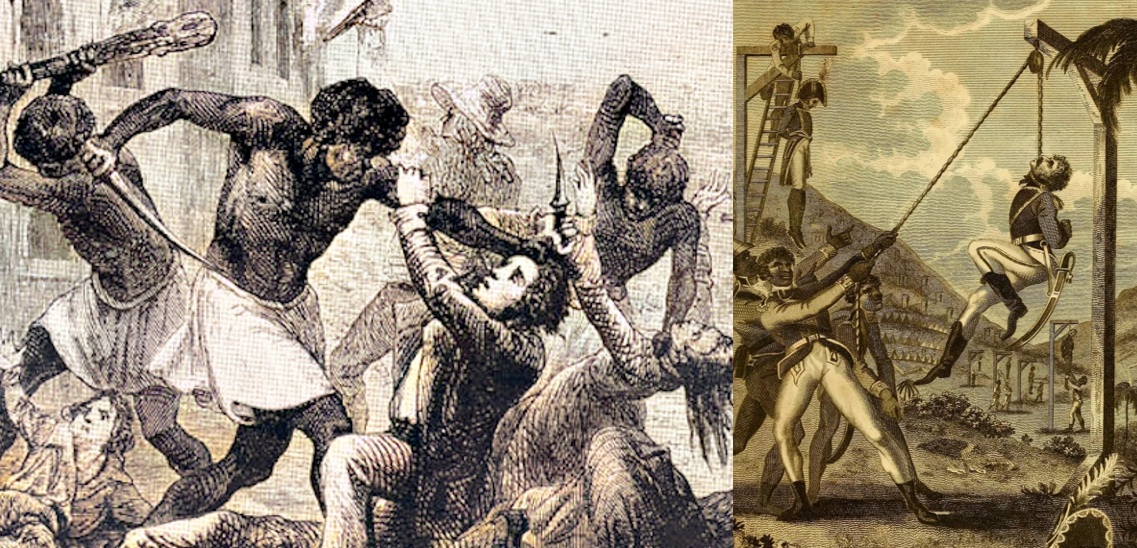
Haiti; Revolution, 1791-1804
Imagine a small factory town in rural Ohio. The workers have no military training. They have no guns. They are outnumbered, starved, and legally considered property. Now imagine they rise up and, within a decade, defeat a combined force of Navy SEALs, Delta Force operators, and the full weight of the Pentagon's military budget. Imagine they capture the American flag, rip out its white stripe, and declare a new nation where the descendants of enslaved people are the ruling class.
That is not hyperbole. That is what happened in Haiti between 1791 and 1804. The French army under Napoleon Bonaparte was the most lethal fighting force on the planet — having conquered Egypt, Italy, and most of continental Europe. And on the sugar plantations of Saint-Domingue, a half-million enslaved Africans did what no European army could: they broke Napoleon. They sent his generals home in coffins. And they founded the world's first independent Black republic.
For the American slaveholding class, this was a waking nightmare. If enslaved people in Haiti could defeat the French, what stopped the half-million enslaved Black Americans in Virginia from doing the same to Thomas Jefferson's militias? The answer, white Southerners decided, was an information cordon so ruthless, so legally sophisticated, that it would take nearly sixty years for the truth to seep through. This is the story of how the U.S. government quarantined a revolution — and why the echoes of that erasure still shape American education today.
The Unthinkable Victory: Haiti vs. Napoleon
To understand the terror of the American planter class, one must first grasp the magnitude of what happened in Haiti. In 1802, Napoleon dispatched his brother-in-law, General Charles Leclerc, with 20,000 of France's most battle-hardened troops — soldiers who had crossed the Alps and crushed Austrian and Russian armies. Their mission: re-enslave the island and restore French colonial rule. The Haitian generals — Toussaint Louverture, Jean-Jacques Dessalines, and Henri Christophe — had no navy, no artillery, no formal military academy. They had sugar cane machetes, guerrilla tactics, and something far more dangerous: the absolute certainty that death was preferable to chains.
What followed was a masterclass in asymmetric warfare. Haitian forces burned their own cities to deny the French food and shelter. They used the mountainous interior to launch hit-and-run ambushes, vanishing into terrain where French cavalry could not follow. And then nature intervened: yellow fever, a disease to which the French had no immunity, slaughtered Leclerc's army by the thousands. By the end of 1803, Napoleon had lost more than 50,000 soldiers in the Caribbean — a greater loss than at the Battle of Waterloo. The French emperor abandoned his New World ambitions, sold the Louisiana Territory to the United States for a fire sale price, and never again tried to reconquer Haiti.
But victory alone was not enough for Jean-Jacques Dessalines, the former slave who became Haiti's first ruler. He understood something that the American slaveholding class would spend the next six decades trying to suppress: the French would never stop trying to reinvade as long as there remained a single French colonist on the island who could serve as a spy, a financier, or a fifth column. In early 1804, Dessalines ordered what history would record as the 1804 Haitian Massacre. Over the course of several weeks, Haitian forces systematically executed between 3,000 and 5,000 remaining French colonists — men, women, and children who had lived on the backs of enslaved labor. It was brutal, indiscriminate, and, by Dessalines' own declaration, a "necessary act of vengeance and security."
The massacre was not total. Dessalines deliberately spared several groups: the Polish soldiers who had defected from the French army and fought alongside the Haitians (whom Dessalines called "the White Blacks of Europe"), German colonists who had never owned slaves, a handful of doctors and skilled artisans Haiti needed to rebuild, and foreign merchants from neutral nations. But the French planter class — the very people who had tortured, branded, and worked hundreds of thousands of Africans to death — was erased from Haitian soil. Dessalines then ratified the 1805 Haitian Constitution, which banned white people from owning land and legally declared every citizen of Haiti, regardless of birth or skin color, to be Black. The message to the world was absolute: slavery would never rise again in this nation, not by invasion, not by infiltration, not by any means.
The American Quarantine: Silencing the Contagion
White Americans watched these events with a mixture of horror and strategic calculation. President Thomas Jefferson — himself a slaveholder who had written that "all men are created equal" — refused to recognize Haitian independence for his entire presidency. He imposed an embargo on trade with the new Black republic and quietly funneled aid to the French in their failed reconquest. But Jefferson's deepest fear was not diplomatic; it was informational. If enslaved Black Americans learned that their counterparts in Haiti had won, the entire Southern economy would collapse.
- Anti-Literacy Laws (1800-1830s): Before the Haitian Revolution, Southern states had no universal prohibition on teaching enslaved people to read. After 1804, states like Virginia, South Carolina, and Georgia passed laws making it a felony to teach any Black person — enslaved or free — to read or write. The goal was explicit: cut off access to Haitian news.
- The Negro Seamen Acts (1822-1826): South Carolina led the way with a law requiring that any free Black sailor arriving in Charleston harbor be jailed for the duration of his ship's stay. The law's sole purpose was to prevent Black sailors from Haiti or the northern U.S. from telling enslaved dockworkers about the revolution.
- Mail Censorship: Southern postmasters routinely intercepted and burned abolitionist newspapers that mentioned Haiti. The U.S. Postal Service, at the behest of slave states, refused to deliver material deemed "incendiary."
- Diplomatic Non-Recognition (1804-1862): The United States refused to formally recognize Haiti as a sovereign nation for 58 years — longer than it refused to recognize the Soviet Union. Southern politicians openly admitted they could not allow a Black Haitian ambassador to walk the streets of Washington, D.C., for fear it would inspire the enslaved population of the capital.
The information blockade was not perfect. Enslaved Americans developed an underground "grapevine telegraph" — whispered news passed between plantations, hidden church meetings, coded spirituals. Leaders like Denmark Vesey, who had lived in Haiti, organized a massive 1822 rebellion plot in Charleston explicitly modeled on the Haitian Revolution. When Vesey's plan was betrayed, he and 35 co-conspirators were executed. In the trial records, prosecutors noted with alarm that Vesey had read newspaper accounts of the Haitian Revolution aloud to his followers.
The Modern Equivalent: Factory Workers vs. Navy SEALs
To make the Haitian victory legible to a modern American audience, consider this: imagine a lightly armed militia from a small Caribbean island defeating the United States military at the peak of its global power. The French army of 1802 was to its era what the U.S. military is today — the most technologically advanced, best-funded, most battle-hardened force in the world. Napoleon had never lost a war. He had conquered Egypt and humiliated the Austrians. And he lost to former slaves.
The asymmetry is almost unfathomable. The French had warships. The Haitians had rowboats. The French had cannon. The Haitians had machetes and captured muskets. The French had a professional officer corps. The Haitian generals had been enslaved sugar workers just a decade earlier. And yet, through a combination of guerilla warfare, strategic genius, and the sheer refusal to accept bondage, they did the impossible. In modern terms, it would be as if a handful of Uber drivers and warehouse workers organized themselves overnight, outfought a Marine expeditionary unit, and forced the President to sell half the country to China just to cover the losses.
The Long Shadow: Why You Were Never Taught This
The American suppression of Haitian history did not end with the Civil War. After Emancipation, white southern historians — the "Dunning School" — constructed a narrative of American history that minimized Black agency and celebrated white reconciliation. Haiti was portrayed as a cautionary tale of Black savagery and political failure. Textbooks published well into the 20th century described the Haitian Revolution as a "slave massacre" rather than a legitimate war of independence. Even today, according to a 2021 survey by the Southern Poverty Law Center, fewer than 10% of American high school students can correctly identify the Haitian Revolution as the world's only successful slave revolt.
That erasure extends to Hollywood, where the Haitian Revolution remains conspicuously absent. Consider this: there have been major studio blockbusters about the American Revolution (The Patriot), the French Revolution (Les Misérables), the Russian Revolution (Doctor Zhivago), the Arab revolt (Lawrence of Arabia), the abolitionist John Brown (The Good Lord Bird), the slave ship Amistad (Amistad), the Civil War (Glory, Lincoln), the fight for British abolition (Belle, Amazing Grace), and even the 1831 Nat Turner rebellion (The Birth of a Nation). Yet there has never been a single major Hollywood studio film — not one — about Toussaint Louverture, Jean-Jacques Dessalines, or the Battle of Vertières, where enslaved Africans defeated Napoleon's army.
The reasons are not financial. The Haitian Revolution has every element Hollywood claims to covet: a charismatic underdog hero (Toussaint Louverture, a former slave who taught himself to read, outmaneuvered three empires, and died in a French prison), a David-and-Goliath military campaign (machetes versus the Grand Army), dramatic betrayals (Toussaint captured by French deception), a tragic romance (the story of Marie-Claire Heureuse Félicité, Dessalines' wife who nursed wounded French soldiers despite the war), and an explosive, cathartic finale (the massacre of the planter class and the birth of the world's first Black republic).
But Hollywood operates inside the same cultural currents that produced the 60-year information quarantine. A blockbuster about enslaved people defeating, slaughtering, and permanently expelling white Europeans from their land would be too dangerous for the global market. It would be too dangerous for white audiences conditioned to see Black revolt as monstrous rather than heroic. It would be too dangerous for a film industry that still struggles to greenlight stories where Black protagonists win — not through respectability, not through white saviors, but through armed, decisive, total victory. The Haitian Revolution is the greatest underdog story in human history. And that is precisely why Hollywood will not touch it.
That erasure is not accidental. It is the legacy of a 60-year information quarantine designed to protect American slavery from the most dangerous idea in human history: that the enslaved can rise up, defeat their masters, and build a nation of their own. On Haitian Flag Day — May 18 — we remember not only the red and blue flag created when Dessalines tore the white stripe from the French tricolor. We remember the blockade of knowledge that followed. And we ask: what other revolutions have been hidden from us?
No Ads. By Us. For Us.
This article was only made possible by readers like you. We hope it inspired you to support Emerald Book, so we can continue producing content like this.
We will never show you ads, never sell your data, and never require a subscription to consume our content. Your gift helps us keep the truth accessible.
Please click the Support button on the bottom right of your screen to make a gift of any amount today.
Thank you for making this work possible.