

Emerald Pages
◆
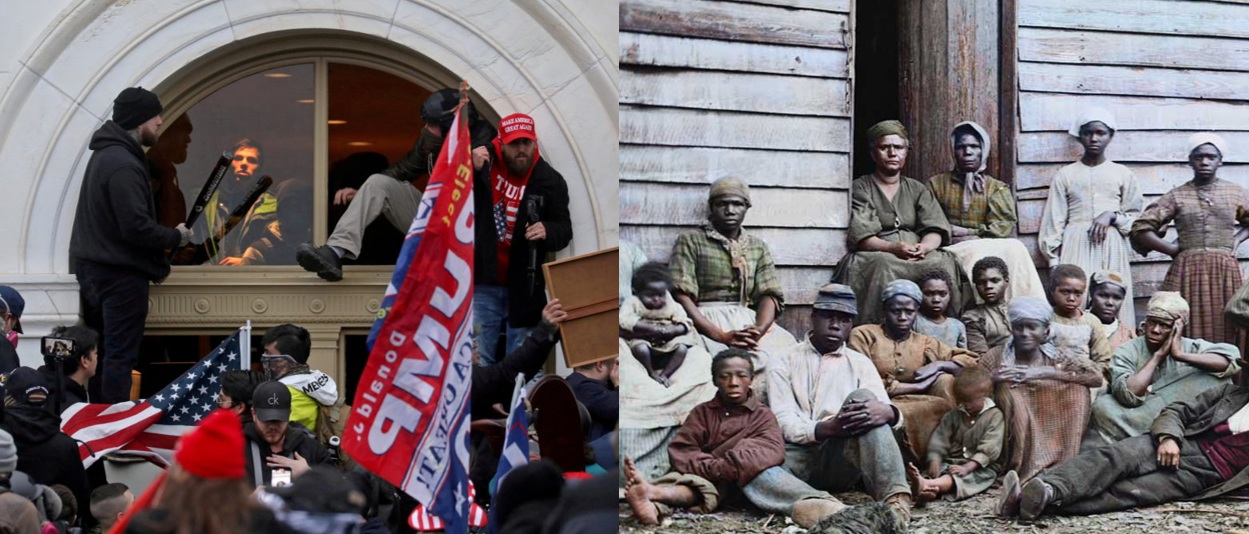
Photo: Emerald Book Image
President Donald Trump has proposed a $1.7 billion compensation fund that would allow January 6 defendants and other political allies to seek taxpayer-funded payouts, according to reports from The New York Times and ABC News. The mechanism is simple: in exchange for dropping his personal $10 billion lawsuit against the IRS over leaked tax returns, the Trump administration would tap the Treasury Department's Judgment Fund — a permanent, automatically refilling pot of money — to pay out claims to individuals who say they were victims of governmental "weaponization." This explicitly includes nearly 1,600 individuals charged in connection with the January 6 Capitol attack, many of whom Trump already granted blanket pardons.
Legal experts and congressional Democrats have sharply condemned the plan, labeling it an unprecedented, corrupt "slush fund" for insurrectionists. Critics point out that because Trump would hold the power to appoint and remove the commission's oversight members without cause, the administration would have unchecked control to distribute $1.7 billion to political allies. U.S. District Judge Kathleen Williams has openly questioned the constitutionality of the case, noting that a sitting president cannot legally sue an agency he entirely oversees — calling the lawsuit a "collusive" sham designed to extract taxpayer cash.
But here is the deeper wound: while the executive branch has found a legal loophole to bypass Congress and direct $1.7 billion to political allies within months, Black Americans seeking reparations for centuries of state-sanctioned harms — slavery, Jim Crow, redlining, mass incarceration — have waited decades for even a study. The foundational federal bill for Black reparations, H.R. 40 (the Commission to Study and Develop Reparation Proposals for African Americans Act), was first introduced in 1989. It has been re-introduced in every single congressional session for over 35 years. It has never once received a full vote on the House or Senate floor.
The Legal Loophole vs. The Legislative Process
The Trump administration bypassed Congress entirely by framing the $1.7 billion fund as a legal settlement to end a specific lawsuit against the IRS. By utilizing the Treasury Department's permanent Judgment Fund, the executive branch tapped into money that is already automatically appropriated by law, requiring zero votes from lawmakers. This is the key: the executive branch has "plenary" settlement authority under federal law, allowing the Attorney General to settle lawsuits against the government without congressional approval.
Black reparations cannot be formatted as a simple lawsuit settlement. Compensating millions of Black Americans requires systemic spending legislation to create new federal programs. Under the U.S. Constitution, only Congress holds the "power of the purse" to pass such massive, multi-trillion-dollar spending bills. And even if a reparations bill passed the House, it faces a virtually insurmountable 60-vote threshold in the Senate due to the filibuster, combined with fierce, unified Republican opposition and hesitation from moderate Democrats.
- $1.7 billion for January 6 defendants: Funded through executive settlement authority + Treasury Judgment Fund — no vote required.
- H.R. 40 for Black reparations: Introduced 1989, re-introduced 18+ times, zero floor votes in 35+ years.
- Senate filibuster: Any reparations bill would need 60 votes — an impossible threshold in current political reality.
- Local progress: Evanston, IL became first U.S. city to pay reparations (2021) using local marijuana tax revenue. California established a state task force but payout bills remain stalled.
Why Presidents Can't Just Order Reparations
While civil rights advocates have pressured Democratic presidents to bypass Congress and establish a Black reparations study commission via Executive Order, such an order is legally fragile. A president can use an executive order to order a study, but they cannot legally distribute taxpayer cash or create long-term financial payouts without congressional funding. Any attempt to use executive funds for a race-conscious financial program would be instantly blocked by federal courts as unconstitutional under the 14th Amendment's Equal Protection Clause.
Meanwhile, the Trump administration is actively pursuing its $1.7 billion settlement. The Department of Justice is rushing to finalize the agreement before Judge Williams can officially strike down the entire lawsuit as invalid. In response, lawmakers have introduced the No Rewards for January 6 Rioters Act — a targeted bill designed to legally bar the Treasury from allowing Judgment Fund access to anyone prosecuted over the Capitol attack. But the race is tight: executive action moves in weeks, while legislation crawls.
The contrast could not be starker. One group — predominantly white political allies who attacked the U.S. Capitol — is on the verge of receiving $1.7 billion in taxpayer compensation through an executive branch legal maneuver. Another group — Black Americans whose ancestors were enslaved, segregated, and systematically excluded from the American dream — cannot get a congressional hearing after 35 years. This is not an accident. It is a design. The structure of U.S. governance makes it legally easier to settle a lawsuit than to remedy a centuries-old moral debt.
As one legal scholar put it: "The Trump plan pushes the absolute boundaries of executive power — but that's exactly the point. They found a way. The question is why, for reparations, no one has ever tried this hard."
No Ads. By Us. For Us.
This article was only made possible by readers like you. We hope it inspired you to support Emerald Book, so we can continue producing content like this.
We will never show you ads, never sell your data, and never require a subscription to consume our content. Your gift helps us keep the truth accessible.
Please click the Support button on the bottom right of your screen to make a gift of any amount today.
Thank you for making this work possible.