

Emerald Pages
◆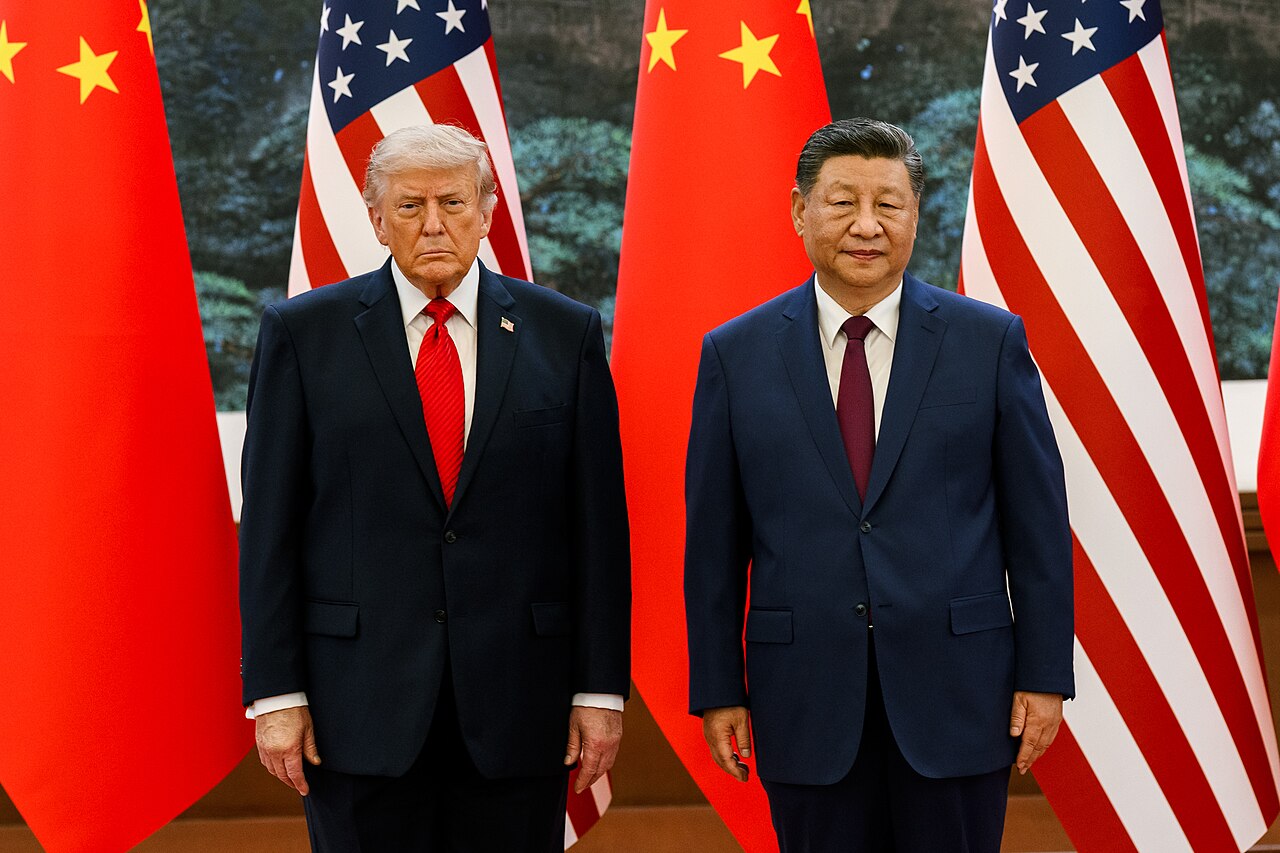
Photo: Wikipedia
When President Donald Trump touched down in Beijing this week alongside a delegation of America's wealthiest tech titans — Elon Musk, Jensen Huang, Tim Cook — the headlines focused on trade truces, Taiwan, and the Strait of Hormuz. But buried inside the summit's most celebrated breakthrough, the greenlighting of Nvidia's advanced H200 AI chips for sale to China, lies a consequence that few news cycles will cover: what an accelerated global AI infrastructure boom means for Black neighborhoods in America.
The answer, according to civil rights researchers and environmental justice advocates, is alarming. AI does not live in the cloud. It lives on the ground — in sprawling, power-hungry data centers that require cheap land, enormous amounts of electricity, and millions of gallons of water. And for decades, the communities absorbing the pollution, displacement, and resource strain of America's industrial buildouts have been disproportionately Black.
The Trump-Xi summit, framed as a diplomatic triumph, has unlocked a new wave of AI hardware investment on a global scale. For American tech companies that have spent years lobbying Washington to ease chip export restrictions, this moment is an opening. For Black communities living near industrial corridors in Mississippi, Alabama, Tennessee, South Carolina, and Maryland, it may be another chapter in a long story of sacrifice without return.
Digital Redlining: The New Face of an Old Pattern
A major 2025 study on AI infrastructure and environmental racism identified a calculated corporate pattern researchers have termed "digital redlining." Tech giants require vast tracts of cheap land to build hyperscale data centers — and the land they consistently choose sits in under-resourced, predominantly Black rural and urban communities. The pattern is not accidental. It follows the same logic as mid-century housing discrimination: place the burden where resistance is lowest and land values are cheapest.
NAACP chapters across Mississippi, Alabama, and Maryland have each mounted community resistance campaigns against data centers proposed for or built within historic Black neighborhoods. The objections are not abstract. Residents point to industrial zoning loopholes that allow high-pollution facilities to operate in residential areas without meaningful community input, and to local governments eager for tax revenue that often fast-track approvals without environmental review.
Toxic Air and a Cancer Risk Four Times the National Average
Keeping thousands of advanced AI microchips running around the clock without overwhelming the electrical grid requires massive backup power. Data centers rely heavily on fossil-fuel-powered generators — burning methane gas and diesel — that pump volatile organic compounds and formaldehyde into surrounding air.
The consequences are already visible in frontline communities. In South Memphis, Tennessee — home to Elon Musk's xAI supercomputer cluster — the localized pollution from dozens of gas turbines has triggered alarming spikes in asthma and respiratory illness. The local cancer risk sits four times higher than the national average. The same Elon Musk who flew to Beijing on Air Force One to protect his Chinese manufacturing interests built that supercomputer cluster in one of Memphis's most vulnerable Black neighborhoods.
Utility Bills, Water Scarcity, and the Energy Burden Shift
The resource demands of AI hardware are staggering. A single hyperscale data center can consume as much electricity as a small city and requires millions of gallons of water daily just to keep servers cool. When utility companies are forced to build new power infrastructure to meet that demand, they pass the cost to everyday consumers — and research consistently shows Black households bear a disproportionate share of that burden.
- Along the East Coast and parts of the South, Black households are experiencing utility rate hikes of 70% or more tied to data center power demand, leading to a wave of shutoffs for missed payments.
- In some rural Black communities near large data center campuses, residents report brown, murky tap water or entirely depleted water pressure as facilities drain local aquifers.
- China's purchase of Nvidia's H200 chips will accelerate data center construction globally — including in the U.S. markets where American tech firms are racing to expand capacity ahead of the AI arms race.
The Job Illusion and Slow-Burn Displacement
Local officials who approve these facilities are typically sold on the promise of jobs and economic development. The reality rarely matches. Once construction concludes, a hyperscale data center requires very few permanent employees to operate — offering virtually no long-term job mobility to the surrounding community. The construction boom employs outside contractors. The tax breaks reduce municipal revenue. And the industrial footprint quietly expands.
As data center campuses grow, they consume land adjacent to residential neighborhoods, driving up specialized industrial land values while simultaneously depressing the residential property values of surrounding Black family homes. Families who cannot sell at a profit and cannot afford rising costs are pushed out — not by a demolition notice, but by slow financial pressure.
What the Beijing Summit Means for This Moment
Trump's visit to China was driven by urgent geopolitical priorities — defusing a trade war, managing Taiwan tensions, and pressuring Beijing to help reopen the Strait of Hormuz amid a 75-day U.S.-Israel conflict with Iran that has driven global oil past $105 a barrel. The summit's outcomes will have real economic implications for Black Americans: a stable trade truce protects the purchasing power of working-class families who spend a higher share of their income on imported household goods, and a resolution to the energy crisis would lower gas prices that function as a regressive tax on Black commuters.
But the Nvidia H200 chip deal is a wildcard. It signals that the global AI infrastructure buildout is entering a new, accelerated phase — one in which the demand for data centers, power plants, cooling systems, and land will surge. If the pattern of the last decade holds, Black communities will once again be asked to absorb the costs of a technological revolution they were never invited to lead.
The diplomacy happening in Beijing's Great Hall of the People is real, and its stakes are high. But so is the quiet crisis unfolding in South Memphis, in rural Alabama, in the corridors of Maryland where data center campuses are pushing up against residential blocks. Both stories are American. Only one is getting covered.
No Ads. By Us. For Us.
This article was only made possible by readers like you. We hope it inspired you to support Emerald Book, so we can continue producing content like this.
We will never show you ads, never sell your data, and never require a subscription to consume our content. Your gift helps us keep the truth accessible.
Please click the Support button on the bottom right of your screen to make a gift of any amount today.
Thank you for making this work possible.