

Emerald Pages
◆
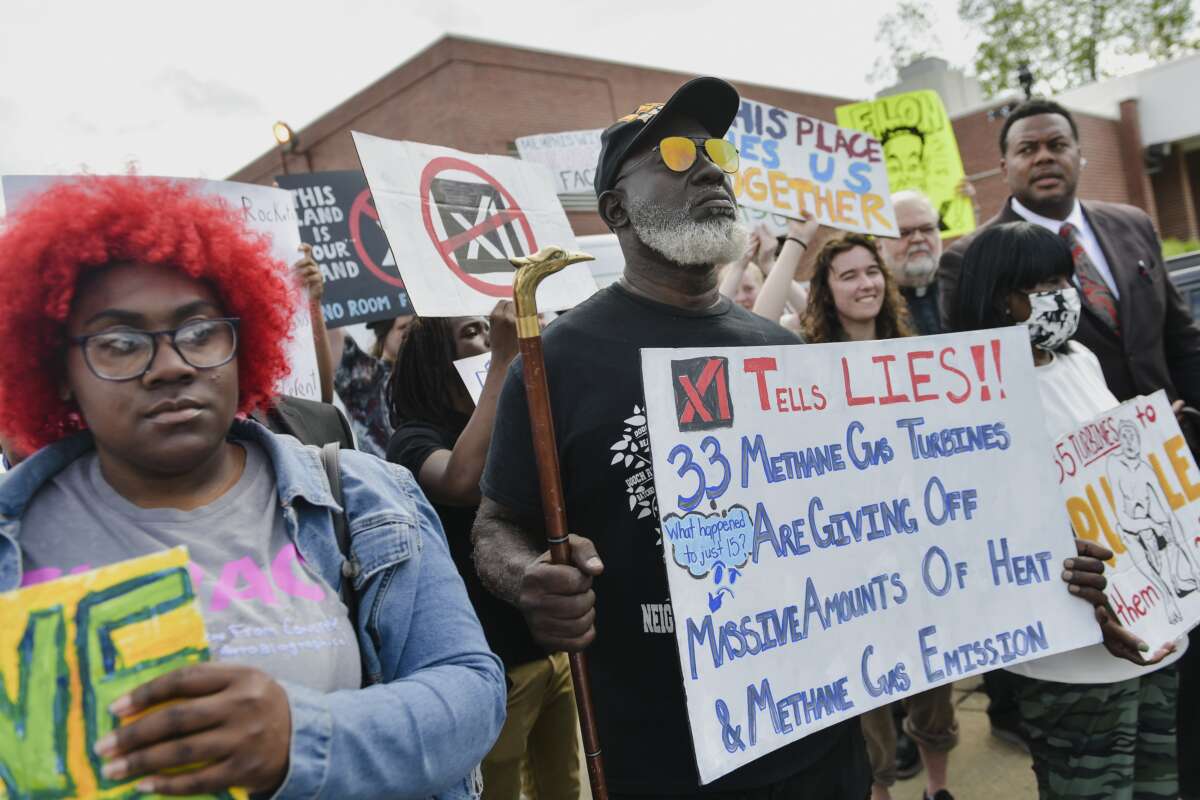
Photo: Brandon Dill for The Washington Post via Getty Images
The artificial intelligence revolution is being built on land that does not belong to the tech industry—and the people being displaced are predominantly Black. Across the United States, a quiet but devastating pattern has emerged over the past three years. As tech giants rush to build hyperscale AI data centers—each consuming as much electricity as hundreds of thousands of homes—they are systematically targeting Black neighborhoods, rural communities of color, and historically undervalued land. When those communities resist, utilities backed by eminent domain law step in to seize what voluntary agreements cannot secure.
This is not a localized problem. According to industry tracking cited by multiple environmental justice organizations, over 25 major U.S. data center projects have been canceled or blocked due to intense local pushback—but at least 69 jurisdictions have already moved to restrict new construction, suggesting that the projects that do get built are landing in communities with less political power to resist. The NAACP, which has launched a national "Stop Dirty Data Centers" campaign, describes the trend as "systematic environmental racism enabled by state-sanctioned eminent domain."
The mechanism varies by state, but the outcome is consistent: land seizures, property devaluation, industrial pollution, and utility rate hikes that fall heaviest on those who can least afford them. While Georgia has emerged as a recent flashpoint—with a single utility project affecting over 330 properties and demolishing 21 homes—the national pattern extends from the Mississippi Delta to Wisconsin farmland to the outskirts of Memphis, where a federal lawsuit now alleges that one of the world's richest men illegally powered his AI supercomputer on the backs of a historically Black neighborhood.
Georgia: A Recent Flashpoint in a Growing Crisis
In late 2025 and early 2026, Georgia became ground zero for a particularly aggressive wave of eminent domain seizures tied to AI data center expansion. Notably, Georgia Power is not directly seizing or tearing down homes to physically build data centers themselves. Instead, the utility is forcing residents off their land to construct massive high-voltage power lines and substations—250 kV to 500 kV transmission line corridors—explicitly required to feed those data centers' insatiable electricity appetite.
The issue stems from a major tech boom across rural and suburban Georgia, where developers are building massive "hyperscale" AI data centers. Construction activity in the Atlanta market nearly tripled between 2023 and 2024, with tech developers flooding suburban and rural counties to buy cheap land. By April 2024, Georgia Power realized the sheer volume of signed contracts from tech companies would entirely overwhelm the existing electrical grid.
In July 2025, the Georgia Public Service Commission officially approved Georgia Power's updated Integrated Resource Plan, greenlighting an unprecedented expansion: over 1,000 miles of brand-new high-voltage transmission lines specifically built to feed the data center surge. The utility is acquiring thousands of acres of land for these corridors, and while Georgia Power attempts to negotiate voluntary easements first, they are actively utilizing eminent domain to legally seize land from uncooperative property owners.
- 330+ private properties affected by a single transmission line project (Project Sail) in Coweta County, Georgia
- 21 homes slated for full acquisition and demolition to clear the 35-mile high-voltage corridor
- 1,000+ miles of new high-voltage transmission lines approved by Georgia regulators for data center feeding
- $17 billion estimated cost of the Project Sail data center campus proposed by Atlas Development
- $150 → $225 The average monthly Georgia electric bill has jumped 50% in two years, driven largely by data center infrastructure costs
Project Sail and the Coweta County Lawsuit
In Coweta County, a single transmission line project known as "Project Sail" has become the epicenter of resistance. The 35-mile high-voltage corridor targets over 330 private properties and is slated to fully acquire and demolish 21 homes. Viral videos from affected homeowners detailing the forced loss of their childhood homes have sparked widespread outrage across social media and local news.
The data center campus that triggered the expansion—an 829-acre hyperscale facility proposed by Atlas Development with an expected cost of $17 billion—was approved by a narrow 3-2 county commission vote in late 2024. On May 5, 2026, nineteen local residents filed an official lawsuit in Coweta County Superior Court against the county government and Atlas Development, aiming to permanently void the zoning vote.
The legal arguments are substantial. Residents allege that the county intentionally ignored its own environmental and zoning laws. The lawsuit reveals that the project sits directly on a designated "Most Significant Groundwater Recharge Area"—property owners argue that the data center's immense water needs and bedrock blasting will permanently contaminate or destroy local water wells. Furthermore, independent financial audits submitted in the lawsuit show that the promised tax revenue could be a fraction of what developers claimed, leaving communities with industrial blight and no economic upside.
Beyond Coweta: Fayette, Toombs, and Statewide Expansion
The land grabs extend far beyond Coweta County. In Fayette County, high-tension power poles and new substations are encroaching directly onto residential neighborhoods to power the massive QTS data center campus. Some homeowners have already sold their homes and moved away to escape the industrialization and noise pollution—including Ansley Hutchings, who sold her Fayette County "forever home" in September 2025 after nearby data center construction destroyed her quality of life.
In rural eastern Georgia—Toombs, Emanuel, and Jefferson counties—landowners are currently holding emergency community meetings with eminent domain attorneys to fight massive 500 kV power lines being run through family farms from Plant Hatch. Residents describe receiving official notices threatening seizure if they refuse to grant access to their property. The opposition has become so severe that regions like Troup County have enacted temporary moratoriums to halt all data center applications while infrastructure impacts are assessed.
The Georgia Power Defense and Community Response
Georgia Power maintains that the infrastructure upgrades are necessary to "strengthen the grid" for the entire state's growing energy needs. However, community groups argue that residential neighborhoods are being turned into industrial right-of-ways solely to benefit multi-billion-dollar tech corporations. Environmental and consumer advocacy groups have taken the Georgia Public Service Commission to court, arguing that the PSC broke state laws by giving Georgia Power a "blank check" to expand fossil-fuel infrastructure to feed data centers.
Recent fuel cost hearings at the PSC revealed that data centers are fundamentally failing to pay their fair share for fuel, leaving everyday residential ratepayers heavily subsidizing the tech companies' massive electricity bills. In response, municipal resistance is hardening—Fayetteville recently passed a strict ordinance completely banning new data centers from being built anywhere within city limits, joining dozens of other cities nationwide enacting permanent prohibitions to protect their water grids and neighborhoods.
How Black Communities Are Disproportionately Affected
The data center boom and Georgia Power's grid expansion are disproportionately harming Black residents, driving severe environmental injustices, wealth extraction, and targeted land displacement. Advocacy groups note that tech developers and utility companies are repeating historical patterns of industrial encroachment on historically Black areas—patterns that date back to redlining and industrial siting practices of the 20th century.
According to environmental justice research cited by Capital B News and Canary Media, when affluent white communities successfully organize to block data centers, developers systematically pivot to nearby Black and lower-income neighborhoods. The calculation is cold but explicit: these areas are perceived to lack the funding, political connections, or legal resources to mount effective resistance. This dynamic is actively playing out from the South Atlanta suburbs (like South Fulton) down through rural middle and eastern Georgia, transforming historically Black residential land into heavy industrial zones.
The environmental penalties are severe. To power these AI hubs, Georgia Power is building over 200 new power generation units. Statistically, fossil-fuel power plants are overwhelmingly constructed near Black communities, exacerbating exposure to hazardous particulate matter and nitrogen dioxide that spike rates of asthma, cancer, and respiratory diseases. Then there is the noise: hyperscale centers require thousands of massive industrial fans and diesel backup generators that run constantly. Black residents report the non-stop, low-frequency hum destroys their quality of life, sleep, and mental health.
The financial injustice cuts even deeper. Because Georgia Power is spending billions to over-excavate lines and secure land for AI data centers, the utility transfers those multi-billion-dollar costs onto regular consumers. This has triggered severe utility bill spikes—the average Georgia bill has jumped from $150 to $225, a 50% increase. Because of systemic economic disparities, Black households in Georgia are disproportionately affected by utility power disconnections when they can no longer afford the artificial inflation on their monthly electricity bills.
Perhaps most devastating is the erasure of generational wealth. Land is the primary mechanism of generational wealth, and eminent domain directly strips it from families. Many Black families in rural Georgia own "heirs' property"—land passed down through generations without formal wills. Georgia Power's aggressive eminent domain tactics frequently target these tracts because legal titles can be harder to defend in court. When Georgia Power seizes land for high-voltage corridors, property values on the remaining land crater, stripping Black families of their equity while the ultimate financial profits flow to multi-billion-dollar out-of-state tech corporations.
A National Pattern of Sacrifice Zones
While Georgia has become ground zero, the exact same collision of Big Tech power demands, grid strain, utility rate hikes, and eminent domain land grabs is triggering massive public backlash across the entire United States. According to national industrial tracking, over 25 major U.S. data center projects have been canceled or blocked due to intense local pushback, and at least 69 U.S. jurisdictions have moved to block or severely restrict new AI data center construction.
Eminent Domain Threatening Farmland Nationwide
The aggressive seizure of land for high-voltage lines feeding tech hubs is occurring well beyond Georgia. In Wisconsin, residents are actively fighting eminent domain threats to family farms and private properties to build transmission networks for a massive 600-acre AI data center campus. In Maryland, Frederick County communities have formed aggressive resistance coalitions to block multi-state transmission line expansions that would cut through historic farmland via eminent domain solely to link power grids to data centers in Northern Virginia's "Data Center Alley." In Utah, a massive 40,000-acre data center project drawing hundreds of protesters would consume 9 gigawatts of power—more than double the current electricity usage of the entire state.
The xAI Memphis Case: Federal Lawsuit Over Illegal Power Plants
In April 2026, the national NAACP and Earthjustice filed a federal Clean Air Act lawsuit against Elon Musk's artificial intelligence company, xAI. The lawsuit alleges that xAI circumvented federal permitting laws to operate 27 unpermitted methane gas turbines to power its "Colossus 2" supercomputer data center. Located in Southaven, Mississippi and South Memphis—both predominantly Black areas—the facility is capable of pumping 1,700 tons of smog-forming nitrogen oxides annually into nearby schools, churches, and homes. Civil rights leaders called the facility a "potential death sentence" for community health, marking the first time a major civil rights organization has directly sued a tech company over data center pollution in a Black community.
Rising Electric Bills and Federal Investigations
Everyday consumers nationwide are footing the bill to upgrade grid infrastructure for Big Tech companies. Because utilities build costly new power plants and transmission wires to handle the tech surge, those billions in structural costs are socialized onto regular residential ratepayers. Data centers consume up to 70% of all new electrical grid capacity, driving massive utility bill increases nationwide.
In Baltimore, Black community organizers have petitioned the Public Service Commission to investigate a proposed data center after neighborhood energy bills spiked nearly 80%. This localized inflation has grown so severe that U.S. Senator Jon Ossoff launched a formal federal probe with the Federal Energy Regulatory Commission to investigate how AI data centers are artificially hiking power bills for families.
Systematic Environmental Racism and Targeted Siting
The pattern of shifting heavy industrial infrastructure into Black and lower-income neighborhoods when affluent white communities fight back is a noted national phenomenon. National civil rights groups like the NAACP have launched coordinated national campaigns ("Stop Dirty Data Centers") to stop developers from treating minority communities as sacrifice zones for intense data center noise, water strain, and air pollution. In rural Black communities across Alabama, South Carolina, and Mississippi, residents report that tap water has turned brown, murky, or dried up entirely due to data centers consuming millions of gallons of groundwater daily. In industrial hotbeds like Bessemer, Alabama, the construction of massive server facilities lowers adjacent residential property values, systematically eroding generational wealth.
Political and Legislative Crackdown
Hostility toward data center proliferation has united polarized politicians from both political parties. Legislatures in New York, Michigan, Oklahoma, and Virginia have introduced state bills to pause or strictly limit data center permits until local environmental and consumer impacts can be fully studied. The issue has reached the highest levels of federal policy, prompting heated debates over whether the federal government should have the authority to completely override individual states regarding where and how these power-hungry facilities connect to the national grid.
National Resistance and Community Organizing
In response, Black communities have organized an aggressive national defense network. The NAACP launched a "Stop Dirty Data Centers" campaign, publishing official Guiding Principles to Protect Frontline Communities. They are demanding legally binding community benefit agreements, corporate tax accountability, and community-owned renewable energy. Grassroots coalitions—such as the "Wear Red" coalition in Alabama—have successfully stormed city council meetings and used door-to-door campaigns to freeze or delay tens of billions of dollars in data center projects.
Back in Coweta County, the nineteen plaintiffs and their neighbors are still fighting. The lawsuit is pending. The transmission lines are still coming. But for the first time, the story of who really pays for artificial intelligence is being told—not in Silicon Valley boardrooms or utility commission hearings, but in the threatened fields, front porches, and courtrooms of communities across America.
As the AI boom accelerates, a central question remains unanswered: Will the revolution be powered by justice, or by displacement? For the Black families watching utility surveyors walk their land from Georgia to Wisconsin to Tennessee, the answer is not yet written—but they are determined to write it themselves.
No Ads. By Us. For Us.
This article was only made possible by readers like you. We hope it inspired you to support Emerald Book, so we can continue producing content like this.
We will never show you ads, never sell your data, and never require a subscription to consume our content. Your gift helps us keep the truth accessible.
Please click the Support button on the bottom right of your screen to make a gift of any amount today.
Thank you for making this work possible.