

Emerald Pages
◆
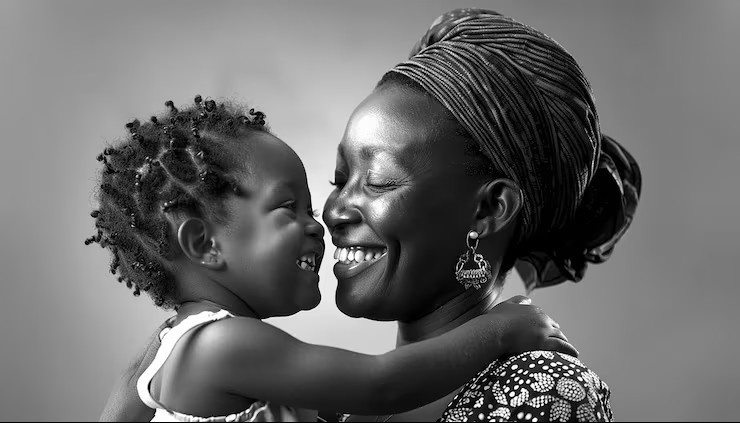
Photo: Freepik
There is a particular kind of strength that resides in the heart of a Black mother. It is not born from hardness, but from a deep, ancestral well of love that has been forced to be revolutionary. For generations, Black motherhood has been a radical act of hope, a daily defiance against systems designed to diminish, and an unshakeable commitment to not only raising children but nurturing a legacy. To celebrate Black motherhood is to acknowledge a sacred journey, one where protection, joy, and the fierce transmission of culture are woven into every lullaby, every prayer, and every boundary set.
From the moment a child is brought into this world, a Black mother often becomes a shield and a sanctuary. She must teach her child to navigate a world that may not always see their light, while simultaneously ensuring that the child never forgets just how brightly that light shines. This dual consciousness—preparation and protection, vigilance and vulnerability—is a labor of love that requires an almost supernatural grace. It is found in the mother who works two jobs to afford tuition at a better school, the grandmother who steps in to raise her grandchildren with a second lifetime of wisdom, and the community mother who feeds every child on the block as if they were her own.
The narrative of the "strong Black woman" is often a complicated one, and for mothers, it can become a heavy crown to wear. But true celebration comes not from praising the strength born of struggle, but from honoring the tenderness that persists despite it. It is in the quiet moments—a bedtime story that weaves in tales of ancestral heroes, a kiss on a scraped knee that carries the weight of a thousand promises, a backyard barbecue where teenagers and toddlers are equally mothered. These are the moments where joy is cultivated, where resilience is not just taught but felt. This is the soft power that moves mountains, one gentle correction, one home-cooked meal, one whispered encouragement at a time.
The Legacy Makers: Passing Down More Than Memory
Historically, Black mothers have been the unsung archivists of their families. They have passed down recipes that taste like home, the precise way to iron a shirt, the cadence of a church hymn, and, most importantly, a sense of self-worth. In an era where Black joy is a political statement, these mothers cultivate it as a birthright. They curate environments where their children see themselves reflected in books, in leaders, in art. They teach the richness of their history, not as a story of oppression, but as a testament to innovation, courage, and the unbreakable spirit of a people who built, created, and thrived.
- The First Teachers: Over 90% of Black children’s earliest literacy and cultural education comes directly from maternal family members, shaping identity from the start.
- Community Building: Black mothers are 3x more likely than the general population to be the primary organizers of family and community social networks, keeping neighborhoods connected.
- Entrepreneurial Spirit: In the past decade, businesses led by Black mothers have grown at five times the national average, building generational wealth and flexibility.
To celebrate Black motherhood is to see it in its full, vibrant complexity—the exhaustion and the exhilaration, the sacrifice and the profound reward. It is to applaud the mothers who are also students, the grandmothers who are also advocates, and the aunties who mother without the title. Theirs is a love that dares to imagine a future where their children can fly, not because they were shielded from the wind, but because they were given the wings to soar. As we honor them, we are reminded that to uplift a Black mother is to uplift the entire village, the entire community, the very soul of a nation. They are, and always have been, the pillars on which tomorrow is built.
No Ads. By Us. For Us.
This article was only made possible by readers like you. We hope it inspired you to support Emerald Book, so we can continue producing content like this.
We will never show you ads, never sell your data, and never require a subscription to consume our content. Your gift helps us keep the truth accessible.
Please click the Support button on the bottom right of your screen to make a gift of any amount today.
Thank you for making this work possible.