

Emerald Pages
◆
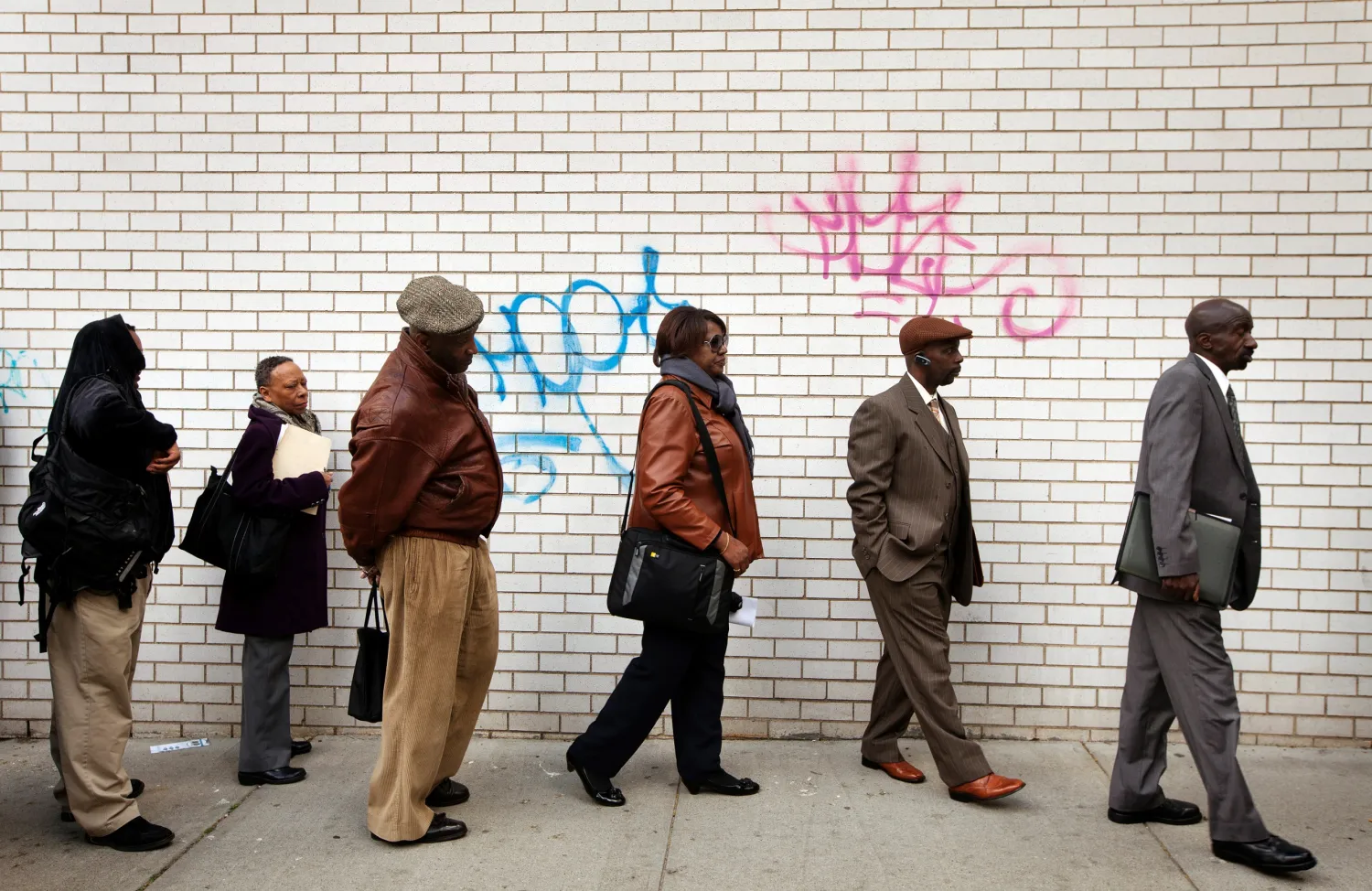
Photo: Brookings
The April 2026 jobs report delivered a reassuring headline for the broader American economy — steady payroll growth, a stable 4.3% unemployment rate, and continued resilience. But beneath that calm surface, a deeply concerning divergence has emerged. While the national numbers held firm, the unemployment rate for Black workers climbed sharply, rising to 7.3% from 7.1% in March. More striking still is the year-over-year comparison: the Black unemployment rate has jumped from 6.4% in April 2025 to 7.3% today — a staggering 14.1% relative increase.
During that same twelve-month period, the unemployment rate for white workers tells an entirely different story. In April 2025, the white unemployment rate stood at 3.8%. As of April 2026, that figure has actually declined to 3.7% — a 2.6% decrease year-over-year. This means that while white workers have seen modest improvement in their job prospects, Black workers have experienced a double-digit surge in unemployment. The disparity is not just persistent; it is actively widening.
The numbers paint a stark portrait of economic divergence. The overall national unemployment rate has barely moved, ticking up just 0.1 percentage points from 4.2% to 4.3% over the year — a relative increase of only 2.4%. By contrast, the Black unemployment rate has climbed a full percentage point, from 6.4% to 7.3%. That 14.1% relative increase represents approximately 419,000 fewer Black Americans employed today compared to January 2025, according to data from the Economic Policy Institute.
Black Women Bear the Brunt
Perhaps the most alarming trend is unfolding specifically for Black women. Their unemployment rate has been particularly volatile, rising from 6.4% in January 2026 to 6.5% in April — after peaking near 8% in late 2025. Month-over-month, the jump from March’s 6.1% to April’s 6.5% represents a dramatic shift in just thirty days.
The National Women's Law Center has noted that Black women's unemployment has climbed steadily since the beginning of the year, with the April 6.5% figure continuing a troubling upward trajectory. This volatility is largely attributed to significant job losses in the federal government sector — a critical source of stable, middle-class employment where Black workers, and particularly Black women, are disproportionately represented.
- Black Unemployment (April 2025): 6.4% → April 2026: 7.3% — a +14.1% relative increase
- White Unemployment (April 2025): 3.8% → April 2026: 3.7% — a -2.6% relative decrease
- Overall U.S. Unemployment (April 2025): 4.2% → April 2026: 4.3% — a modest +2.4% increase
- Black Women's Unemployment: Rose from 6.1% in March 2026 to 6.5% in April 2026
The contrast could not be more clear. While the white unemployment rate has moved in a positive direction over the last year, the rate for Black workers has skyrocketed. This divergence is not a statistical anomaly — it reflects structural vulnerabilities that have been exacerbated by shifting economic conditions and targeted workforce reductions.
The Federal Workforce Factor
So what explains the disparity? Analysts point to the significant contraction in the federal workforce, which shrank by roughly 10.3% in 2025. Since Black workers are overrepresented in stable public-sector roles compared to their share of the private-sector workforce, they have absorbed a disproportionately large share of these job losses. The federal government has long been a reliable pathway to middle-class stability for Black Americans — and as those positions disappear, the unemployment rate rises accordingly.
This dynamic helps explain why the overall unemployment rate remained relatively flat while Black unemployment spiked. The broader economy added jobs in other sectors, but those gains did not offset the concentrated losses in areas where Black workers have historically found stable employment. For white workers, whose employment is more broadly distributed across the economy and less reliant on federal positions, the impact has been barely perceptible — hence the slight year-over-year decline in their unemployment rate.
As of the April 2026 report, the Black unemployment rate now stands at more than double the white rate — 7.3% compared to 3.7%. That gap, which has persisted for decades, is not just remaining stable. It is actively widening at an alarming pace. And for the nearly 180,000 Black Americans who lost employment between March and April alone, the headline stability of the national economy offers little comfort.
No Ads. By Us. For Us.
This article was only made possible by readers like you. We hope it inspired you to support Emerald Book, so we can continue producing content like this.
We will never show you ads, never sell your data, and never require a subscription to consume our content. Your gift helps us keep the truth accessible.
Please click the Support button on the bottom right of your screen to make a gift of any amount today.
Thank you for making this work possible.