

Emerald Pages
◆
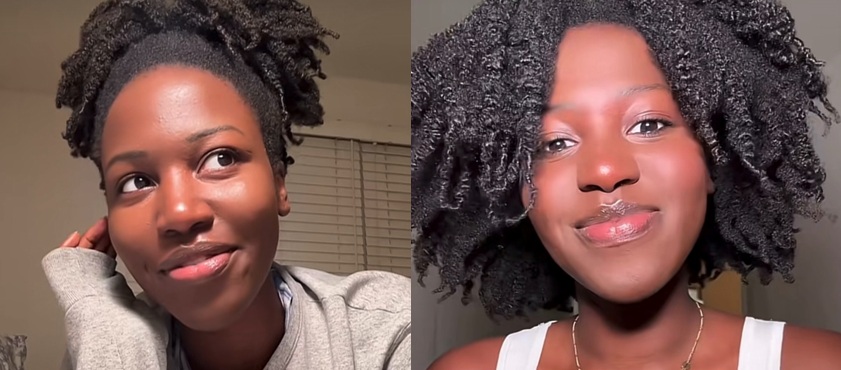
Photo: Screenshot via @aishamarienoelle / TikTok
Aisha Marie Noelle was doing what she's done for over 100,000 followers: sharing joy. The TikTok creator, a political science major and philosopher-in-training from the Dominican Republic, had just hit 110,000 followers on the platform. To celebrate, she uploaded a short video of herself singing, smiling, and dancing—a routine milestone post that her community had come to love. But when TikTok's AI-generated video summary appeared beneath her content, the celebration turned into a disturbing algorithmic insult.
"This video features an animated sequence where a person's face gradually transforms into a stylized monkey face," the AI summary read. There was only one problem: No such transformation existed. The video contained no animation, no filters, and no monkey imagery of any kind. Aisha was simply being herself—singing, celebrating, and existing as a Black woman on a platform whose artificial intelligence had just, without evidence or cause, compared her to a primate.
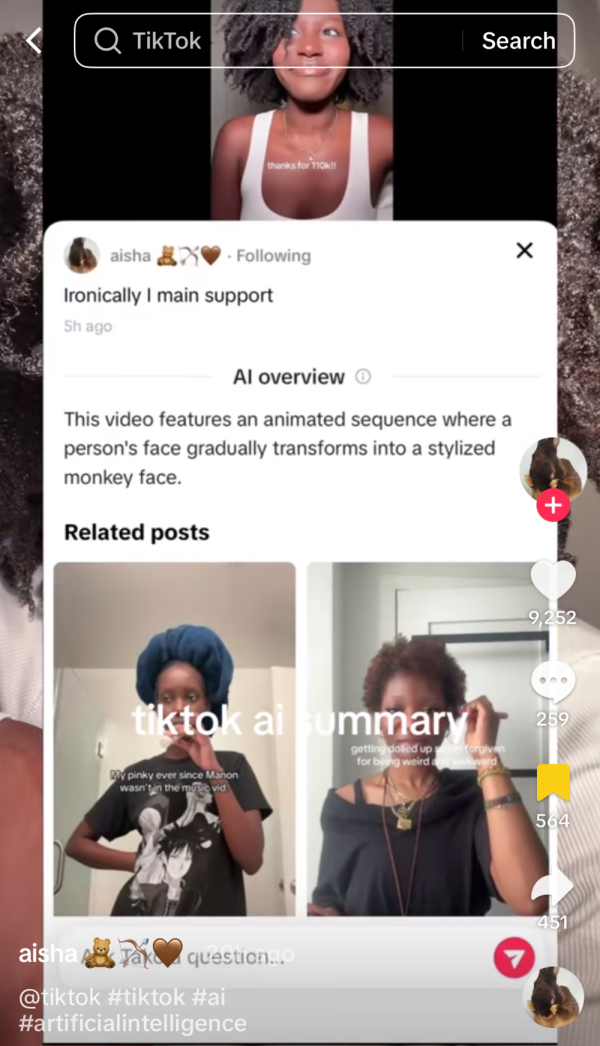
Photo: Screenshot of TikTok's AI-generated summary erroneously describing Aisha's celebration video.
The incident, first shared by one of her followers, has reignited a painful and well-documented conversation about racial bias in artificial intelligence systems. For decades, AI models—particularly those trained on uncurated internet data—have consistently misidentified Black people as apes, gorillas, and other primates. In 2015, Google Photos famously tagged a Black couple as "gorillas." In 2021, Facebook's AI auto-generated "primate" suggestions for videos featuring Black men. And now, TikTok's automated summary tool has added its own entry to that ugly timeline.
A Celebration, Not a Caricature
Aisha Marie Noelle is not an anonymous viral accident. She is a thoughtful content creator with a growing audience—over 100,000 followers on TikTok alone. A political science major with a minor in philosophy, she originally moved from the Dominican Republic to Houston in 2021. Her content regularly explores social commentary, academic theories, feminism, community empowerment, and even foreign policy. One of her most discussed pieces is titled "The United States of Israel," a sharp critique of international relations. She has also shared personal milestone videos—Q&As, "Mommy n me" celebrations, and exactly the kind of genuine, unfiltered check-ins that make TikTok feel human.
Her 110K celebration video was firmly in that latter category. Viewers who have since rewatched the clip describe it as warm, unpolished, and joyful—a woman singing along to music, smiling at the camera, and acknowledging her community's support. There are no special effects. No animated overlays. No "stylized monkey face," as the AI claimed. Just a Black woman existing publicly.
- No animation present: The video is a straightforward, unfiltered recording with zero digital alterations or face filters.
- No primate imagery: Independent reviews of the clip confirm absolutely no monkeys, apes, or stylized animal faces.
- Racial pattern: The AI misidentification mirrors years of documented algorithmic bias specifically targeting Black individuals.
The question, then, is not whether TikTok's AI made an error. The question is how a system with no visual evidence of a monkey could confidently assert that a Black woman's face was "transforming" into one. The answer, researchers say, lies in the data.
The Bias Is Built In
Artificial intelligence models are not neutral. They are trained on massive datasets scraped from the internet—datasets that contain centuries of racist caricature, dehumanizing imagery, and unequal representation. When an AI has seen disproportionately more images of Black faces labeled alongside primates (whether in racist memes, historical stereotyping, or unbalanced training sets), it learns to make that association faster and more confidently than it should.
"This is not a bug. It's a feature of how these systems are built," says Dr. Simone Okonkwo, an AI ethics researcher at Howard University who was not involved in the TikTok incident but has studied racial bias in commercial AI. "If you train a model on a dataset that overrepresents Black faces in degrading contexts, it will absolutely generate degrading outputs. The machine isn't being malicious—it's being accurate to the data we fed it. That's the terrifying part. We built the bias, then we automated it."
TikTok has not yet issued a public explanation for how its video summary AI generated the "monkey face" description. The company's automated content tools are designed to help users quickly understand video content without watching it fully—a feature many critics have called unnecessary and, in cases like this, actively harmful.
Indeed, the AI summary feature has long been unpopular among both creators and viewers. Users report that it frequently mischaracterizes content, strips context, and generates descriptions that feel either bizarrely off or, as in this case, deeply offensive. Yet the tool remains on by default for many users, with no clear way to permanently disable it. Critics argue that TikTok is solving a problem nobody asked for—automated video descriptions—while ignoring the urgent problem of algorithmic racism that everyone is asking about.
A Pattern of Dehumanization
For Aisha Marie Noelle, the AI's error is not an isolated glitch. It is part of a long, exhausting pattern in which technology repeatedly fails to recognize Black humanity. From facial recognition systems that misgender and misidentify Black women to chatbots that parrot white supremacist talking points, the tech industry's track record on race is catastrophic.
"I was just singing," Aisha said in a follow-up video addressing the incident. Her voice, calm but weary, cut through the technical jargon. This was not abstract. This was dehumanization, automated and delivered directly to her audience.
The response from her followers was swift and angry. Comments poured in expressing outrage, solidarity, and frustration with a platform that has repeatedly failed creators of color. "This is why we keep saying tech companies need Black people in every room where AI is built," one user wrote. "Not just as consultants—as decision-makers." Another added: "The AI summary feature is useless anyway. But even if it worked perfectly, it shouldn't be allowed to be racist."
As of this publication, TikTok has not issued an apology or technical explanation. The video remains live, with the "monkey face" description still attached—a small but brutal reminder that algorithms, left unchecked, will repeat the worst of human history at scale.
For Aisha Marie Noelle, the calculus is simple. She did not ask for this feature. She did not ask to be a test case for algorithmic racism. She asked only to celebrate 110,000 followers. That request, apparently, was too much for TikTok's AI to handle without reverting to the kind of dehumanizing imagery that no Black person in 2026 should have to fight against—especially not from a machine.
No Ads. By Us. For Us.
This article was only made possible by readers like you. We hope it inspired you to support Emerald Book, so we can continue producing content like this.
We will never show you ads, never sell your data, and never require a subscription to consume our content. Your gift helps us keep the truth accessible.
Please click the Support button on the bottom right of your screen to make a gift of any amount today.
Thank you for making this work possible.