

Emerald Pages
◆
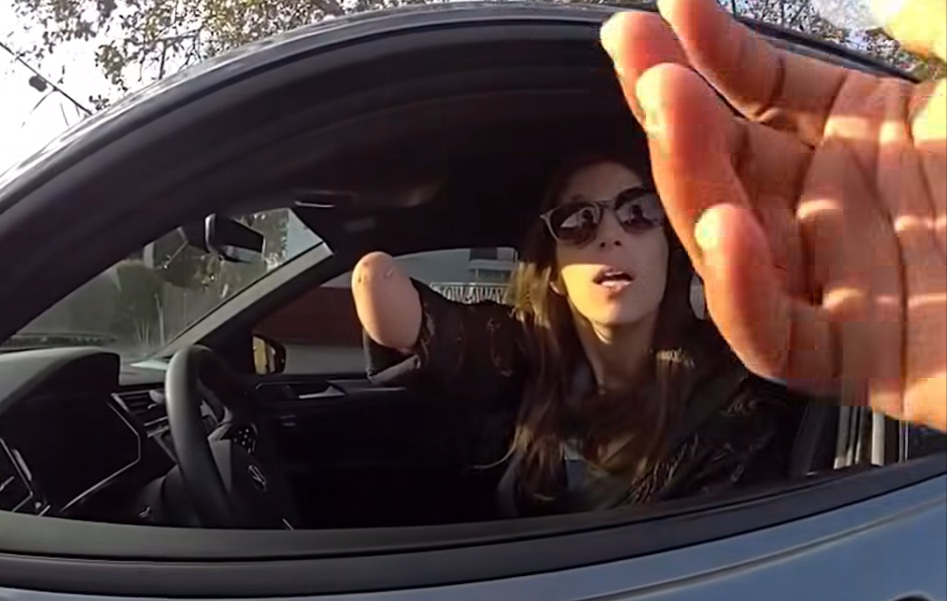
Photo: TikTok | @slightlyoff.balance
The blue lights flashed in Kathleen "Katie" Thomas's rearview mirror on a quiet February evening along North Dixie Highway in Lake Worth Beach, Florida. An adaptive athlete and fitness influencer born with a limb difference, Thomas assumed it would be a routine stop—maybe a broken taillight, maybe nothing at all. But when the Palm Beach County Sheriff's deputy approached her window and leaned down with absolute conviction, the interaction took a turn no one could have predicted.
"You drove past me holding the phone with your right hand, manipulating that phone," the deputy declared. "I mean, I saw you." Thomas, who has lived her entire life without a right hand—her arm ends just below the elbow—giggled at the absurdity. She lifted her residual limb toward the window, smiled, and said, "Obviously not. So, you want to just call this a day?" It was the moment when common sense should have prevailed. It did not.
Instead of apologizing or retreating, the deputy doubled down. The body-camera footage, which would later amass over 23 million views in just 48 hours, captured a surreal interrogation. "Did you or did you not hold a phone with your right hand?" he pressed. Thomas, still trying to defuse the tension, raised her right arm again. The deputy then asked her to swear "hand to God" that she hadn't been holding a phone. She complied, raising her arm once more. And then came the moment that turned a traffic stop into a viral symbol of institutional absurdity: the deputy looked at her limb and flatly corrected her. "The other hand to God," he said.
The overwhelming viral backlash brought immediate embarrassment to the department. Just one day before the trial, the deputy who wrote the ticket formally requested the court to drop the case. The official court records log the reason for dismissal as "insufficient evidence."The Palm Beach County Sheriff's Office later issued a statement defending the deputy's split-second real-time observation, but noted that they ultimately withdrew the charge due to a "lack of clarity on how violations are labeled in our citation software." They also confirmed that an internal agency review of the traffic stop is underway.
Thomas later admitted that while she initially expected a shared laugh, the deputy's absolute refusal to back down left her feeling deeply unsettled. He handed her a $116 traffic citation and told her she could take it to court if she disagreed. That bureaucratic shrug—"fight it in court"—is, for criminal justice reformers, the telltale signature of an American policing system that prioritizes procedure over humanity and authority over accountability.
The Global Training Gap: 21 Weeks vs. 3 Years
To understand how a deputy could stare at an amputated limb and still issue a ticket for using the missing hand, you have to look at what American police academies actually teach—and, more critically, what they leave out. According to the U.S. Bureau of Justice Statistics, the average American police recruit receives just 806 hours of basic training. That sounds substantial until you compare it to the rest of the developed world.
- The U.S. Average: ~806 academy hours (roughly 20 weeks) before field training.
- Germany & Finland: 2.5 to 3 years of academic and tactical study, including university degrees in criminal justice.
- Japan: 15 to 21 months of training before an officer patrols alone.
- The Cosmetology Comparison: In states like Illinois, a cosmetology license requires 1,500 classroom hours—more than double the 560-640 hours required for a police academy graduate.
American academies prioritize firearms (73 hours on average) and defensive tactics (64 hours) while spending a fraction of that time on de-escalation, ethics, and disability awareness. The result is a "warrior" mentality that emphasizes command presence over communication—an approach that makes it nearly impossible for an officer to admit a mistake once a citation has been announced.
So Much Misconduct: Millions of Hours
The Thomas case is not an isolated anecdote; it is a window into a much larger crisis. It is impossible to state an exact number of police misconduct videos online because there is no single, centralized repository that tracks them all. However, the total number spans hundreds of thousands, if not millions, of hours of footage distributed across social media, activist databases, and official government portals.
The 2020PB Project, born out of the George Floyd protests, cataloged over 500 vetted videos of aggressive police behavior in just the first weeks of the demonstrations. Human rights organizations like WITNESS Media Lab have reviewed hundreds of hours of community-led abuse footage. And because over 80% of local U.S. police officers now wear body-worn cameras, an immense volume of public records requests feeds viral content channels. The deputy who ticketed Thomas knew he was being recorded; he simply did not believe he was wrong. That is not a camera issue. That is a training issue so profound that many departments are now turning to artificial intelligence just to sift through the millions of hours of footage to flag misconduct.
The Aftermath: Grace, Not Bitterness
In interviews following the viral explosion, including an appearance on CBS Mornings, Thomas displayed remarkable grace. She stated she holds no ill will toward the deputy. Instead, she hopes the video serves two purposes: normalizing limb differences and highlighting the urgent need for better law enforcement training when interacting with individuals with disabilities.
"I don't think he was a bad person," Thomas said. "I think he was a person trained to never be wrong in the moment. And that training is what really needs to change." The deputy has not been publicly identified or disciplined beyond the internal review. The citation is gone. The body-camera footage remains. And across America, millions of viewers have watched a five-minute traffic stop that distilled a generation of criticism about U.S. police training into a single, unforgettable line: "The other hand to God."
Until the United States decides to fund police education at the level it funds military equipment and tactical gear, stories like Katie Thomas's—where common sense loses to ego and procedure—will remain a staple of the evening news. The deputy wanted her to raise her other hand. She didn't have one. The system, it turns out, didn't either.
No Ads. By Us. For Us.
This article was only made possible by readers like you. We hope it inspired you to support Emerald Book, so we can continue producing content like this.
We will never show you ads, never sell your data, and never require a subscription to consume our content. Your gift helps us keep the truth accessible.
Please click the Support button on the bottom right of your screen to make a gift of any amount today.
Thank you for making this work possible.