

Emerald Pages
◆
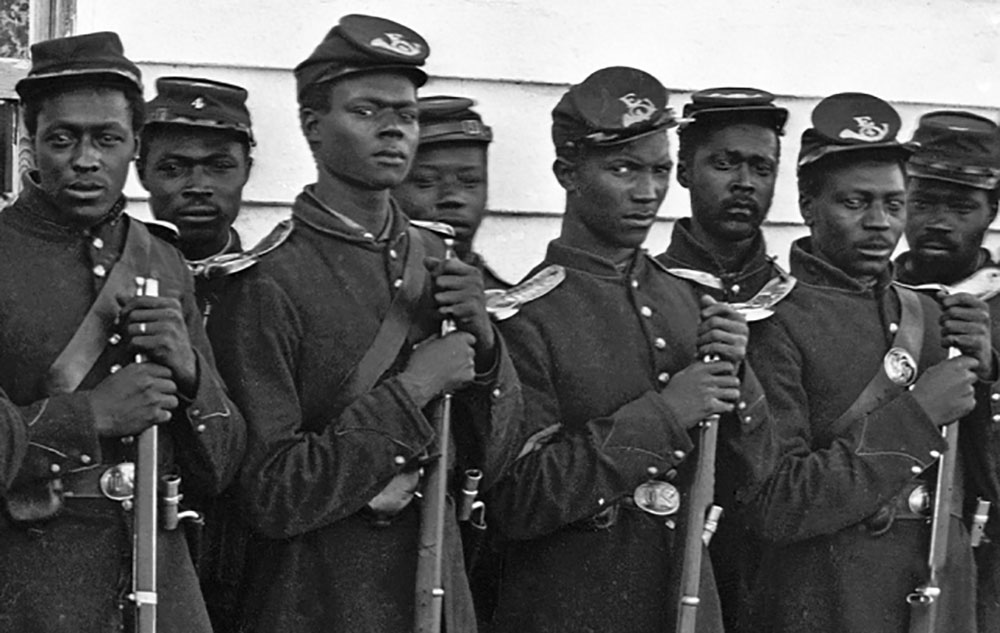
Photo: William A. Gladstone Afro-American Military Collection, Manuscript Division, Library of Congress, Washington, D.C.
The story of Memorial Day did not begin with a general's order or a congressional proclamation. It began with shovels in the dirt, with calloused hands digging up a mass grave behind a Confederate prison camp. It began with 28 formerly enslaved men who, in the spring of 1865, decided that the Union soldiers who died for their freedom deserved more than a pauper's burial.
On May 1, 1865, just weeks after the Confederate surrender at Appomattox, a crowd of 10,000 people—overwhelmingly newly freed Black Americans—gathered at the Washington Race Course in Charleston, South Carolina. What they created that day was the nation's first large-scale, organized Memorial Day commemoration. Yet for more than a century, their story was deliberately erased from the national narrative.
To understand how Black soldiers and freed people invented Memorial Day, we must first understand what happened at the Washington Race Course. During the final year of the Civil War, Confederate forces had transformed this elegant horse racing track—a playground for the low-country planter aristocracy—into an open-air prison camp. At least 257 Union soldiers died there from disease, exposure, and starvation. Their bodies were thrown into a chaotic mass grave behind the track's grandstands, denied even the dignity of individual burial.
How Freed People Built the First Memorial Day
When Charleston fell to Union forces in February 1865, white residents fled the city. The emancipated Black population remained—and they immediately set to work righting the wrongs they found. Over a two-week period in April 1865, a group of 28 Black workmen volunteered to exhume the mass grave. Carefully, reverently, they uncovered the bodies of the 257 Union soldiers and reinterred them into neat, individual graves.
But they did not stop there. These men built a tall, 100-yard whitewashed wooden fence completely surrounding the new graveyard. At the front entrance, they erected a large archway and painted the words: "Martyrs of the Race Course." It was a radical political statement—reclaiming the land of the slaveholding elite to honor the men who died fighting for Black liberation.
- 28 freed Black men exhumed and properly reburied every Union soldier from the mass grave
- 3,000 Black schoolchildren led the parade carrying roses and singing "John Brown's Body"
- The 54th Massachusetts Infantry Regiment—the famous all-Black Union unit—marched in double-time through the event
- 10,000 attendees gathered for speeches, scripture readings, and a massive picnic celebrating freedom
On the morning of May 1, 1865, the ceremony began at 9:00 AM. The procession was led by 3,000 Black schoolchildren, arms overflowing with spring flowers, singing the abolitionist anthem "John Brown's Body." They were followed by hundreds of Black women carrying floral baskets and crosses, then Black men marching in strict cadence. Finally, a full brigade of Union infantry—including the famous 54th Massachusetts and the 21st U.S. Colored Infantry—marched in double-time columns around the graves.
Why Their Story Was Hidden
Despite being the earliest recorded mass commemoration of its kind, this event was systematically erased from American history. As white Southerners retook political control of the South during the post-Reconstruction era, the story was suppressed locally. The very site of the first Memorial Day was transformed into Hampton Park, named to honor Wade Hampton III—a former Confederate general and leader of the white supremacist "Redeemer" movement that stripped Black Americans of their voting rights.
For more than a century, the memory of the 10,000 freed people and the "Martyrs of the Race Course" was pushed out of local guidebooks and history texts. The Union soldiers buried at the racecourse were disinterred and moved to the Beaufort National Cemetery, leaving the site empty of its graves. The story might have remained buried forever had it not been for Yale historian David Blight, who in 1996 discovered a handwritten veteran's narrative tucked into an unsorted archive at Harvard University, pointing researchers back to the original newspaper archives.
From Local Tribute to National Holiday
The Charleston commemoration inspired similar traditions across the South, particularly among women's memorial associations. The National Cemetery Administration specifically recognizes Mary Ann Williams of the Ladies Memorial Association of Columbus, Georgia, for originating the idea of a fixed annual date to blanket the graves of both Union and Confederate soldiers with spring flowers.
These scattered local traditions directly inspired Major General John A. Logan, leader of the Grand Army of the Republic (a Union veterans organization). On May 5, 1868, Logan issued General Order No. 11, designating May 30, 1868, as a nationwide "Decoration Day" to honor those who died in the Civil War. He chose May 30 because it did not mark the anniversary of any specific battle and ensured flowers would be in full bloom across all states.
Originally restricted to honoring those lost in the Civil War, the holiday expanded after World War I to commemorate American personnel who died in all U.S. military conflicts. In 1966, President Lyndon B. Johnson and Congress officially declared Waterloo, New York, as the "birthplace" of Memorial Day, recognizing that town's community-wide observance on May 5, 1866. Finally, Congress passed the Uniform Monday Holiday Act, which went into effect in 1971, establishing "Memorial Day" as a federal holiday anchored to the last Monday in May.
Restoring the True History
Today, the site of the first Memorial Day is still Hampton Park, located next to The Citadel military college in Charleston. But the historical narrative has begun to shift. The city of Charleston dedicated a First Memorial Day Historical Marker inside the park, near the reflecting pool. The plaque officially cements the role of those newly freed Black Americans into the landscape that was once dedicated to a Confederate general.
The soldiers of the 3rd U.S. Infantry Regiment (The Old Guard) still walk through Arlington National Cemetery just before the holiday weekend, placing a small American flag in front of all 260,000+ gravestones—a direct continuation of what those 10,000 freed people did in Charleston so long ago. And every year, as Americans fire up their grills and head to the beach for the unofficial start of summer, a quieter tradition persists: at 3:00 PM local time, the National Moment of Remembrance asks everyone to pause for one minute of silence.
The story of Memorial Day is not simple. It involves a Confederate general's park, a Union general's order, a New York town's proclamation, and a federal law. But it begins, as so many American stories do, with the courage and vision of Black Americans who, in their first days of freedom, understood that the men who died for their liberation deserved to be remembered. They built a cemetery. They marched with flowers. They sang for victory. And in doing so, they invented a tradition that would outlast the attempts to erase it.
No Ads. By Us. For Us.
This article was only made possible by readers like you. We hope it inspired you to support Emerald Book, so we can continue producing content like this.
We will never show you ads, never sell your data, and never require a subscription to consume our content. Your gift helps us keep the truth accessible.
Please click the Support button on the bottom right of your screen to make a gift of any amount today.
Thank you for making this work possible.