

Emerald Pages
◆
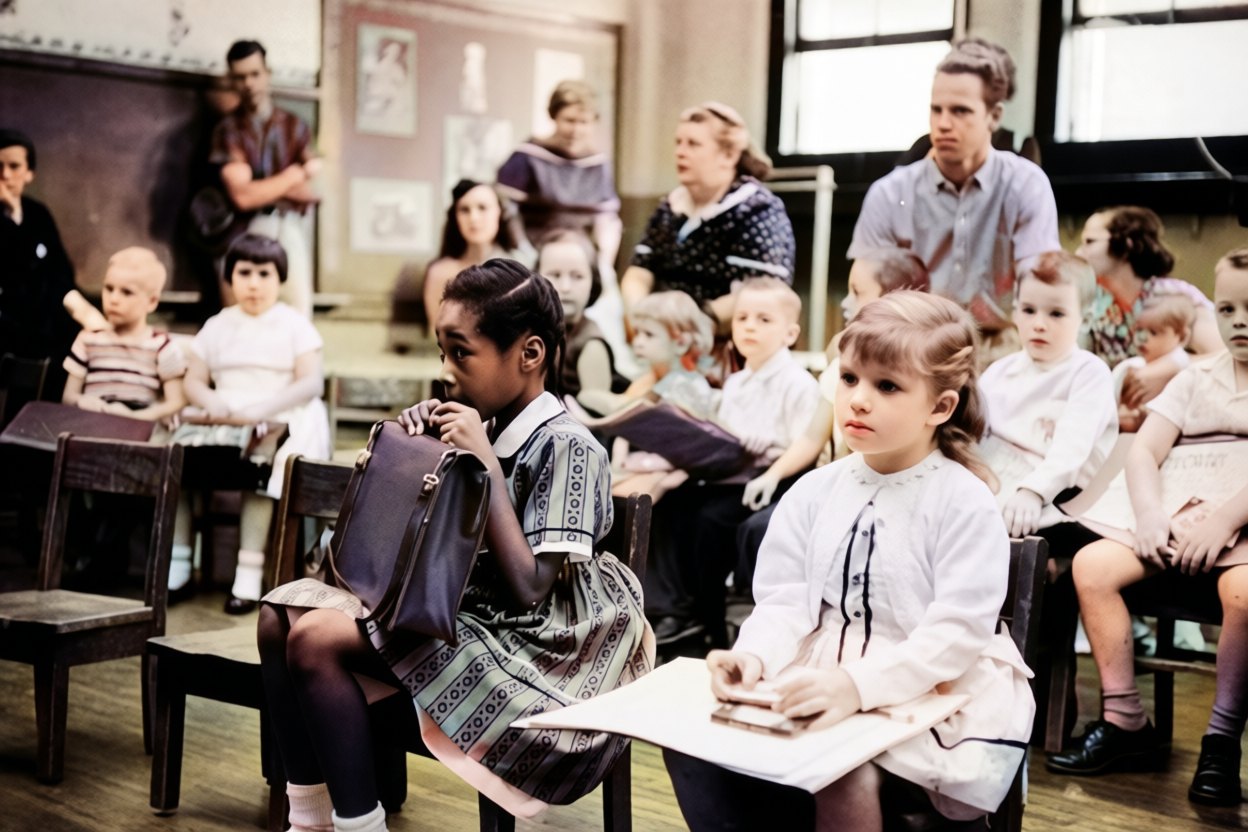
Photo: Facebook | African American History
When parents choose majority-White schools for their Black children, they are often seeking opportunity: smaller class sizes, advanced courses, well-funded arts programs, and a pathway to elite colleges. But beneath the glossy brochures and impressive test score averages lies a reality that researchers from the American Psychological Association and the National Institutes of Health have been documenting for decades. The psychological harm of placing Black students in Predominantly White Institutions (PWIs) is not anecdotal — it is a predictable, measurable outcome of racial isolation, hyper-surveillance, and cultural erasure.
While these environments are frequently chosen for their academic resources, the accompanying social and emotional toll can severely jeopardize a child's mental health. From chronic minority stress to the burden of constant representation, Black children in majority-White schools navigate a minefield that their white peers never see. We examined the four primary categories of psychological harm identified by researchers, the developmental impact across grade levels, and the uncomfortable question: is the educational benefit worth the cost?
1. Chronic Minority Stress and Hyper-Surveillance
The most pervasive harm documented by researchers is what they call Racial Battle Fatigue — the psychological and physiological exhaustion that comes from constantly anticipating and navigating racial stress. Black students in majority-White schools report feeling as though they are always "on stage," aware that any mistake, any slip in behavior, any emotional reaction will be interpreted through the lens of negative stereotypes about Black people.
This pressure to be "perfect" — to outperform peers just to be seen as average — creates an intense burden of representation. One student interviewed in a Northeastern University study described it this way: "If I get a B, it's because I'm lazy. If the white kid next to me gets a B, it's just a B." Studies tracking the health of minoritized adolescents note that those attending highly White schools report double the rates of depressive-anxious and somatic symptoms, including frequent headaches, stomach aches, and chest pains — physical manifestations of unrelenting stress.
2. Deep Social Isolation and Alienation
Belonging is not a luxury — it is a psychological necessity. Yet qualitative studies reveal that Black students in majority-White high schools experience a profound deficit in their sense of institutional belonging. They routinely struggle to form genuine relationships with peers who do not understand their lived experiences, who may ask intrusive questions about their hair, their speech, or their cultural practices, or who simply exclude them from social events altogether.
Cultural invisibility compounds this isolation. School curricula, social norms, and beauty standards in PWIs typically cater to the white majority. Black history is often reduced to slavery and the Civil Rights Movement — two units that position Black people as either victims or saviors, never as full, complex human beings. In this environment, Black students can feel invisible or, paradoxically, viewed as "exotic outsiders." The result is a loneliness that follows them from the cafeteria to the classroom to the bus ride home.
- Lack of mirrored peers: Without other Black students to affirm their experiences, children internalize the message that their way of being is abnormal or lesser.
- Social exclusion patterns: Black students are systematically left out of study groups, birthday parties, and informal mentoring networks that white peers take for granted.
- Code-switching exhaustion: Constantly modulating speech, dress, and behavior to fit white norms is mentally draining and erodes authentic self-expression.
3. Identity Confusion and Internalized Racism
When immersed exclusively in white cultural norms without a strong counter-balancing foundation at home or in the community, children may develop what psychologists call an identity crisis. They struggle to integrate mainstream U.S. culture with their Black cultural heritage. Without active racial socialization — deliberate teaching about Black history, culture, and pride — children in predominantly white spaces are at risk of internalizing the systemic biases of their surroundings.
This internalization can manifest in heartbreaking ways: a child who refuses to play with Black dolls, who expresses a preference for lighter skin or straighter hair, who distances themselves from Black peers to gain acceptance from white classmates. By adolescence, these students may actively reject their own culture, viewing it as an obstacle to success. The tragedy is that this rejection does not guarantee acceptance — white peers rarely see them as "one of us," leaving them stranded between two worlds.
4. Adultification and Discriminatory Discipline
Perhaps the most externally visible harm is the discipline gap. Academic research consistently shows that Black children in majority-White schools are disproportionately subjected to harsher disciplinary practices — suspensions, expulsions, and referrals to law enforcement — for the exact same behaviors as their white classmates. This is driven by a phenomenon researchers call adultification bias: the tendency of white educators, often unconsciously, to view young Black children (especially girls) as older, less innocent, and more aggressive than their white peers.
A Black kindergartener who throws a tantrum is labeled "threatening" while a white classmate doing the same thing is "having a bad day." A Black teenager talking back to a teacher is "defiant" and "dangerous" while a white teenager is "assertive" or "going through a phase." These differential perceptions lead to real consequences: Black students lose instructional time, develop records of misbehavior that follow them from grade to grade, and internalize the message that they are inherently bad. This early penalization erodes trust in adult authority and educational systems — a loss that rarely heals.
Developmental Harm Across Grade Levels
The impact of racial isolation is not uniform — it shifts and intensifies as children develop. Understanding these developmental windows is critical for parents and educators seeking to mitigate harm.
Early childhood (Grades K-5): Children form racial identities by age four. When they enter majority-White schools without peers who look like them, they can develop early internalized biases — preferring white features, feeling their own appearance is inferior, or expressing shame about their families. Adultification bias means Black elementary students face higher suspension rates than their white peers for identical behaviors, replacing a warm introduction to education with institutional rejection before they can even read proficiently.
Middle school (Grades 6-8): This stage centers on forming a personal identity. Lacking a Black peer group forces students to choose between masking their authentic culture to fit in or facing total social exclusion. Teachers frequently call on the few Black students to speak as the definitive voice for their entire race during history lessons — a burden no child should carry. Meanwhile, early romantic and social pairing begins, and Black students are often excluded due to Eurocentric beauty standards that dominate the school's social hierarchy.
High school (Grades 9-12): By this stage, the cumulative toll manifests as chronic racial battle fatigue — severe academic burnout, high anxiety, and clinical depression. School counselors and teachers in majority-White schools are statistically less likely to recommend Black students for Advanced Placement or honors tracks, steering them instead toward remedial courses even when their test scores match or exceed white peers. School Resource Officers disproportionately target and monitor Black teenagers, criminalizing normal adolescent rebellion. The result is not just psychological damage but a systematic funneling away from the very opportunities that motivated the school choice in the first place.
The Education Benefit: Real, Conditional, or Myth?
This raises a difficult question: given these harms, is the educational benefit of majority-White schools real? The answer, according to economists and sociologists, is complicated. The academic benefits associated with predominantly White schools are largely driven by funding, resources, and institutional stability — not the racial makeup of the student body. Due to historic housing discrimination, majority-White school districts generally possess larger property tax bases, yielding advanced science labs, well-funded arts programs, newer textbooks, and better-maintained infrastructure.
However, the assumption that merely placing a Black student in a resource-rich environment guarantees an elite education is a myth. In practice, segregation often continues inside the school building through a process known as "second-generation segregation" or tracking. Black students are statistically far less likely to be recommended for advanced tracks by white staff, even when their test scores match their white peers. White teachers routinely underestimate the academic capability of Black students, leading to lower grading standards and less encouragement. The discipline gap actively disrupts learning. And Stanford University research reveals that the academic achievement gap between Black and white students actually widens in wealthy, highly educated towns.
Prominent Black scholars, such as sociologist Noliwe Rooks in her book Integrated, argue that the historical implementation of desegregation decimated Black educational self-determination. When schools integrated following Brown v. Board of Education, the burden was placed entirely on Black children. Over 38,000 Black teachers and principals were fired, and thousands of historically excellent, supportive Black schools were permanently closed. Black children were forced into hostile environments where their intellect was doubted daily. A landmark study by economist William A. Darity Jr. at Duke University found that Black adults who attended racially balanced or majority-White schools in the mid-20th century actually completed less total schooling than those who attended predominantly Black schools. The psychological trauma and daily discrimination effectively canceled out the resource benefits.
What Can Be Done?
Acknowledging these harms is not an argument against integration. It is an argument for integration that prioritizes the psychological safety and cultural affirmation of Black children. For parents currently navigating these environments, researchers recommend several protective strategies: deliberate racial socialization at home (teaching children Black history, culture, and pride before the school can teach them inferiority); building community with other Black families in the same school or district; advocating for diverse staff hiring and anti-bias training; and being willing to transfer a child out of a school that is causing measurable psychological distress.
For educators and administrators, the evidence is clear: diversity without inclusion is not enough. Schools must move beyond counting Black bodies in enrollment statistics and examine internal tracking patterns, discipline disparities, curriculum representation, and the daily lived experiences of their Black students. Until then, placing Black children in majority-White schools will remain what it has always been for too many families: a trade-off between resources and mental health, between opportunity and belonging, between a better resume and a whole self.
No Ads. By Us. For Us.
This article was only made possible by readers like you. We hope it inspired you to support Emerald Book, so we can continue producing content like this.
We will never show you ads, never sell your data, and never require a subscription to consume our content. Your gift helps us keep the truth accessible.
Please click the Support button on the bottom right of your screen to make a gift of any amount today.
Thank you for making this work possible.