

Emerald Pages
◆
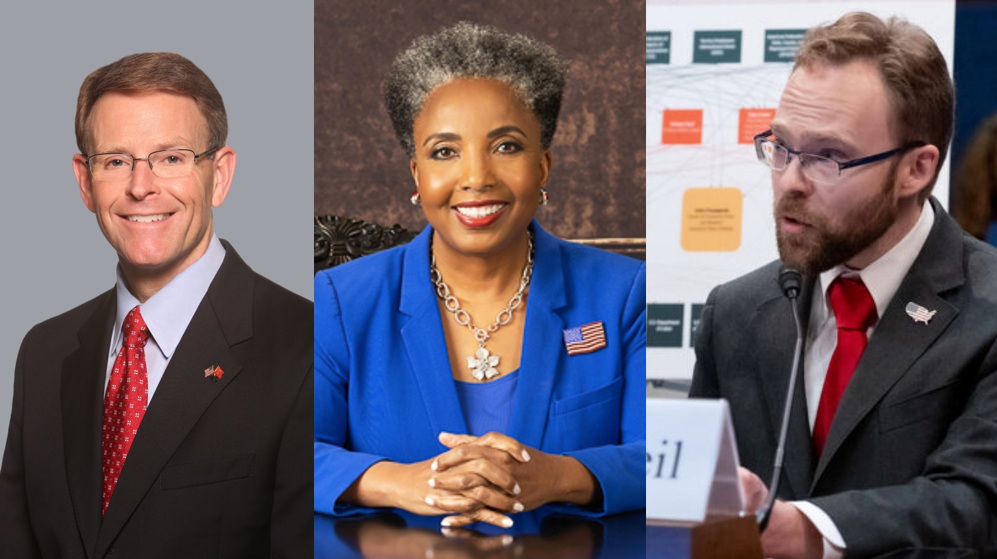
Tony Perkins (left), Dr. Carol Swain (center), Tyler O'Neil (right) Photo: Emerald Book Image
A routine congressional hearing aimed at scrutinizing the Southern Poverty Law Center erupted into chaos on Wednesday when three Republican-selected witnesses repeatedly refused—or outright failed—to label the Proud Boys and neo-Nazis as white supremacist organizations. The dramatic exchange forced Rep. Jasmine Crockett (D-TX) to abandon judicial courtesy and directly admonish the panel, declaring that the groups are, in her words, "freaking white supremacists."
The hearing, titled "The Southern Poverty Law Center: Manufacturing Hate," was convened by the House Judiciary Committee's Republican majority specifically to attack the credibility of the SPLC, a watchdog that tracks domestic hate groups. But the proceedings quickly backfired when Democrats turned the spotlight onto the GOP witnesses' own definitions of extremism. Under direct questioning, the three experts and advocates selected by Republicans equivocated, dodged, and hid behind technicalities rather than give a simple "yes" or "no" answer.
The first confrontation came when Rep. Crockett asked witness Tyler O'Neil, a senior editor at the conservative outlet The Daily Signal, whether the Proud Boys are a white supremacist organization. O'Neil answered flatly: "No, they're not white supremacist." When Crockett pressed further, Dr. Carol Swain, a conservative legal scholar and former professor, refused to commit, stating that the classification "depends on how you define it."
The Neo-Nazi Evasion
Perhaps most stunning was the testimony of Tony Perkins, president of the Family Research Council, a prominent conservative Christian policy organization. When asked whether neo-Nazis are white supremacists—a question that for most Americans requires no deliberation—Perkins initially refused to give a direct affirmative. Instead, he offered that neo-Nazis are "certainly antisemitic," substituting one form of hatred for another to avoid uttering the specific phrase "white supremacist." Only after Crockett repeatedly cut him off and demanded a straight up-or-down answer did Perkins issue a reluctant, hedged "yes."
The contrast could not have been starker. Immediately afterward, Crockett turned to Maya Wiley, the president of the Leadership Conference on Civil and Human Rights—a witness called by Democrats. When asked the exact same two questions, Wiley answered "Yes" to both without hesitation or qualification.
- Tyler O'Neil (The Daily Signal): Said the Proud Boys are "not white supremacist."
- Dr. Carol Swain (Conservative scholar): Said it "depends on how you define it" for both groups.
- Tony Perkins (Family Research Council): Called neo-Nazis "antisemitic" but evaded "white supremacist" until pressed.
Following the panel's collective hesitation, Rep. Crockett threw her hands up in visible frustration. "Woo! Thank God! Jesus Christ, I didn't think we were going to get there," she exclaimed. Then, leaning directly into the microphone, she delivered the line that has since gone viral across social media: "Let me be clear. Proud Boys are freaking white supremacists. Neo-Nazis are too." She then accused the committee's Republican majority of "coddling" and "minimizing" groups that participated in the January 6 attack on the U.S. Capitol.
Why Couldn't They Say It?
To outside observers, the witnesses' refusal to use a seemingly obvious label appeared baffling. But the hesitation was not an accident; it was a calculated political and legal strategy. According to documents and statements from the hearing, the Republican witnesses were operating under two primary pressures.
First, the hearing took place amid intense scrutiny over a $1.8 billion Trump-administration program nicknamed the "Anti-Weaponization Fund." This Department of Justice-backed program was designed to financially compensate individuals who claim they were unfairly targeted by federal investigations—including several defendants tied to January 6 who have documented affiliations with the Proud Boys. If the witnesses openly admitted on the congressional record that the Proud Boys are a white supremacist organization, they would effectively be acknowledging that the government was using taxpayer money to reimburse white supremacist extremists.
Second, the witnesses were explicitly assembled to discredit the Southern Poverty Law Center's authority to designate hate groups. Organizations like the Family Research Council and media outlets like The Daily Signal have been flagged or criticized by the SPLC in the past. By arguing over definitions—claiming the Proud Boys are merely "nationalists" or "anti-immigrant" rather than "white supremacist"—the witnesses attempted to paint the SPLC's entire methodology as politically motivated fraud. Agreeing with the SPLC's classification would have legitimized the watchdog's authority to label hate groups, undermining the central premise of the Republican hearing.
Mainstream watchdog organizations, including the Anti-Defamation League and the Southern Poverty Law Center itself, have long documented that both the Proud Boys and neo-Nazi movements traffic heavily in white supremacist, antisemitic, and white nationalist ideologies. The Proud Boys, despite having some non-white members and leaders such as Enrique Tarrio, have been designated by the SPLC as a hate group due to their track record of violent rhetoric against minorities, women, and left-leaning political opponents.
The hearing ultimately highlighted a profound and deeply consequential divide in American politics: not just over policy, but over the very words used to describe hate groups. By prioritizing semantic escape hatches and defending a massive government compensation fund, the three witnesses created a nationally televised moment that many viewers found shocking. For Rep. Crockett and the Democratic members of the committee, the episode served as proof that the Republican majority is more interested in shielding extremists than confronting them.
As the hearing adjourned, one thing was clear: the question of whether domestic extremist groups should be called what they are remains, for some in Congress, a surprisingly difficult question to answer.
No Ads. By Us. For Us.
This article was only made possible by readers like you. We hope it inspired you to support Emerald Book, so we can continue producing content like this.
We will never show you ads, never sell your data, and never require a subscription to consume our content. Your gift helps us keep the truth accessible.
Please click the Support button on the bottom right of your screen to make a gift of any amount today.
Thank you for making this work possible.