

Emerald Pages
◆
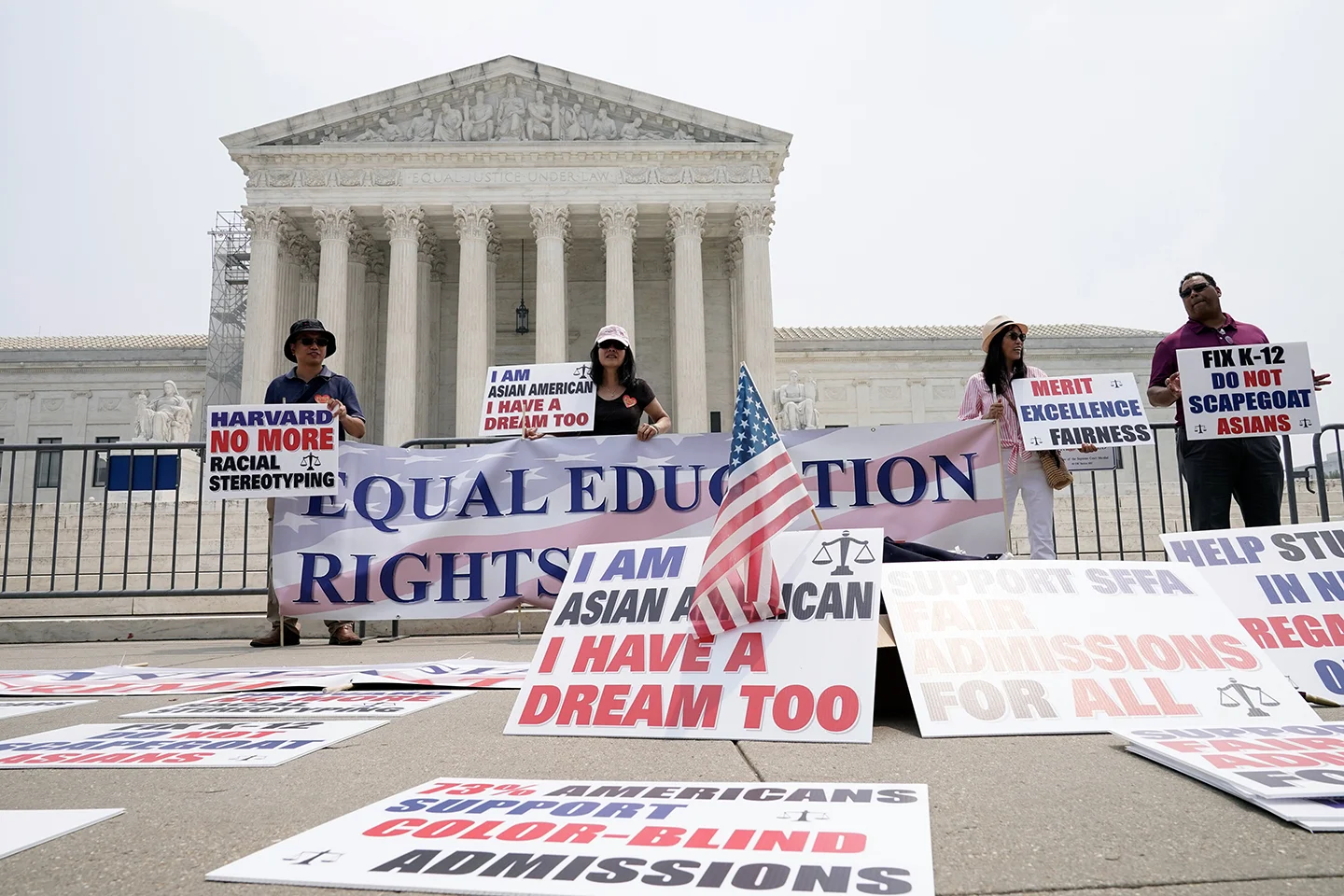
Photo: Mariam Zuhaib | AP
WASHINGTON, D.C. — Two years after the Supreme Court struck down race-conscious admissions in Students for Fair Admissions v. Harvard, the promises of a radical demographic shift at America's elite universities have turned to dust. Contrary to the fierce rhetoric of 2023, which argued that the decision would finally level the playing field for disgruntled white applicants, the Class of 2029 has arrived on campus, and virtually nothing has changed for the demographic the policy was supposedly "saving."
In fact, the data suggests the ruling has been a catastrophic failure for its intended beneficiaries while actively harming underrepresented minorities. The assumption was that without racial guardrails, elite campuses would inevitably become whiter. Instead, according to the latest 2026 enrollment reports compiled by The Hechinger Report and the National Bureau of Economic Research, white student enrollment has remained so flat that the numbers are statistically insignificant.
According to data tracking the 2024 and 2025 admissions cycles, among 71 private, highly selective colleges, the total number of incoming white male students in the first two post-ruling cycles increased by less than 100 students per year. At the Massachusetts Institute of Technology (MIT), the percentage of enrolled white students actually dipped slightly from 38 percent to 37 percent, while the University of North Carolina at Chapel Hill saw its white freshman share move up marginally from 63.7 percent to 63.8 percent. The "white surge" simply never arrived.
The Disappearing Act: Black and Hispanic Enrollment
If white students didn't win, someone had to lose. At highly selective schools, the losses were concentrated almost entirely among underrepresented minority groups—but not in the way many expected. The most dramatic declines hit Black women the hardest. At private selective schools, enrollment for Black women plummeted by 27 percent compared to a 23 percent drop for Black men. Hispanic student enrollment also fell sharply, though not as dramatically as Black enrollment.
The numbers are stark. An analysis by the Philanthropy Roundtable in early 2026 found that highly selective schools saw a large drop in Black first-year students and a smaller decrease for Hispanic students. The nationwide trend was downward: in 2024 and 2025, dozens of elite colleges experienced their largest drops in Black enrollment in 15 years. This is not a minor correction; it is an evisceration of decades of progress toward diverse representation at top institutions.
- Brown University: White student share dropped by 3 percentage points while Asian American enrollment surged from 29% to 33%.
- Columbia University: Asian American freshman share skyrocketed from 24% to 32%, squeezing white enrollment in the process.
- Duke University: Asian American enrollment fell sharply from 35% to 29%, defying expectations of universal Asian gains.
- Yale University: Asian American freshmen plummeted from 30% down to 24% despite the end of affirmative action.
The mixed results for Asian American students came as a major surprise. While some schools like MIT and Johns Hopkins University saw massive Asian American gains, roughly as many top schools saw Asian enrollment drops as those that saw increases. At Yale, Duke, Princeton, Dartmouth, and Bowdoin, Asian American enrollment fell significantly. Experts attribute this to the rise of socioeconomic-based admissions frameworks, which prioritize low-income Pell Grant recipients—a category that statistically excludes many middle-to-higher-income Asian applicants.
The Cascade Effect: Winners and Losers Down the Ladder
While elite schools saw Black and Hispanic enrollment plummet, the news is not uniformly bad across all of higher education. Public flagship universities and regional institutions have emerged as unexpected beneficiaries of what researchers call the "cascade effect." High-achieving minority students who were displaced from Ivy League and elite private schools chose to enroll at top-tier state schools instead.
Overall, freshman enrollment of underrepresented minority groups increased by 8 percent across public flagship universities. The University of Mississippi experienced a massive 50 percent increase in Black freshman enrollment, while Louisiana State University saw its Black freshman cohort increase by 30 percent. Temple University, La Salle University, and North Carolina Central University all recorded major, unexpected surges in Black enrollment.
A small handful of elite schools managed to defy the trend by aggressively recruiting low-income students and expanding financial aid. The University of Virginia and Duke University both reported that the share of Black, Hispanic, and Indigenous students in their incoming classes actually increased from the prior year. Nationwide, 15 out of 18 highly selective institutions drastically increased their share of Pell Grant-eligible students to offset the ban on race-conscious admissions.
However, researchers note a troubling downside to the cascade effect. Because students cascaded down to less selective colleges, high-achieving Black students are increasingly attending institutions that historically have lower graduation rates and fewer elite alumni networking opportunities. Meanwhile, total enrollment dropped at historically Black colleges and universities, concentrating gains in the public state sector rather than spreading them equitably.
The Gender Wildcard
A final complicating factor is gender. Women now make up nearly 60 percent of all college students nationwide, and many colleges have quietly practiced a form of "affirmative action for men" by relaxing standards for male applicants to maintain a 50/50 gender balance. With ongoing federal scrutiny of Diversity, Equity, and Inclusion initiatives in 2026, experts predict that pressure to eliminate gender-conscious balancing will disproportionately impact white men—the largest subset of male applicants—making admissions potentially more competitive for them moving forward.
The broader long-term decline for white students—particularly white men—continued independent of the Supreme Court ruling. Across the wider landscape of higher education, the share of self-reported white freshmen dropped overall, driven not by affirmative action but by changing U.S. youth demographics. The population of high school graduates is growing increasingly diverse over time, a demographic reality that no court ruling can reverse.
The evidence is clear as of mid-2026: the end of affirmative action did nothing to boost white enrollment at elite universities. It harmed Black and Hispanic students, created uncertainty for Asian American applicants, and triggered a cascade of students into less selective institutions with poorer outcomes. For those who believed that race-neutral admissions would create a fairer system, the data offers a sobering lesson: eliminating tools for equity does not create equality. It merely conceals inequality behind statistical noise and demographic shifts.
No Ads. By Us. For Us.
This article was only made possible by readers like you. We hope it inspired you to support Emerald Book, so we can continue producing content like this.
We will never show you ads, never sell your data, and never require a subscription to consume our content. Your gift helps us keep the truth accessible.
Please click the Support button on the bottom right of your screen to make a gift of any amount today.
Thank you for making this work possible.