

Emerald Pages
◆
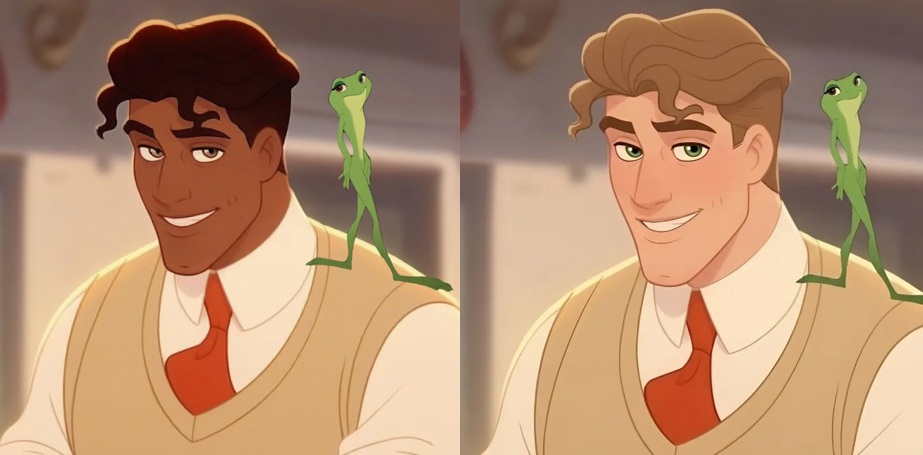
Photo: Emerald Book Illustration
There are no Black Disney princes in the official Walt Disney Animation Studios lineup. Not in nearly 100 years of storytelling. When Disney introduced its first Black princess, Tiana, in 2009, her love interest, Prince Naveen, was not Black. He is the prince of Maldon, a fictional, racially ambiguous country — voiced by a Brazilian actor, designed with Mediterranean and South Asian aesthetics. Not African. Not African-American.
As one critic put it: "It's like they don't want Black men to be seen as leaders or attractive — even though they get fetishized already." This absence is not an accident. It is a pattern.
There are exceptions — but they prove the rule. In live-action, Niles Fitch played Prince Tuma in Disney+'s Secret Society of Second-Born Royals (2020), marking Disney's first official Black live-action prince. And in the MCU (a Disney subsidiary), T'Challa is a literal African prince of Wakanda. But the traditional animated canon — the fairy tale heart of Disney — remains empty. No Black prince has ever worn that crown.
The Erasure of Prince Naveen
Scholar Ajay Gehlawat argues that Disney's choice was deliberate. A wealthy Black male lead would have activated historical stereotypes about Black economic success being threatening. A white male lead would have invoked the "white savior" trope rescuing a working-class Black woman. So Disney chose an empty middle ground: a racially ambiguous, exoticized prince from a fake country. This bypassed depicting a desirable, elite Black romantic lead entirely.
Then there's the "animal transformation" trope. Critics point out that when Black characters lead animated films, they are often transformed into animals for most of the runtime. Tiana and Naveen spend 57 out of 97 minutes as frogs. In Pixar's Soul, Joe Gardner spends most of the film as a blue spirit or a cat. As the Los Angeles Review of Books noted in "Disney's Disembodied Black Characters," this trope visually erases the physical presence, attractiveness, and human intimacy of Black characters. Disney can market a "diverse" film without animating Black romantic love.
- 0 — Black princes in the official Disney animated canon after 100 years
- 57 minutes — Time Tiana and Naveen spend as frogs, erasing Black human intimacy
- 31.7% — BIPOC characters in Disney films (1937–2021), but mostly in supporting or comedic roles
The "Black Man in a Dress" Gatekeeping
Instead of romantic leads, Hollywood offers Black men another path: emasculation through comedy. Eddie Murphy in The Nutty Professor and Norbit. Martin Lawrence in Big Momma's House. Tyler Perry's Madea. These franchises generated hundreds of millions while reinforcing that a Black man's primary value is self-ridicule.
In an NPR essay on Black comedians in dresses, cultural critics argue that stripping a Black man of his traditional masculinity makes him "palatable" and non-threatening to white audiences. Dave Chappelle and Katt Williams have spoken publicly about intense industry pressure to wear dresses for major roles — a gatekeeping mechanism for Black stardom. Media historians trace this directly to 19th-century minstrelsy, where Black performers were forced into ridiculous caricatures. The binary trap remains: Black men can be hyper-masculine criminals/athletes or emasculated comedians — rarely nuanced, romantic leading men.
The Fear of Desire: Black Men and Romance
Perhaps the most revealing boundary involves who is allowed to desire Black men — and whom Black men can desire on screen. Data tracking American marriage trends shows Black-white marriages increased more than fivefold over 40 years. Black men are statistically the most likely to form interracial marriages. Yet media analyses reveal that Hollywood produces double the number of films featuring a white man with a woman of color compared to a Black man with a partner of a different race.
Studios hide behind economics: the myth that films with Black romantic leads "don't travel well" internationally. So Black men are shifted into action, sports, or comedy — genres requiring less cultural translation than romance. A content analysis found that when interracial couples with Black men do appear, they are disproportionately "honest but unaffectionate" — stripped of passionate kissing, shared beds, or romantic intimacy. This is a corporate strategy to avoid backlash from audiences with racial biases against Black male sexuality.
The Historical Roots: Property, Myth, and the White Gaze
To understand this absence, confront the foundational anxieties. Historically, white women were viewed as the property of white men. A Black man with a white woman was a direct challenge to white male authority. To justify control and violence, institutions manufactured the myth of the "Black beast" — the hyper-sexual, predatory Black man. This myth justified thousands of lynchings, segregation, and the destruction of Black communities like Tulsa.
Hollywood's first blockbuster, The Birth of a Nation (1915), explicitly centered on this fear: a Black man pursues a white woman who leaps to her death rather than be with him, with the KKK as heroes. This taboo became embedded in the industry's DNA. Even today, studios avoid stories where a Black man wins a romantic conflict over a white man. The deeply internalized expectation is that the white male protagonist must remain the ultimate aspirational figure.
Media studies call this the "problem frame" — consumers are conditioned to view Black men through violence, poverty, and struggle, not career excellence, stable fatherhood, or domestic romance. When a group is associated with disruption, they cannot be framed as objects of soft, aspirational love. They are feared, pitied, or laughed at — but rarely desired.
Independent creators are slowly filling the gap with crowdfunded animations centered on Black royalty and romance. But the absence from mainstream studios — no Black Disney prince after 100 years — sends a clear message. The crown remains off-limits. And so does desire.
No Ads. By Us. For Us.
This article was only made possible by readers like you. We hope it inspired you to support Emerald Book, so we can continue producing content like this.
We will never show you ads, never sell your data, and never require a subscription to consume our content. Your gift helps us keep the truth accessible.
Please click the Support button on the bottom right of your screen to make a gift of any amount today.
Thank you for making this work possible.