

Emerald Pages
◆
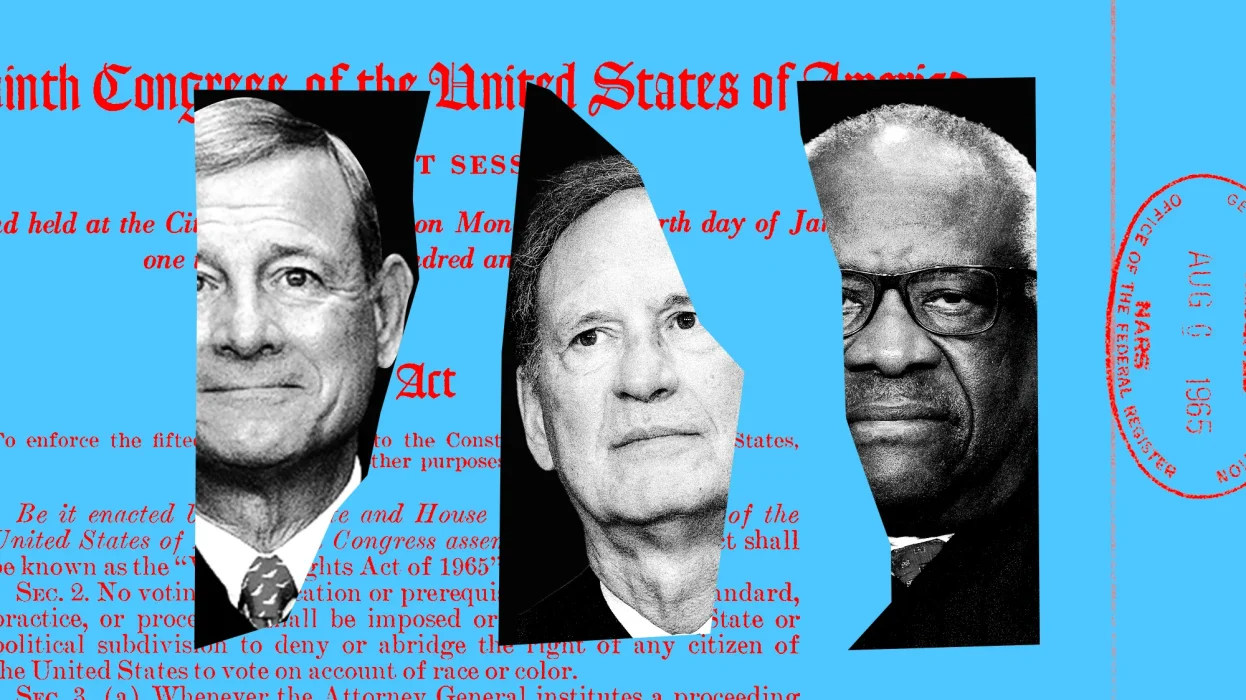
Photo: Erin Schaff | New York Times
For the first time in over half a century, the United States is no longer considered a liberal democracy. According to the V-Dem Institute’s 2026 report, the country has officially entered a state of “competitive authoritarianism.” While pundits point to the second inauguration of Donald Trump in 2025 as the inflection point, the truth is darker and more procedural. The first shot in America’s slide toward autocracy was not fired in a capitol riot, but in a quiet courtroom decision last month that gutted the heart of the Voting Rights Act of 1965.
To understand why this judicial act is the lynchpin of authoritarian collapse, we must first confront a painful historical truth that scholars like Steven Levitsky have stressed: America did not become a true democracy in 1776, nor after the Civil War, nor even with the 19th Amendment. “The United States only became a full democracy in 1965,” Levitsky notes. Before the Voting Rights Act, the U.S. was a flawed electoral democracy at best—a system where racial gerrymandering, poll taxes, and literacy tests prevented millions from participating. The 1965 Act was the final ingredient that transformed a constitutional republic into a liberal democracy, specifically through Section 5, which required states with a history of discrimination to “pre-clear” any voting changes with the federal government.
The recent ruling striking down the remaining enforcement mechanisms of the Act has effectively removed the guardrails. By eliminating the ability to challenge discriminatory laws before they take effect, the court has authorized states to experiment with the very tactics that defined the pre-1965 era. This is not merely a return to the past; in the hands of a movement led by Donald Trump, it is the foundation for a new autocratic order. As data from The Century Foundation’s Democracy Meter shows, the quality of American democracy dropped sharply immediately following the gutting of these protections, aligning perfectly with the normalization of authoritarian tactics.
The Architecture of Emotional Control
How does the removal of a voting law lead to the "loneliness" of totalitarianism described by Hannah Arendt? The answer lies in emotional manipulation. Once the structural check of a free and fair vote is weakened, the autocrat no longer needs to win your mind; he only needs to master your feelings. The slide toward autocracy in 2026 is defined by four distinct emotional levers.
- Fear and the Cultivation of Crisis: With voting less secure, leaders frame issues like immigration as a “border invasion.” This manufactured insecurity makes citizens willing to trade liberty for the illusion of safety provided by a “savior” leader.
- Anger and Affective Polarization: When you cannot trust an election result, your political identity hardens into a tribal weapon. This “us versus them” hatred lowers the bar for accountability; leaders are excused for violating norms because the opposition is seen as an existential threat.
- Confusion and the Erosion of Truth: By attacking the press under the guise of fighting “fraud,” the regime induces cognitive instability. When citizens cannot agree on basic facts, they retreat into tribal beliefs, looking to a single authoritarian voice for clarity.
- The Father Figure Dynamic: The most potent tool. In times of perceived crisis, the public reverts to a childlike state seeking protection. The leader is framed as the “Father of the Nation”—a figure whose approval is essential for survival, whose authority is not to be questioned, and whose "rash edicts" replace messy democratic debate.
This "national daddy complex" leads to what psychologists call "moral disengagement." The public stops judging the leader's actions against ethical standards and instead judges them against loyalty to the patriarch. This is the bridge between a flawed election and a full autocracy.
The Consolidation: When Your Feelings Become Irrelevant
Once power is consolidated—armed with a loyal judiciary and a compliant executive branch—the relationship shifts. The regime no longer needs to convince you; it requires only your submission. As the Union of Concerned Scientists notes, authoritarian regimes control information and suppress dissent until the individual is stripped of agency.
In this stage—which scholars like those at Bright Line Watch argue the U.S. is currently entering—your private thoughts become irrelevant. Through mechanisms like Schedule F (reclassifying civil servants as political appointees) and the use of "acting" officials to bypass Senate oversight, the state ensures that only loyalists remain. If you feel angry or betrayed, it doesn't matter because you cannot safely express it without risking your livelihood or freedom. Self-censorship becomes mundane. You stop trusting your own eyes because the regime controls all shared reality. Eventually, you are left in a state of "loneliness," where your internal world exists in a vacuum, disconnected from any power to change the world around you.
The Checklist of Collapse
This is not speculation. Since the gutting of the Voting Rights Act, the Trump administration has moved rapidly to realize this eventuality through specific structural changes:
- The Unitary Executive: Aggressive efforts to bring the Federal Reserve and FCC under direct presidential control, ending their historic independence.
- Impunity and Law Enforcement: Directing the Department of Justice to act as a personal legal defense firm rather than an impartial arbiter of justice.
- Impoundment of Funds: Refusing to spend money appropriated by Congress, effectively nullifying the legislature’s "power of the purse."
- Emergency Powers: Bypassing a divided Congress by declaring national emergencies to enact policy that was rejected by the legislature.
The gutting of the Voting Rights Act was the first shot because it normalized the idea that democratic participation is a threat to the state. By making your vote less powerful, the regime made your thoughts less relevant. When the rallying cry of the leader is that the system is "rigged" unless he wins, and the courts agree, the slide from flawed democracy to anocracy is complete. The firewalls of 1965 have been breached. Without them, the "father figure" no longer needs your consent—only your silence.
No Ads. By Us. For Us.
This article was only made possible by readers like you. We hope it inspired you to support Emerald Book, so we can continue producing content like this.
We will never show you ads, never sell your data, and never require a subscription to consume our content. Your gift helps us keep the truth accessible.
Please click the Support button on the bottom right of your screen to make a gift of any amount today.
Thank you for making this work possible.