

Emerald Pages
◆
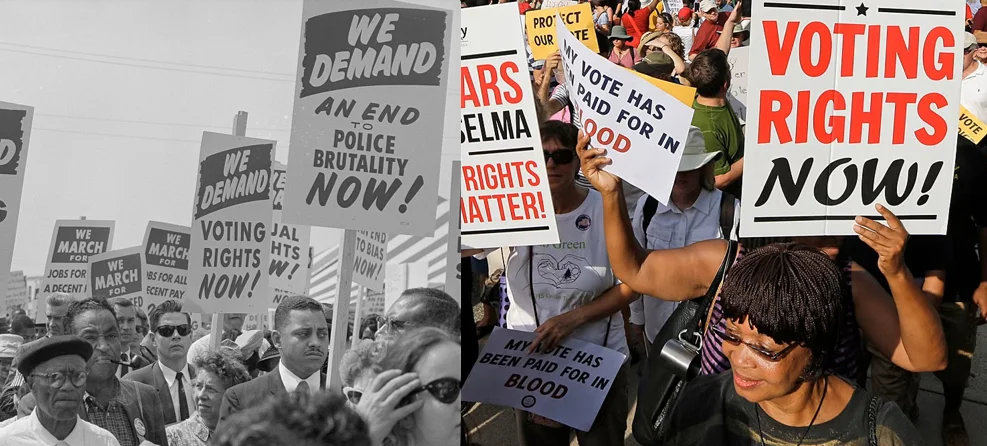
Photo: Emerald Book Image
Barack Obama once said: "80% of the world's problems involve old men hanging on to power." He wasn't speaking hypothetically. He was describing a global affliction—and nowhere is it more visible than in the United States today. Consider this: the majority of Congress, the President, and six of nine Supreme Court justices were alive before the Civil Rights Act of 1964 and the Voting Rights Act of 1965. They remember a time when Black Americans were legally denied the right to vote, segregated in schools, and barred from public accommodations. That was not ancient history. That was 61 years ago. And those same people—the ones who lived through Jim Crow—are still the ones running the country.
The fight for equality is not a fight of "our ancestors." It is a fight of our current leaders' lifetimes. When the people making laws were already adults before those laws guaranteed basic human rights to all citizens, the question must be asked: can they truly lead us into a future they never imagined?
How Recent? The Numbers Tell the Story
The Voting Rights Act was signed on August 6, 1965—just 61 years ago as of 2026. To be alive before that law, you need to be born on or before August 5, 1965, making you roughly 61 years old or older today. That is not elderly by modern standards. That is the age of many working professionals. And yet, that simple fact reveals a government frozen in time.
- President Donald Trump (born 1946) was 19 years old when the Voting Rights Act passed. He was already voting before millions of Black Americans could.
- Senator Chuck Grassley (born 1933) was 32 years old—a grown man with a career and family, living in a segregated America.
- Representative Hal Rogers (born 1937) was 28 years old.
- Six of nine Supreme Court justices were born before the Voting Rights Act, including Clarence Thomas (1948), Samuel Alito (1950), Sonia Sotomayor (1954), John Roberts (1955), Elena Kagan (1960), and Brett Kavanaugh (February 1965).
These are not names from a history textbook. These are the people who currently hold the highest offices in the land. They are not ancestors. They are the sitting government. The 119th Congress is the third-oldest in American history. The Senate's median age is 64. At least 24 members of Congress are 80 or older.
Congress: The Pre-Rights Majority Still in Power
In the 119th Congress, approximately 295 members (55%) were born before the Civil Rights Act of 1964. Approximately 260 members (49%) were born before the Voting Rights Act of 1965. That means nearly half of the legislature—the people writing federal laws, approving judges, and controlling the budget—were alive at a time when Black Americans were systematically denied the most basic rights.
And it gets even more striking: 175 members (33%) were already old enough to vote before the Civil Rights Act existed. 155 members (29%) were already old enough to vote before the Voting Rights Act guaranteed Black suffrage. That means one in three members of Congress cast ballots in elections where millions of their fellow citizens—solely because of the color of their skin—could not. Those same people are now writing voter ID laws, redistricting maps, and election procedures.
Obama's Warning
When Obama said that 80% of the world's problems involve old men hanging on to power, he was pointing to a simple truth: the refusal to cede power across generations is a structural barrier to progress. The average age of retirement from Congress has steadily risen. Seniority, not merit, still dictates committee assignments. And the result is a government that looks less like the country it serves and more like a retirement home for the pre-Civil Rights generation.
This has real consequences. The same Supreme Court that gutted the Voting Rights Act in 2013 has a majority of justices who were alive before the Act even existed. The same Congress that struggles to pass police accountability measures is led by people who grew up watching Bull Connor turn fire hoses on Black children on television. Their formative experiences were of a world where racial hierarchy was the law. Is it any wonder that progress feels slow?
The Ancestor Trap
There is a tendency, especially among younger Americans, to speak of the civil rights era as something that happened to "our ancestors." But unless you are a teenager, your parents likely grew up in the 1960s and 1970s. Many grandparents were young adults during the civil rights movement. This is not the 1800s.
And because it is recent, the people who were there—who remember separate water fountains, literacy tests, and neighborhoods that were legally "white only"—are still very much alive. Many of them are judges. Many are senators. One is the President. They are not ghosts. They are not ancestors. They are the government.
A Generation That Cannot Imagine the Future
The problem with a gerontocracy is not just that it is undemocratic. It is that the elderly tend to conserve the world they grew up in. They pass laws to protect the institutions that served them. They resist change because change threatens the stability they have enjoyed. And when those leaders grew up in a world where Black people were legally inferior, their "stability" is built on a foundation of inequality.
The question for voters in 2026 and beyond is whether they will continue to accept a government led by people who personally remember a time before Black people had rights. Or whether they will finally heed Obama's words and demand that the old men (and women) step aside. The fight for equality is not a fight of our ancestors. It is a fight of our current leaders' lifetimes.
No Ads. By Us. For Us.
This article was only made possible by readers like you. We hope it inspired you to support Emerald Book, so we can continue producing content like this.
We will never show you ads, never sell your data, and never require a subscription to consume our content. Your gift helps us keep the truth accessible.
Please click the Support button on the bottom right of your screen to make a gift of any amount today.
Thank you for making this work possible.