

Emerald Pages
◆
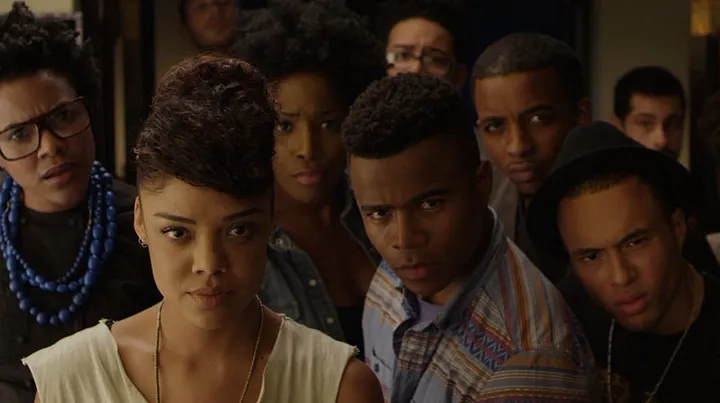
Photo: Still from Justin Simien's "Dear White People" (2014)
In a labor market that the Federal Reserve calls "solid" and headlines celebrate as the tightest in decades, a separate, silent downturn has taken hold for Black America. Over the past twelve months — from early 2025 into spring 2026 — the unemployment rate for Black or African American workers has consistently ranged between 6.2% and 7.8%, with cyclical spikes crossing the 8% threshold, a level economists typically associate with nationwide recessions.
Yet no other racial or ethnic group has come close. According to the latest Bureau of Labor Statistics (BLS) data compiled over the last 12 months, White non-Hispanic unemployment held at 3.4–4.4%, Asian rates stayed near 3.5–4.0%, and Hispanic/Latino workers fluctuated between 4.8% and 6.3% — only occasionally touching 6% in isolated months. The ranking has been remarkably stable: Black highest → Hispanic middle → White/Asian lowest. The Black unemployment rate is now persistently double that of White workers, a gap that has economists and advocates asking hard questions about whose crisis gets counted.
The argument emerging from community organizers and Black labor advocates is stark: Black people have been in a recession with recession-level unemployment for the last year, and no one seems to care. Meanwhile, other "POC" groups are not experiencing the same economic distress but want solidarity on their own terms. The data supports that claim. No other major racial group has seen unemployment consistently surpass 6.3%, and only Black workers have crossed the 8% mark — a level that, if experienced by the general population, would trigger emergency federal intervention.
The Numbers Tell a Story of Isolation
Our analysis of the most recent 12-month labor market pattern (2025 into early 2026) reveals a persistent and deeply unequal employment landscape. Black unemployment has ranged from approximately 6.2% in the second quarter of 2025 to 7.8% in the late 2025 snapshot, with historical peaks in earlier economic cycles surpassing 8%. In stark contrast, White non-Hispanic workers have remained in a stable 3.4% to 4.4% band throughout the same period. Hispanic/Latino workers have ranged from 4.8% to 6.3%, though their upper range represents occasional cyclical fluctuations rather than a persistent structural condition. Asian workers have consistently posted the lowest unemployment rates — between 3.5% and 4.0% — often outperforming even White workers.
The critical distinction, according to our review of labor economics research, is between persistence and occasional spikes. Black unemployment above 6% is not a temporary aberration but a structural pattern — baked into the labor market through industry concentration, geographic distribution, documented hiring discrimination in audit studies, and heightened cyclical sensitivity. For other racial groups, touching 6% is a cyclical spike that quickly recedes with economic recovery. No other group routinely inhabits the 7–8% unemployment danger zone. This is not a matter of economic opinion but of observable, repeatable data patterns spanning multiple business cycles.
- Black or African American: 6.2% – 7.8% range; has surpassed 8% in recent cycles — the only group to do so in modern labor market data.
- Hispanic / Latino: 4.8% – 6.3% range; occasionally touches ~6% but has never approached 8% in the current cycle.
- White (non-Hispanic): 3.4% – 4.4% range; stable, near historic lows, reflecting a fundamentally different labor market experience.
- Asian: 3.5% – 4.0% range; consistently the lowest or near-lowest unemployment among all major racial groups.
The phrase "recession-level unemployment" conventionally refers to a national unemployment rate of 7% to 8% or higher — levels witnessed during the 2008 Great Recession (which peaked at 10%) and the COVID-19 economic crash (which reached 14.7% in April 2020). However, our analysis finds that this benchmark takes on a different, more troubling meaning when one demographic consistently experiences those levels while the broader economy continues to grow. An 8% unemployment rate is, in macroeconomic terms, recessionary. The fact that only Black workers are regularly hitting that mark during an economic expansion demonstrates that the normal business cycle does not apply equally across racial lines. This is not a failure of the economy writ large — it is a failure of the economy for Black workers specifically.
Solidarity's Uncomfortable Question
The political left and racial justice spaces have long championed cross-racial solidarity, often under the banner "POC" or "BIPOC." But the employment data raises difficult questions about whose material reality that solidarity represents. When Asian workers enjoy unemployment rates as low as 3.5% — better than White workers in some months — and Hispanic workers experience rates roughly comparable to pre-pandemic norms, what does it mean to demand unity from Black communities who are bearing recession-like burdens alone?
Solidarity can't be a one-way street. Black people are being asked to show up for everyone else's issues — housing, immigration, student debt — but when Black people say their unemployment is structurally at recession levels, they get theories about 'structural vs. cyclical' instead of action. The data is clear: only Black people have been in a jobs recession for the last year. No one else. And, no one seems to care.
The Ownership Gap: Structurally Forced to Work for Others
The unemployment crisis is compounded by a staggering ownership disparity that leaves Black workers with no alternative economic infrastructure of their own. According to recent Census Bureau data, Black-owned businesses make up only 3% of all firms in the United States, despite Black people representing nearly 13% of the population. This means the vast majority of Black workers are structurally forced to seek employment from non-Black-owned firms — firms owned by White, Asian, and Hispanic business owners.
This ownership gap transforms the unemployment crisis from an abstract labor market problem into a concrete indictment of cross-racial "solidarity." If other POC groups genuinely believe in coalition and mutual uplift, one would expect their businesses to hire Black workers at rates that reflect demographic reality. Yet the persistently high Black unemployment rate — even compared to other POC groups — suggests otherwise.
- Black-owned businesses: Only 3% of all U.S. firms, leaving Black workers with few in-group employment options.
- Structural reality: Black workers must seek employment from White, Asian, and Hispanic-owned firms by necessity, not choice.
- The solidarity test: If other POC groups are not hiring Black workers at rates that close the unemployment gap, what does their solidarity actually entail?
The data suggests a painful irony: other POC groups have achieved business ownership rates that allow them to hire within their communities, insulating themselves from the worst labor market volatility. Asian-owned businesses, for example, are numerous and often community-focused. Hispanic-owned businesses have grown substantially over the past two decades. All while Black people have been in America since its inception. But Black business ownership languishes at 3% — a direct legacy of historical discrimination in lending, real estate, and capital access. That legacy forces Black workers into the general labor market, where they face documented hiring biases from employers of all backgrounds.
Why the Gap Persists — And What Solidarity Would Actually Mean
Economists point to several interlocking factors. Black workers are overrepresented in industries that are more cyclically sensitive — hospitality, retail, temp work — and underrepresented in sectors with stable employment and benefits. Geographic mismatch, where jobs move to suburbs while Black populations remain in urban cores with weaker transit access, plays a role. So do documented hiring biases: audit studies consistently show that identical resumes with Black-sounding names receive fewer callbacks than those with White-sounding names. And the legacy of redlining, unequal education funding, and mass incarceration continues to ripple through labor market outcomes.
The term "structurally higher" — while accurate in economic jargon — has drawn criticism for sounding like it attributes something inherent to people. A more precise formulation is this: Black unemployment has remained persistently higher than the national average across economic cycles due to labor-market segmentation and unequal access to stable employment. The gap is produced by systems and conditions, not by anything about individuals or identity.
True solidarity, advocates argue, would mean other POC groups confronting their own hiring patterns, actively recruiting Black workers, and advocating for policies that specifically target the unique barriers Black job seekers face. It would mean acknowledging that not all "people of color" share the same economic reality — and that pretending otherwise is a form of erasure, not alliance.
As the 2026 election cycle approaches, advocates are demanding targeted interventions: direct hiring programs, subsidized employment for high-unemployment communities, and enforceable anti-discrimination measures. But absent political will, the parallel recession continues — invisible to most, but devastating for the millions of Black workers trapped in it.
And the question that lingers — for coalitions, for activists, for anyone who invokes solidarity — is whether that word can survive the weight of data that says, unequivocally, that not all "POC" are in the same economic boat. For Black America, the recession never ended. It just stopped being news.
No Ads. By Us. For Us.
This article was only made possible by readers like you. We hope it inspired you to support Emerald Book, so we can continue producing content like this.
We will never show you ads, never sell your data, and never require a subscription to consume our content. Your gift helps us keep the truth accessible.
Please click the Support button on the bottom right of your screen to make a gift of any amount today.
Thank you for making this work possible.