

Emerald Pages
◆
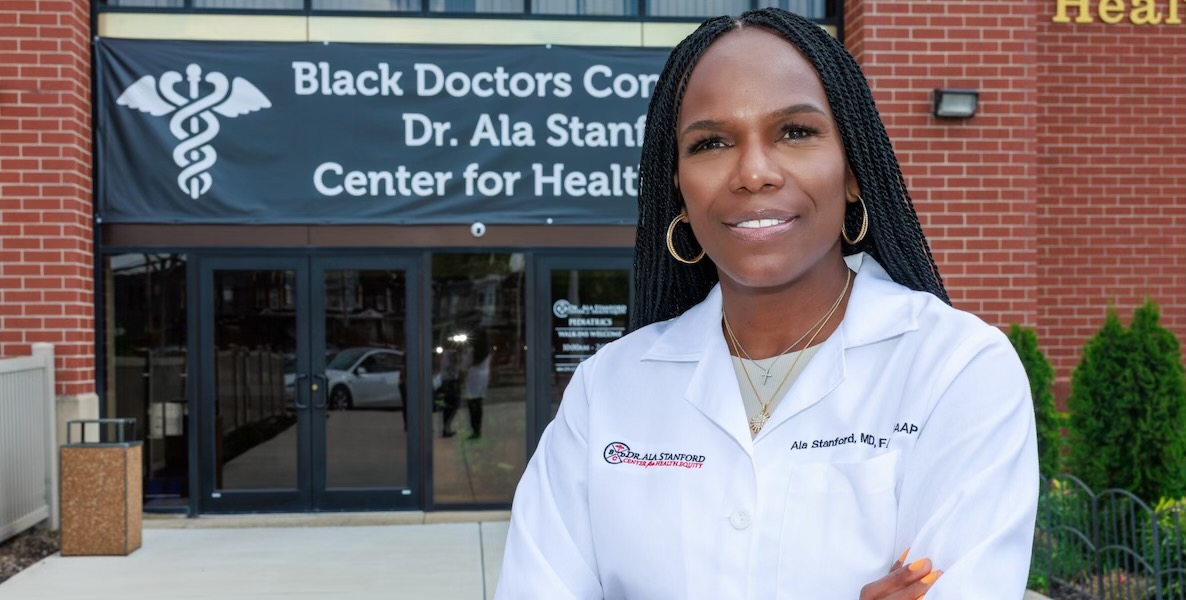
Photo: Dr. Ala Stanford Center for Health Equity
In the spring of 2020, as the COVID-19 pandemic exposed the raw fault lines of American healthcare, Dr. Ala Stanford did what the systems around her failed to do: she got in her car. Armed with tests, PPE, and a deep-rooted sense of justice, she drove to Black neighborhoods in Philadelphia where infection rates were spiking and testing sites were nonexistent. That blue minivan became the first mobile clinic of what would later become the Black Doctors COVID-19 Consortium—and the spiritual foundation of the Dr. Ala Stanford Center for Health Equity.
What started as a grassroots emergency response has since evolved into a permanent, brick-and-mortar institution with a sweeping mission: to reduce racial health disparities and expand access to care in underserved communities. The Center, often referred to as DASCH or simply ASHE, is not just a clinic; it is a corrective lens, refocusing the medical establishment on the people it has historically left behind. By meeting people where they are—literally and figuratively—Dr. Stanford and her team are rewriting the relationship between Black and brown communities and the healthcare system.
The Center’s work is rooted in data that is as stark as it is motivating. In Philadelphia, where life expectancy can vary by as much as 20 years between neighboring zip codes, ASHE has become a critical intervenor. Its model combines direct primary and preventive care with aggressive community outreach. Services are often free or low-cost, and the staff reflects the demographics of the neighborhoods they serve—a deliberate strategy to dismantle decades of medical mistrust born from studies like Tuskegee and ongoing biases in treatment.
More Than a Clinic: A Community Hub
Housed in a welcoming facility at the corner of 20th Street and West Lehigh Avenue—a stretch now also known as Dr. Ala Stanford Way—the Center offers everything from hypertension and diabetes management to well-child visits and behavioral health support. But its true innovation lies in its wraparound approach. Patients can also access social services, nutrition counseling, and even assistance with utility bills—recognizing that a person's health is shaped by their environment as much as their genetics. During the 2022-2023 mpox outbreak, the consortium was widely recognized for its rapid, non-stigmatizing community outreach and vaccination efforts, particularly for Black and Brown communities disproportionately affected by the virus.
- 100,000+ people tested and vaccinated by the consortium since its founding.
- 20-year life expectancy gap exists between some Philadelphia neighborhoods; the Center targets the lowest-resource zip codes.
- 100% of patients are seen regardless of insurance status; the Center operates on a hybrid model of grants, donations, and insurance reimbursement.
Education is another pillar of the mission. The Center runs community health worker training programs, hiring locally to create a pipeline of trusted advocates who go door-to-door. They host "health talks" in barbershops, churches, and community centers—spaces that have always been trusted, but rarely utilized for clinical outreach. This isn't just healthcare; it's a reclamation of public health as a public good.
The impact has not gone unnoticed. Dr. Stanford served as the Region 3 Director for the U.S. Department of Health and Human Services (HHS) from 2022 to 2023, and her work has been cited by the Biden administration as a national blueprint for health equity. In 2024, she published her memoir and manifesto, Take Care of Them Like My Own: Faith, Fortitude, and a Surgeon's Fight for Health Justice, offering a deeper look into the experiences that shaped her mission. Despite these national accolades, the Center remains fiercely local. When asked about expansion, Stanford often speaks of creating a replicable "ecosystem" rather than a single national chain. The goal is to empower other communities to build their own solutions, using ASHE as a blueprint. Recently, the Center announced a partnership with local universities to research social determinants of health, ensuring that their on-the-ground work informs policy changes at the city and state level.
Now entering its fifth year as a permanent institution, the Dr. Ala Stanford Center for Health Equity stands as a testament to what began with that blue minivan. The challenges—funding, systemic inertia, the sheer weight of historical neglect—remain immense. But the model works. When you treat people with dignity, remove barriers, and show up consistently, trust is rebuilt. And in that trust lies the foundation for genuine health equity.
No Ads. By Us. For Us.
This article was only made possible by readers like you. We hope it inspired you to support Emerald Book, so we can continue producing content like this.
We will never show you ads, never sell your data, and never require a subscription to consume our content. Your gift helps us keep the truth accessible.
Please click the Support button on the bottom right of your screen to make a gift of any amount today.
Thank you for making this work possible.